Menu
Small Botanical Extract Orders to Africa: Compare Landed Costs
For a small botanical extract order, compare the cost of receiving a usable shipment, not just the ingredient price. The destination country, intended use, shipment size and delivery responsibilities all belong in the enquiry. “Shipping to Africa” is too broad to produce a reliable landed-cost comparison.
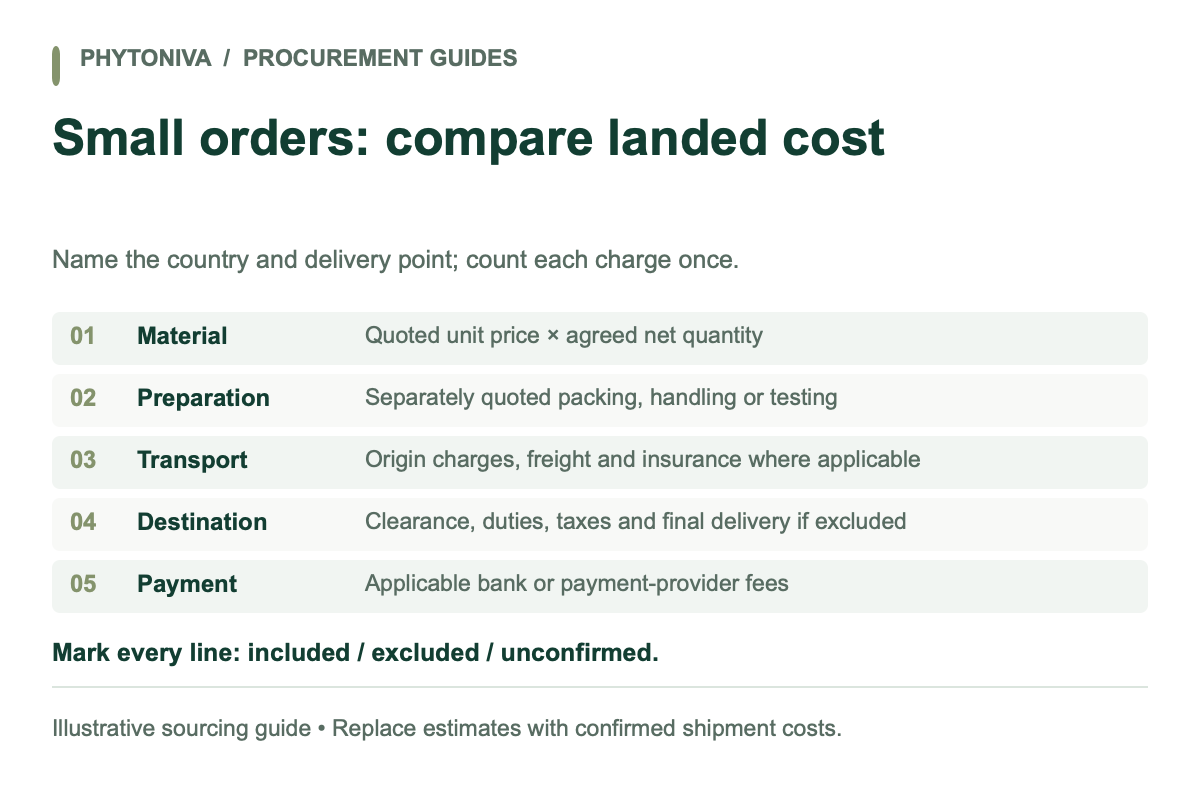
- Material: quoted price and agreed net quantity for the exact grade.
- Preparation: packing, handling or testing charges quoted separately.
- Transport: origin charges, freight and insurance where applicable.
- Destination: clearance, duties, taxes, handling and final delivery where not included.
- Payment: applicable bank or payment-provider fees.
- Mark each item included, excluded or unconfirmed; count each charge once.
Start with the country, application and receiving location
Give the supplier the destination country and city or postcode, and explain whether the raw material is intended for food, supplements, cosmetics or another use. Describe the material accurately, including its composition and form. Your importer or customs broker should confirm the appropriate classification and applicable import requirements before dispatch.
Requirements must be checked for the specific destination. For example, Kenya’s KEBS PVoC guidance describes its pre-export conformity process. Whether a particular ingredient shipment requires that process or qualifies for an exemption needs confirmation; a small sample should not automatically be treated as exempt.
Build a cost sheet with explicit inclusions
- Material: quoted unit price multiplied by the agreed net quantity, for the exact specification.
- Preparation: any separately quoted packing, handling or testing charge.
- Transport: origin charges, international freight and insurance where applicable.
- Destination: clearance, duties, taxes, handling and final delivery where these are not included.
- Payment: applicable bank or payment-provider fees.
Mark each line as included, excluded or still unconfirmed. Avoid double-counting freight or clearance already included in the delivery term. Ask for the named destination and responsibility split in writing; a courier quotation by itself does not show that every import-related cost has been covered.
Use two calculations for a first-order decision
Cash required: the full amount you expect to pay across the purchase, transport and import process. Comparable cost per net kilogram: the agreed cost items divided by the net quantity received. If taxes may be recoverable, keep them visible in the cash plan and ask your accountant how to treat them in the cost comparison.
As a deliberately hypothetical illustration, an order with 500 currency units of material, 150 of freight and 50 of other non-overlapping charges totals 700. If its net quantity is 10 kg, those stated items equal 70 per kg. This is not a PHYTONIVA quote, freight estimate or duty calculation; replace every input with confirmed figures for your shipment and add any missing costs.
Compare trial sizes without overbuying
Request separate offers for a sample, a pilot quantity and a practical repeat order. Compare each against your formulation plan, storage conditions and expected consumption. A larger order can spread fixed charges over more material, but it also commits more cash and creates more inventory. Ask for the offered shelf life and storage conditions before choosing quantity solely on price per kilogram.
Keep the sample identifier and approved specification with the purchase order. If the commercial supply option changes, review the new material and documents before shipment rather than assuming the first sample approval still applies.
Check documents before paying for freight
Ask which commercial, quality and destination-specific documents will accompany the shipment and who prepares each one. Have your importer review the proposed document set and product description before dispatch. Resolve missing information while the goods are still at origin; do not assume that a COA alone settles import clearance.
Our country-focused guides cover starting questions for South African buyers, skincare ingredient buyers in Nigeria and beverage developers buying stevia for Kenya. They are procurement guides, not shipment-specific import approvals.
Send a complete small-order enquiry
Include the ingredient and specification, intended application, trial quantity, repeat-order estimate, destination city or postcode, sample needs and required documents. Ask for sample fees, MOQ, packing, lead time and delivery scope. These terms are confirmed for the selected supply option; we do not promise a universal small-order minimum or a fixed delivery cost.
PHYTONIVA coordinates botanical ingredient sourcing and trade. Send your purchasing brief to discuss an order, or browse the product catalog before preparing your RFQ.
Sourcing coordination and quality checks
PHYTONIVA manages trade, sourcing and supplier coordination, matching ingredients and supply options to your specification, application and destination. The manufacturing partner provides its COA and relevant quality documents. Before procurement and dispatch, we arrange independent third-party quality testing and obtain the report for the agreed testing scope.
Specifications, sampling, test scope, methods and acceptance criteria are agreed before ordering. The manufacturer COA and agreed third-party test report accompany the shipment. Certification is checked separately for the named holder, product and valid scope.
See our quality and documentation process