Menu
Botanical Extract Specifications: A Buyer’s Guide
Botanical extract specifications define what a quotation actually covers. Two products with similar names may differ in plant part, composition, extraction process, analytical method or carrier content. Establish those details before comparing prices or assuming that one material can replace another.
Start with identity and composition
Record the botanical name, plant part, extract form and any carrier or added ingredients. Ask for the actual material code and specification version. If your requirement refers to a branded ingredient, request evidence of its identity and authorized supply; a similar assay percentage does not establish equivalence to a proprietary ingredient.
Distinguish a marker from demonstrated activity
A marker may be measured for identification or quality control without proving a clinical benefit. State the analyte, target value, units, reporting basis and test method. A percentage reported on a dry basis may not be directly comparable with a percentage for the material as supplied.
For turmeric extract, distinguish total curcuminoids from curcumin alone. For green tea extract, specify total polyphenols, catechins, EGCG and caffeine separately where relevant. For ashwagandha, record the plant part and the particular withanolide assay. For Garcinia, clarify the HCA form, method and reporting basis. For stevia, distinguish total steviol glycosides from individual glycosides. These are questions for a specification review, not a list of grades guaranteed to be in stock.
Keep extraction ratio and assay separate
An extraction ratio describes a different attribute from a measured marker percentage. Ask how the ratio is defined, which starting material and extract it refers to, and whether carriers are included. Do not interpret a ratio as a measured active-content result or as evidence that one product is more effective.
Define the physical performance you need
Describe the formulation format, processing conditions, appearance, taste and relevant particle-size requirements. For a beverage, distinguish true solubility from a dispersion or suspension and define the conditions used to test it. Ask for a sample of the proposed grade and have your formulator assess it against agreed criteria.
Review the COA and other documents
Request a COA identifying its issuer and the relevant material or batch. Check the analytes, methods, units, limits and reported results against the agreed specification. A manufacturer-issued COA and an independent third-party test report are separate records; compare the sample or batch identity and the tests covered by each. Keep manufacturer or laboratory attribution clear; do not relabel another party’s report as your own laboratory’s work.
List any safety data, technical declarations or certification documents required for your project. Availability and scope must be confirmed for the proposed source. An ingredient COA does not by itself substantiate a finished-product health claim or establish market eligibility.
Put the purchasing requirements in one brief
- Botanical identity, plant part and requested form.
- Target assay or ratio, method and reporting basis.
- Carrier, solvent and formulation constraints.
- Sample requirements and acceptance criteria.
- Trial quantity, repeat-order estimate and packing needs.
- Destination, intended use and required documents.
Ask the supplier to identify any differences between the offered grade and your brief. Confirm MOQ, sample charges, testing scope, delivery terms and lead time for that option. A proposed custom specification remains subject to feasibility review; it is not a guarantee that a matching grade can be produced.
PHYTONIVA coordinates ingredient sourcing and trade. Use the ingredient catalog to prepare a shortlist, review the quality documentation guidance, then send your specification for assessment.
From specification to evaluation
Use your botanical extract specifications checklist to connect the written requirements with the material being evaluated. Review the botanical identity, processing details and analytical methods, and confirm which documents apply to the offered grade. The diagrams below summarize the purchasing checks and review workflow; apply them to the proposed grade and confirm the details in the quotation.
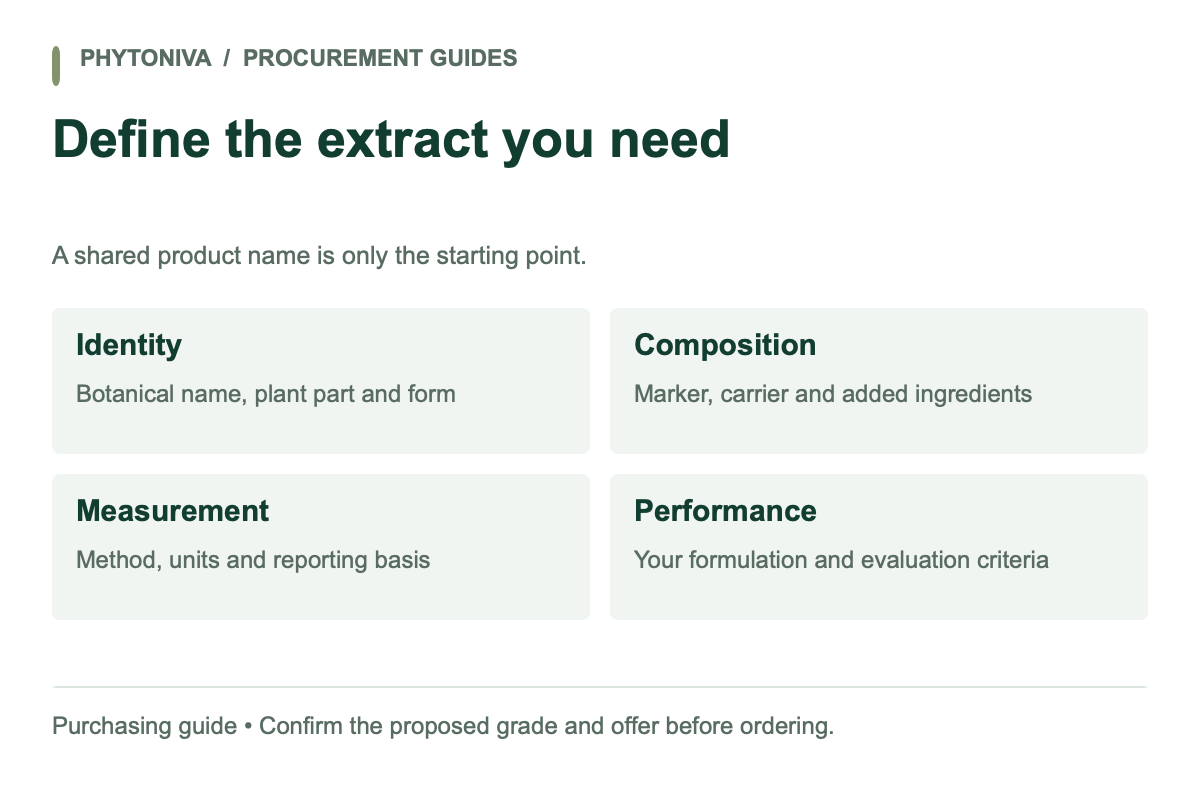
- Identity: Botanical name, plant part and form
- Composition: Marker, carrier and added ingredients
- Measurement: Method, units and reporting basis
- Performance: Your formulation and evaluation criteria
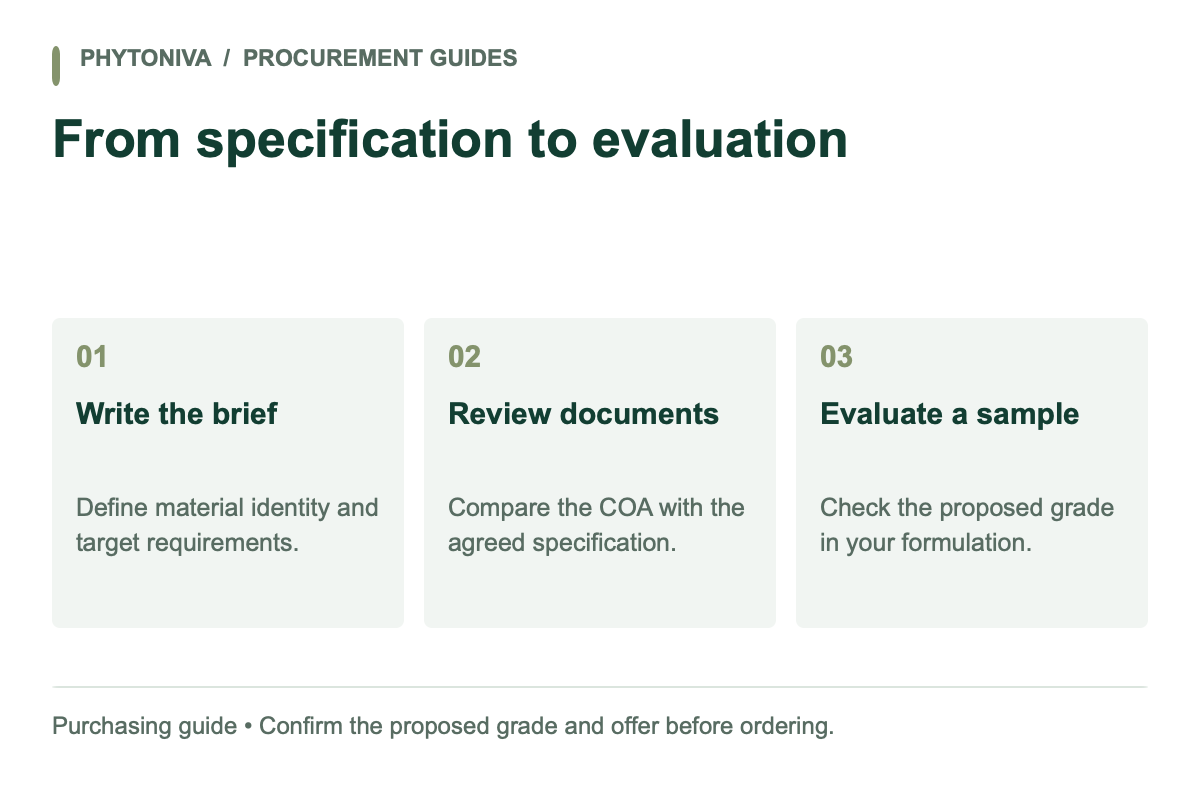
- Write the brief: Define material identity and target requirements.
- Review documents: Compare the COA with the agreed specification.
- Evaluate a sample: Check the proposed grade in your formulation.
Independent reference: WHO quality control methods for herbal materials
Sourcing coordination and quality checks
PHYTONIVA manages trade, sourcing and supplier coordination, matching ingredients and supply options to your specification, application and destination. The manufacturing partner provides its COA and relevant quality documents. Before procurement and dispatch, we arrange independent third-party quality testing and obtain the report for the agreed testing scope.
Specifications, sampling, test scope, methods and acceptance criteria are agreed before ordering. The manufacturer COA and agreed third-party test report accompany the shipment. Certification is checked separately for the named holder, product and valid scope.
See our quality and documentation process