Menu
Botanical extract quality.
Start with a clear specification.
Agree botanical extract quality requirements before ordering. The manufacturing partner provides the COA; PHYTONIVA coordinates independent third-party testing. The COA and agreed test reports are supplied with the shipment.

Agree the requirements. Receive the records with your shipment.
Share the ingredient, specification, intended use and destination. Before ordering, agree the quality criteria, testing scope and required documents for the selected supply option.
Specification and composition — before ordering
Confirm botanical identity, plant part, grade, composition, carrier and applicable declarations. Agree the target assay, method, units and acceptance limits. The technical specification (TDS) defines the requirements for the order.
Manufacturer COA — with the shipment
The manufacturing partner supplies the Certificate of Analysis (COA) for the material supplied. It accompanies the shipment and identifies the relevant product or batch, test items, methods and results.
Independent test report — with the shipment
PHYTONIVA commissions independent third-party quality testing before procurement and dispatch. The report for the agreed tests accompanies the shipment. Sampling, test methods, acceptance criteria, costs and timing are agreed for the order.
Certificates — check the specific source and product
Tell us if your application requires Halal, Kosher, organic or another certification scheme. We coordinate checks against the selected manufacturer, facility and product, including the issuing body, scope and validity. This is separate from the COA and testing report.
From sourcing brief to independent quality checks
PHYTONIVA is a trading and sourcing partner. We match manufacturers and products to your requirements and coordinate the quality review. Independent third-party testing and the resulting report form part of our purchasing and pre-dispatch checks.
1. Match the requirement
Confirm the ingredient, botanical identity, plant part, specification, application and destination. Use this brief to compare the relevant manufacturing and supply options.
2. Confirm the document and testing scope
Agree the specification, required declarations and certificate requirements before ordering. Record which manufacturer COA and third-party test report will accompany the shipment; a certification certificate is a separate record.
3. Agree the test plan
Confirm the sample or batch, sampling arrangements, test items, methods and acceptance criteria before commissioning testing. Agree the testing arrangements, cost and timing for the purchasing project.
4. Review the results and provide the shipment records
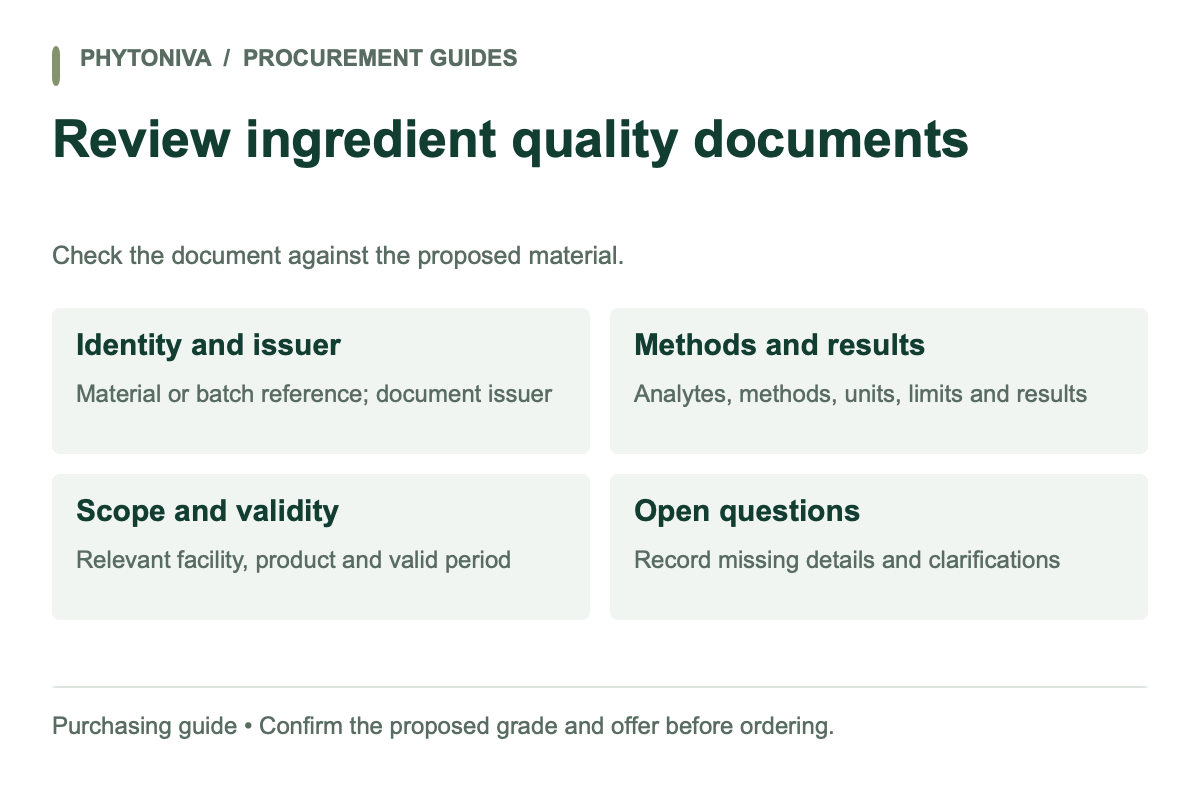
PHYTONIVA obtains the independent test report and compares the results with the agreed criteria during purchasing and pre-dispatch review. The manufacturer COA and agreed test report are provided with the shipment, linked to the material or sample identified in each document.
Factory-supplied COA, certification-body certificates and third-party test reports have different issuers and purposes. A test report covers the sample and items stated in it; it is not a blanket certification or proof that every possible indicator was tested. Testing scope and commercial arrangements are confirmed for the project.
Check certification by product and source
Documentation from production partners must be matched to the offered material and purchasing project. We confirm the applicable records against your requirements; a certificate for one facility does not cover the entire catalog.
Tell us the certification your project requires
- Product
- Ingredient name, grade, target specification and plant part.
- Use and market
- Finished-product category, destination and any scheme your customer specifically requires.
- Review scope
- Certificate holder, issuing body, validity dates, certified facility or product scope, and how the offered material falls within that scope.
Discuss certificate requirements ↗
PHYTONIVA coordinates sourcing and trade. Certificates belong to the named business, facility or product. Brochure logos, facility photographs and a document list are not substitutes for valid certificates.
Agree the criteria before ordering. Check the records on delivery.
Before ordering, define comparable methods, units and reporting bases in the specification. Total polyphenols and a single constituent assay are different measurements; an extraction ratio does not replace an assay. When the shipment arrives, match the accompanying COA and agreed test report to those criteria.
Before a sample or bulk order, record the specification version, material identity, test conditions, acceptance criteria and document requirements. Confirm the commercial grade and terms, and review any change to carrier, method or grade.
Sample orders and clear technical questions are welcome. MOQ, charges, packaging and lead time are discussed according to the specification and supply conditions. Order size does not replace the necessary quality checks.
Laboratory context
These existing photographs show analytical equipment and laboratory workstations. Confirm the relevant testing capability, reports and production source for the particular ingredient project.


Discuss quality and certificate requirements
Send the product, specification, application, quantity, destination and required certification scheme. We will clarify the order requirements and the documents to be supplied with the shipment.