Menu
Shiitake Mushroom Extract: Benefits and Uses
Shiitake mushroom extract brings a familiar edible mushroom into a more composition-focused ingredient format. Made from Lentinula edodes, it attracts interest for its polysaccharides, including beta-glucans, and research into immune responses. For brands developing mushroom capsules, blended powders or food concepts, its value starts with understanding the mushroom, the preparation and the characteristics a formulation actually needs.
Here we explain what distinguishes shiitake extract, what benefits researchers have investigated and how to compare a proposed grade. PHYTONIVA welcomes sample-order enquiries and can discuss MOQ according to specifications, packaging and supply conditions.
What is shiitake mushroom extract?
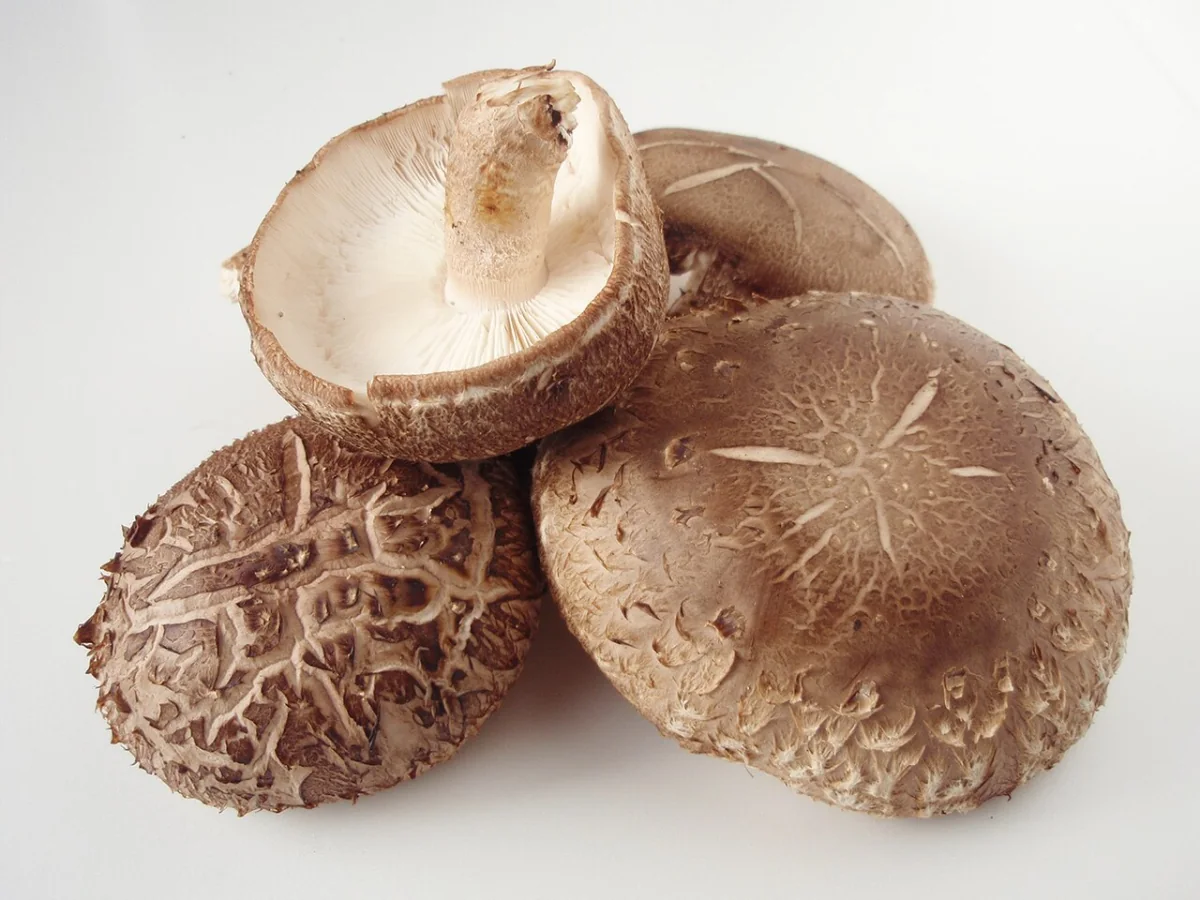
Shiitake is an edible fungus widely recognized as a fresh or dried culinary mushroom. The mushroom with a cap and stem is the fruiting body. Mycelium is the network of fungal filaments that grows through a cultivation medium. A fruiting-body ingredient, a mycelial preparation and material containing cultivation substrate should be identified separately.
Whole shiitake powder is made by drying and milling the starting material. Extraction instead recovers selected components, followed by concentration and, for a powder ingredient, drying. The starting material, extraction conditions and any carrier affect the resulting composition. An extract supplied as powder is therefore a different purchasing specification from milled whole mushrooms.
These distinctions matter when matching a product concept: a culinary mushroom powder and an extract selected for a constituent target may play different roles. Confirm the exact fungal material and process before deciding which fits your formulation.
Polysaccharides, beta-glucans and lentinan
Polysaccharides are long chains of sugar units. Beta-glucans are a particular group made from glucose with beta linkages. Lentinan is a specific shiitake-derived beta-glucan discussed in research; its name should not be used as a synonym for all shiitake polysaccharides. Research involving defined lentinan preparations, including injected formulations, does not establish the effects of an ordinary oral bulk extract. Lentinan background.
“20–30% polysaccharides” does not mean “20–30% beta-glucan.” A published analytical method measured total glucan and alpha-glucan separately, then calculated beta-glucan by subtraction. Method and sample preparation influenced the result. A buyer needs the actual analyte, analytical method and reporting basis to compare offers meaningfully. Original mushroom glucan analysis study.
For an ingredient brief, decide whether broad polysaccharide content or a separately measured beta-glucan target matters most. Also describe any carrier and its proportion: the final formulation uses the complete ingredient, not just its headline percentage.
What shiitake benefits are being studied?
Immune responses: findings from a human food study
In a four-week study, 52 healthy adults ate 5 or 10 g of whole dried shiitake daily. Researchers observed greater activity and proliferation in selected ex vivo immune-cell tests, increased salivary secretory IgA and reduced blood C-reactive protein. These findings explain interest in shiitake and immune function. However, the study compared two mushroom intakes, not mushrooms against a mushroom-free placebo, and measured biomarkers rather than fewer infections. It tested whole mushrooms, so its intake amounts and findings cannot be transferred directly to an extract. Dai and colleagues’ human study.
Antioxidant and metabolic research: extraction makes a difference
A 2025 laboratory study compared shiitake polysaccharide extracts made with water or alkaline media, with or without ultrasound. Preparation changed swelling behavior, antioxidant test results and inhibition of carbohydrate-digesting enzymes. The extract with the highest beta-glucan concentration was not strongest in every test. This supports investigating composition and processing together; it does not demonstrate blood-sugar control or antioxidant benefits in people. The study used crude experimental extracts, whose accompanying compounds could contribute to the findings. Original extraction study.
For development teams, the useful question is which preparation and evidence match the proposed product. A broad shiitake identity or a higher percentage alone cannot establish the performance of a finished formula.
Where can formulation teams evaluate shiitake extract?
- Capsules and tablets: compare constituent targets alongside particle size, flow, moisture and bulk density. Trial the sample in the intended blend and filling process; concentration alone does not determine manufacturing suitability.
- Mushroom blends and sachets: evaluate shiitake’s contribution to the blend’s ingredient profile, taste, color and mouthfeel. Record each mushroom species and amount so the formulation remains clear and reproducible.
- Beverages and food concepts: test dispersion, sediment and flavor in the actual recipe. Check behavior at the intended concentration, pH and processing temperature. Do not infer full solubility or a clear drink from the word “extract.”
A small, controlled sample comparison is useful: hold the base recipe and inclusion level constant, then record appearance, handling and stability observations for each candidate. These are proposed development checks, not verified properties of every available grade. The intended use must also be assessed for the destination market.
Choosing a 20–30% polysaccharide reference grade
Our supplier reference catalogue lists shiitake mushroom extract with 20–30% polysaccharides. This is a starting point for discussing specifications, not confirmation of current stock or a beta-glucan guarantee. The offered grade and its method of analysis need to be agreed for the project.
First confirm Lentinula edodes and the fruiting-body or mycelial source. Then compare extraction process, full composition, assay basis and any separate beta-glucan requirement. Agree relevant microbial, contaminant and residual-solvent criteria for the actual process and application. A useful purchasing specification connects these details to your product format and acceptance requirements.
View the shiitake extract catalogue entry. If you are comparing mushroom ingredients, our maitake extract guide explains a different species and its research.
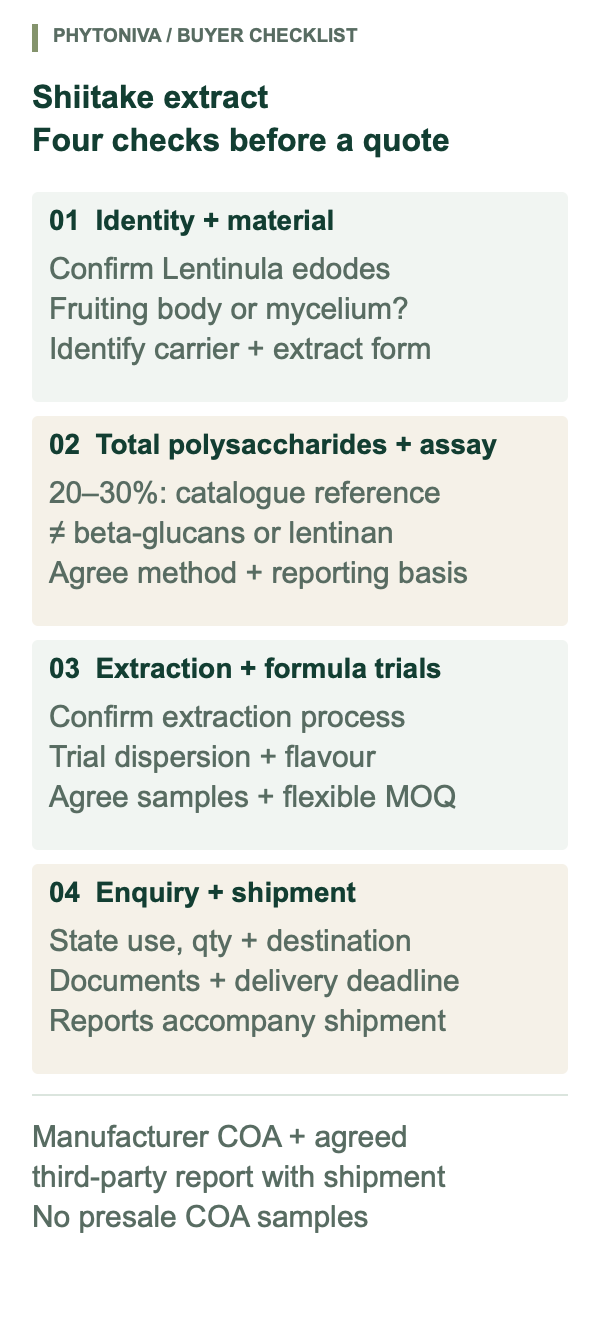
Shiitake extract: four checks before a quote
Identity + material
Confirm Lentinula edodes identity, whether the source material is fruiting body or mycelium, the extract form, and any added carrier. These materials and formulations should not be treated as interchangeable.
Total polysaccharides + assay
The catalogue reference is 20–30% total polysaccharides. This is not a beta-glucan or lentinan assay and does not guarantee that every grade is available. Agree the test method and reporting basis; specify beta-glucans or lentinan separately if either is the purchasing target.
Extraction + formula trials
Confirm the extraction process, then evaluate dispersion and flavour in the intended formula using a sample. Sample orders are welcome. MOQ, sample costs, packaging and supply conditions can be discussed for the project; sample availability and terms must be agreed.
Enquiry + shipment
Send the specification, intended application, quantity, destination, document needs and deadline. Before ordering, agree the sample or batch to be tested, test scope, methods, acceptance criteria and delivery terms. The manufacturer COA and agreed third-party test report accompany shipment. No presale COA sample or public COA download is currently offered.
Safety information relevant to shiitake
Shiitake can cause skin reactions, including the characteristic streak-like rash called shiitake dermatitis. Reports involve raw or cooked mushrooms; skin and gastrointestinal reactions have also been described after shiitake powder consumption. A food history does not establish the safety of a concentrated preparation. People with previous reactions should seek professional advice rather than assuming an extract is suitable. Product teams should review allergy information, processing and intended users; processing alone should not be presented as eliminating the risk. Shiitake safety information.
Frequently asked questions
Should I choose whole mushroom powder or extract?
Start with your formulation goal. Compare the complete ingredient composition and sample performance. Whole powder retains the milled starting material, while an extract is selected through processing; neither description alone guarantees the better fit.
Can I order a sample before a larger purchase?
Yes, sample-order enquiries are welcome. Tell us what you want to evaluate and the quantity required. Sample charges, packaging, MOQ and supply arrangements are discussed for the proposed specification.
Who provides the quality documents?
PHYTONIVA coordinates trade, procurement and supply resources. The manufacturer provides its COA, while we arrange third-party quality testing before procurement and dispatch. The manufacturer COA and agreed third-party report accompany the shipment; presale COA samples and public downloads are not currently offered. Agree the testing scope and document requirements before ordering. A manufacturer COA, third-party test report and certification are distinct documents; a report covers its listed samples, tests and results, not all products or batches. Read our quality coordination workflow.
Discuss your shiitake extract project
Send your target specification, intended use, quantity, budget, destination, document needs and timing. We can help compare suitable products and supply arrangements, from an initial evaluation sample to a planned bulk order.
Request a quotation · sales@phytoniva.com · WhatsApp +86 19991898850
Sourcing coordination and quality checks
PHYTONIVA manages trade, sourcing and supplier coordination, matching ingredients and supply options to your specification, application and destination. The manufacturing partner provides its COA and relevant quality documents. Before procurement and dispatch, we arrange independent third-party quality testing and obtain the report for the agreed testing scope.
Specifications, sampling, test scope, methods and acceptance criteria are agreed before ordering. The manufacturer COA and agreed third-party test report accompany the shipment. Certification is checked separately for the named holder, product and valid scope.
See our quality and documentation process