Menu
Poria Cocos Extract: Benefits and Buying Guide
Poria cocos extract, also called Fuling or Hoelen extract, brings together two ingredient stories: fungal polysaccharides and triterpenes such as pachymic acid. This makes it interesting to formulation teams exploring mushroom blends and sleep-oriented product concepts. The starting material is usually a sclerotium—a dense fungal storage structure—rather than the familiar cap-and-stem mushroom.
This guide explains the ingredient, what sleep research actually found, and how to assess a 20% polysaccharides reference specification. PHYTONIVA welcomes sample orders; MOQ can be discussed according to specification, packaging and supply conditions.
What is Poria cocos extract?
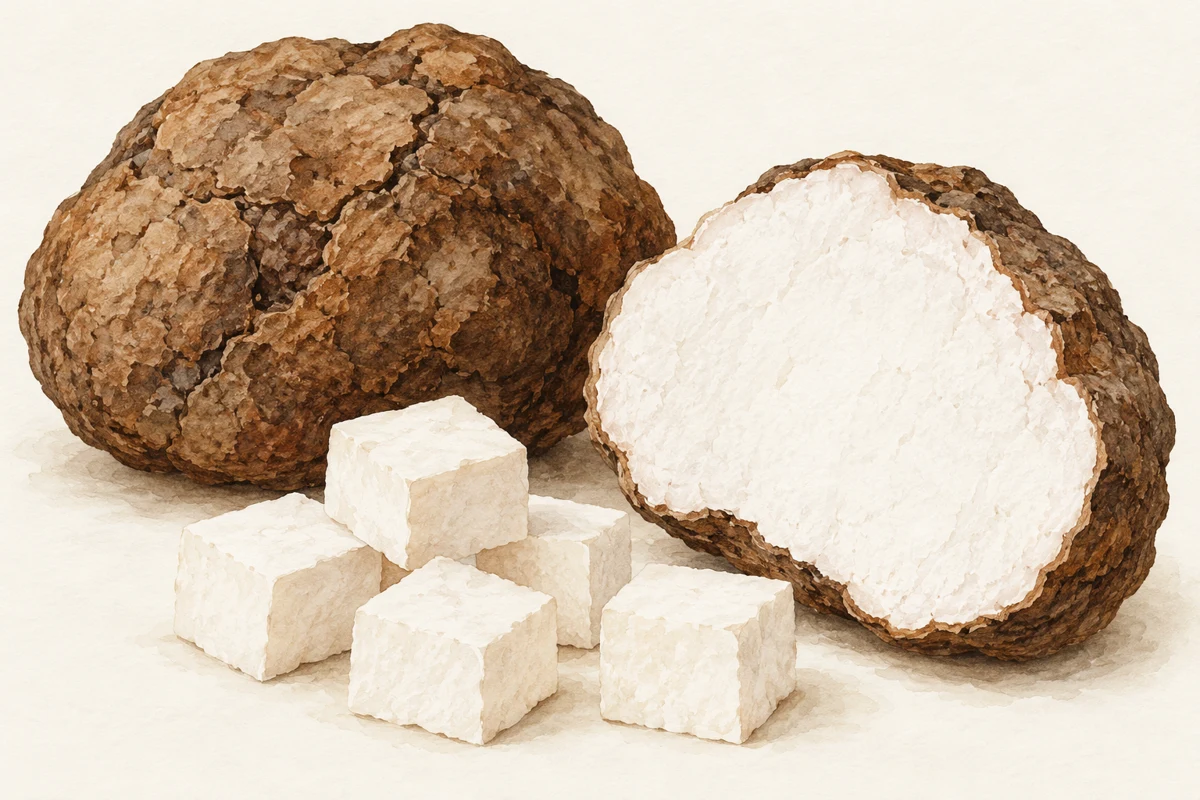
Fuling raw material commonly appears as a brown-skinned sclerotium with a pale interior, or as peeled pieces and powder. An extract is produced through an extraction and concentration process; milled sclerotium powder is a different material. Confirm whether the offered extract starts with peeled inner tissue, the outer layer, whole sclerotium or cultivated mycelium, since these should not be treated as interchangeable.
The widely used trade name Poria cocos has a complicated taxonomic history. A molecular study distinguished cultivated East Asian Fuling as Pachyma hoelen from North American Pachyma cocos. Ask the manufacturer to document the offered identity and source rather than relying only on an English trade name. Original taxonomy study.
Polysaccharides and triterpenes: different buying targets
Polysaccharides are carbohydrate polymers; triterpenes are a different chemical group. Pachymic acid is one triterpene investigated in Poria research. A percentage for total polysaccharides does not state the amount of pachymic acid, and it is not automatically a beta-glucan result. These distinctions matter when matching a supplier specification to the purpose of a formula.
Choose the analytical target before comparing quotations. For a polysaccharide-focused brief, agree the assay method, reference standard, reporting basis and carrier declaration. For a triterpene-focused brief, request a separately defined marker specification and suitable method. Extraction solvent and processing also matter: evidence from a particular ethanol extract cannot simply be transferred to a differently prepared polysaccharide grade.
What effects have researchers explored?
Sleep: an early human signal
A small 2023 before-and-after study reported 21 participants in its analysis. After two weeks with a specific ethanol-derived preparation, mean total sleep time rose from about 327 to 357 minutes, while wake time after sleep onset fell. There was no parallel placebo group, so the study cannot establish that the extract caused the change. It also does not establish equivalence to a commercial 20% polysaccharide grade. Read the original study.
Why pachymic acid attracts attention
In mice, isolated pachymic acid shortened the time to drug-induced sleep and prolonged sleep in pentobarbital experiments; accompanying work investigated GABA-related signaling. This provides a mechanistic research lead, not proof of improved natural sleep in people or proof that every Poria extract has the same effect. Original animal study.
Combination products require their own interpretation
A four-week randomized placebo-controlled trial in 70 women examined a drink combining Poria, Ziziphus spinose and GABA. The combination improved measured sleep outcomes and some skin measures compared with placebo. Because three ingredients were combined, neither the sleep nor skin findings can be attributed to Poria alone. The short, specific-population study is a formulation research example, not a claim for this bulk ingredient. Original combination trial.
Application directions to evaluate
- Capsules: assess bulk density, flow and fill consistency with the intended excipients. Identify which constituent profile supports the development brief.
- Mushroom powder blends: check flavor, color, particle size and blend uniformity. An extract and a milled powder should have separate ingredient specifications.
- Drinks or sachets: test dispersion, sedimentation and sensory performance at the intended use level and pH. Neither a polysaccharide percentage nor the word “extract” guarantees clear-water solubility.
These are development checks, not validated performance claims. For another fungal ingredient comparison, explore our Agaricus extract guide. Finished-product claims and suitability must be assessed for the actual formulation and destination.
Selecting a 20% polysaccharide reference grade
The reference catalogue lists Poria Cocos Extract, polysaccharides 20%. Use it to start a specification discussion, not as a current-stock commitment. Compare the proposed material with the Poria catalogue result, then agree the identity, source tissue, extraction process, carrier and analytical target.
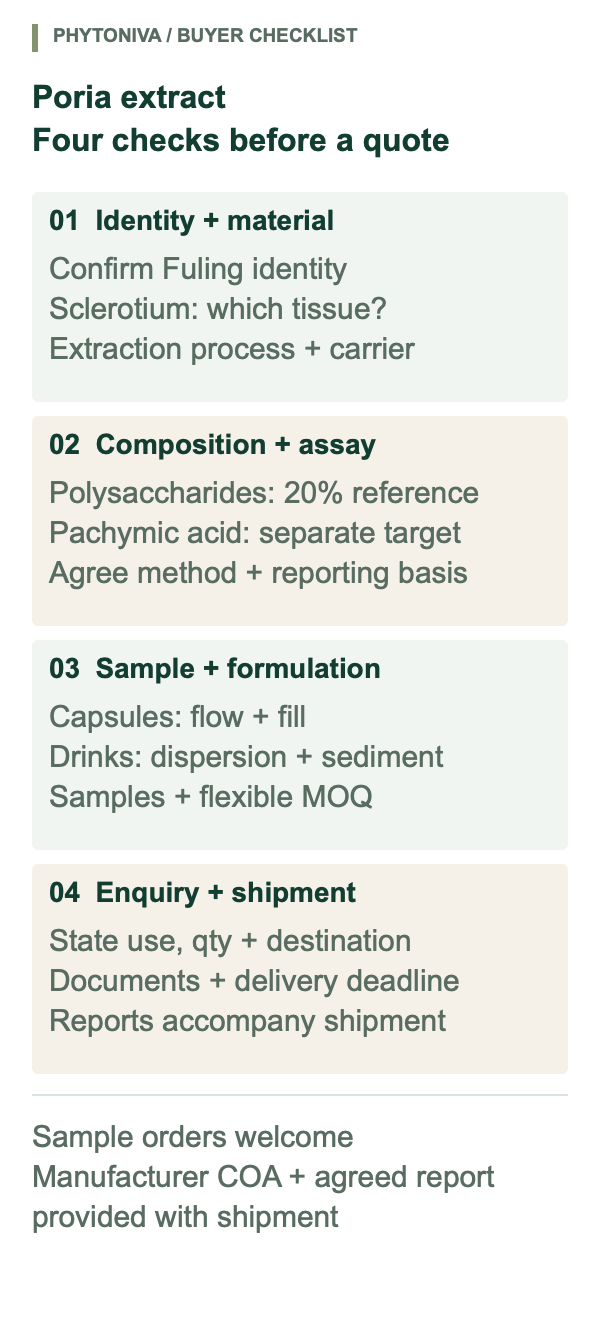
Poria extract: four purchasing checks
Identity + material
Confirm the offered fungal identity and whether the starting material is peeled tissue, outer layer, whole sclerotium or mycelium. Specify extraction and carrier.
Composition + assay
20% polysaccharides is a catalogue reference. Pachymic acid and beta-glucans are separate analytical targets; agree the assay, reference standard and reporting basis.
Sample + formulation
Trial samples in the intended formulation for flow, fill, flavor and dispersion. Agree microbial, contaminant and process-related tests. Sample costs and MOQ depend on specification, packaging and supply conditions.
Enquiry + shipment
Provide specification, use, quantity, budget, destination, documents and timing. Before ordering, agree the tested sample or batch, testing scope, methods, acceptance criteria and delivery conditions. Manufacturer COA and agreed third-party reports accompany shipment.
Safety and formulation boundaries
Small, short studies cannot establish long-term safety or suitability for pregnancy, breastfeeding, children or people taking medicines. The small human sleep study noted a decrease in blood potassium within the normal range in the tested subgroup; this is a finding for further investigation, not evidence of established electrolyte harm. Have a qualified reviewer assess the intended population, medicines and formula before use. Do not present a sleep-oriented ingredient as a substitute for assessment or treatment of persistent sleep problems.
Buyer FAQ
Is 20% polysaccharides the same as 20% beta-glucans?
No. Total polysaccharides, beta-glucans and pachymic acid are different analytical targets. Ask for the method and reporting basis appropriate to the agreed specification.
Can the sleep studies be used as evidence for the offered grade?
Only after assessing whether the identity, process and composition are relevant. A catalogue percentage alone does not demonstrate equivalence to a studied preparation or establish a finished-product benefit.
Who supplies the quality documents?
PHYTONIVA coordinates trade, procurement and supply resources; the manufacturer issues its COA. PHYTONIVA arranges third-party quality testing before procurement and dispatch. Manufacturer COA and agreed third-party reports accompany shipment; presale COA samples and public downloads are not currently offered. Reports cover their listed samples, tests and results, and are distinct from certification or efficacy evidence. See our quality coordination workflow.
Discuss Poria extract samples or bulk supply
Tell us the specification, application, quantity, budget, destination, document requirements and target delivery date. We help match products and supply options to these needs. Sample terms, packaging and MOQ are discussed for the proposed supply; free samples are not promised.
Request a Poria extract quotation · sales@phytoniva.com · WhatsApp +86 19991898850
Sourcing coordination and quality checks
PHYTONIVA manages trade, sourcing and supplier coordination, matching ingredients and supply options to your specification, application and destination. The manufacturing partner provides its COA and relevant quality documents. Before procurement and dispatch, we arrange independent third-party quality testing and obtain the report for the agreed testing scope.
Specifications, sampling, test scope, methods and acceptance criteria are agreed before ordering. The manufacturer COA and agreed third-party test report accompany the shipment. Certification is checked separately for the named holder, product and valid scope.
See our quality and documentation process