Menu
Agaricus Blazei Extract: Benefits and Bulk Buying
Agaricus blazei extract is a mushroom ingredient valued for its polysaccharide profile and research into immune activity and metabolic health. Often called the almond mushroom or himematsutake, the cultivated mushroom is discussed in modern taxonomy as Agaricus subrufescens. For brands and formulation teams, it offers a fungal ingredient to evaluate in capsules, powder blends and mushroom-based product concepts.
This guide connects the product’s identity, constituents and human research with practical specification choices. PHYTONIVA welcomes sample orders, with MOQ discussed according to specification, packaging and supply conditions.
What is Agaricus blazei extract?
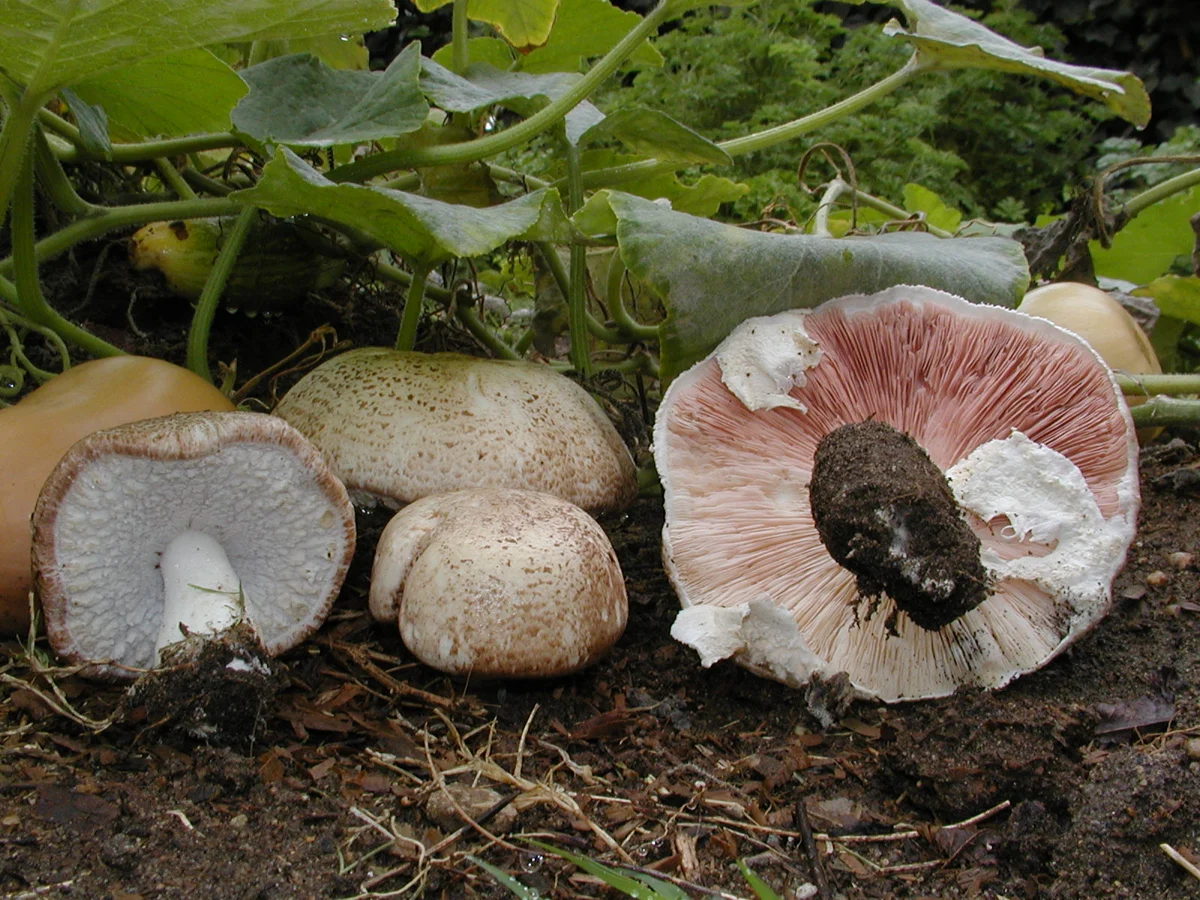
The commercial name needs a little care. A taxonomic study using genetic and mating evidence linked cultivated Brazilian mushrooms marketed as Agaricus blazei or Agaricus brasiliensis to Agaricus subrufescens. A trade name alone therefore should not replace the manufacturer’s species identification. Original taxonomy study.
A fruiting body is the familiar cap-and-stem mushroom; mycelium is its growing network of fungal filaments. Either material must be identified explicitly in a sourcing brief. Whole mushroom powder is dried and milled material, while an extract recovers selected constituents and is commonly concentrated and dried. The starting material, extraction process and carrier determine how the resulting ingredient differs from ordinary mushroom powder.
Polysaccharides and product characteristics
Polysaccharides are a central focus of Agaricus research. Glucans and related polysaccharide preparations have been investigated for effects on immune responses. However, “total polysaccharides” describes a broader analytical category than beta-glucans. A product listed at 20% polysaccharides is not automatically 20% beta-glucans, nor does that percentage identify the preparation used in a clinical study.
For development, the useful distinction is between a commercial specification and a measured constituent profile. Confirm the analytical method, reporting basis, carrier and any separate beta-glucan requirement. Color, mushroom flavor, particle size and dispersion should be assessed on the proposed sample rather than assumed from the ingredient name.
What benefits have researchers studied?
Insulin resistance: a small human trial
A randomized, double-blind study enrolled 72 adults with type 2 diabetes already taking metformin and gliclazide. Participants received a specific Agaricus extract or placebo for 12 weeks. Among the 60 participants reported at the end, the extract group had a lower insulin-resistance index and higher adiponectin levels than the placebo group. This is an interesting metabolic research signal, but it concerns an adjunct to prescribed medicines in a defined patient group—not replacement treatment or proof that any commercial grade lowers blood sugar. The trial was small and short, and does not establish equivalence with a 20% polysaccharide catalogue grade. Original randomized trial.
Immune activity and quality of life
A 2004 study in patients receiving chemotherapy for gynecological cancers reported improved natural killer cell activity and some quality-of-life measures with a specific Agaricus preparation. This helps explain research interest in immune-related effects. It does not establish cancer treatment, improved survival, infection prevention or the same benefit in healthy consumers; the clinical setting and studied preparation matter. Original clinical study.
How to use the findings in a development brief
The research supports investigating clearly identified preparations and measurable constituent profiles. It does not support transferring a study’s outcomes to an unspecified extract. A useful brief separates the intended product concept, the extract’s analytical specification and the evidence needed for any finished-product claim. Safety and permitted claims need review for the actual use and destination.
Applications worth evaluating
- Capsules: assess bulk density, flow and fill consistency using the proposed sample.
- Powder blends: test flavor balance, color, mixing uniformity and moisture sensitivity in the complete formula.
- Beverage concepts: check wetting, dispersion, sediment and stability at the intended serving conditions. An extract designation does not guarantee clear-water solubility.
These are development checks, not tested performance promises. For comparison with another mushroom ingredient, see our shiitake extract guide.
Choosing a 20% polysaccharide reference grade
The reference catalogue lists Agaricus Blazei Extract, polysaccharides 20%. Treat this as a discussion starting point, not a current-stock statement or beta-glucan result. Confirm the offered species, fruiting-body or mycelial source, extraction medium, carrier, assay method and reporting basis. Review the Agaricus product catalogue result alongside your project requirements.
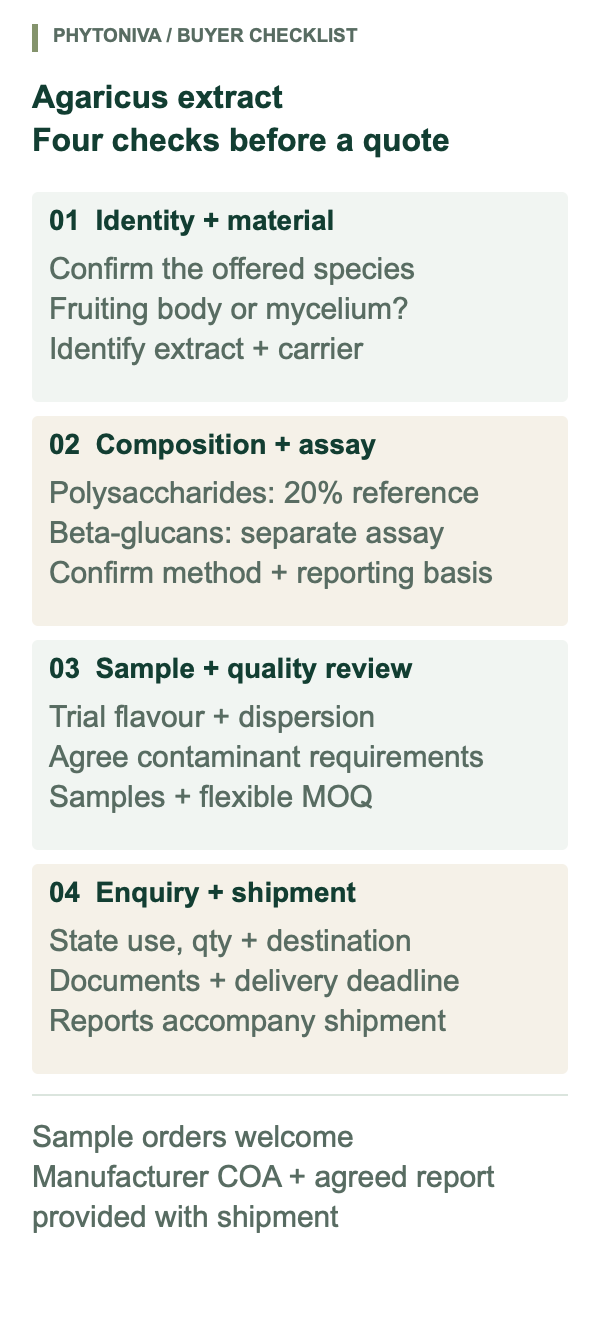
Agaricus extract: four purchasing checks
Identity + material
Confirm the identity behind the Agaricus blazei trade name, starting material, extraction process and carrier.
Composition + assay
20% polysaccharides is a catalogue reference. Agree the analyte, method and reporting basis; beta-glucans require their own specification.
Sample + quality review
Evaluate formulation samples for flavor, color, flow and dispersion. Agree microbial and contaminant requirements, including relevant arsenic testing, and process-related tests. Sample costs and MOQ depend on specification, packaging and supply conditions.
Enquiry + shipment
Provide specification, use, quantity, budget, destination, documents and timing. Before ordering, agree the tested sample or batch, testing scope, methods, acceptance criteria and delivery conditions. Manufacturer COA and agreed third-party reports accompany shipment.
Product-specific safety considerations
Mushroom allergy matters. Published case reports have also described severe liver injury associated with Agaricus extract use in cancer patients; other contributing factors were not fully excluded. These reports do not quantify the risk of every extract, but they make liver safety a substantive part of product assessment. People with liver disease or those receiving cancer treatment should seek clinical advice before use. Original liver-injury case series.
MSK notes possible effects on blood glucose and laboratory evidence of CYP3A4 inhibition, whose clinical significance remains uncertain. Medication users should discuss use with a clinician. Contaminant assessment should include relevant arsenic requirements: reported findings in some samples do not establish the composition of the offered batch. Clinical safety information.
Frequently asked questions
Is Agaricus blazei the same as ordinary button mushroom?
No. Specify the species; Agaricus bisporus, the common button mushroom, is a different ingredient. Ask the manufacturer to document the identity behind the commercial Agaricus blazei name.
Does 20% polysaccharides mean 20% beta-glucans?
No. They are different specifications. Request a defined beta-glucan assay if that is the constituent your project requires.
Who provides quality documents, and when?
PHYTONIVA coordinates trade, procurement and supply resources. The manufacturer issues its COA; PHYTONIVA arranges third-party quality testing before procurement and dispatch. Manufacturer COA and agreed third-party reports accompany shipment; presale COA samples and public downloads are not currently offered. A report covers its listed sample, tests and results, and is distinct from a certification or proof of efficacy. Quality coordination workflow.
Discuss an Agaricus extract sample or bulk order
Send your target specification, intended use, quantity, budget, destination, documents and required timing. Sample orders are welcome; sample costs, MOQ, packaging and supply conditions are agreed for the project. We help match products and supply arrangements to your requirements.
Request a quotation · sales@phytoniva.com · WhatsApp +86 19991898850
Sourcing coordination and quality checks
PHYTONIVA manages trade, sourcing and supplier coordination, matching ingredients and supply options to your specification, application and destination. The manufacturing partner provides its COA and relevant quality documents. Before procurement and dispatch, we arrange independent third-party quality testing and obtain the report for the agreed testing scope.
Specifications, sampling, test scope, methods and acceptance criteria are agreed before ordering. The manufacturer COA and agreed third-party test report accompany the shipment. Certification is checked separately for the named holder, product and valid scope.
See our quality and documentation process