Menu
Maitake Mushroom Extract: Benefits, Ingredients and Uses
Maitake mushroom extract is an ingredient made from Grifola frondosa, the edible mushroom also known as hen of the woods. Its polysaccharides, including beta-glucans, make it interesting to teams developing mushroom capsules, blends and other nutrition concepts. Research explores how particular maitake preparations interact with immune responses and metabolic pathways; understanding those preparations helps buyers choose a more relevant specification.
This guide explains the mushroom, its main constituents, the findings behind the interest, and practical formulation choices. PHYTONIVA welcomes sample-order enquiries and can discuss MOQ according to the specification, packaging and supply conditions.
What is maitake mushroom extract?
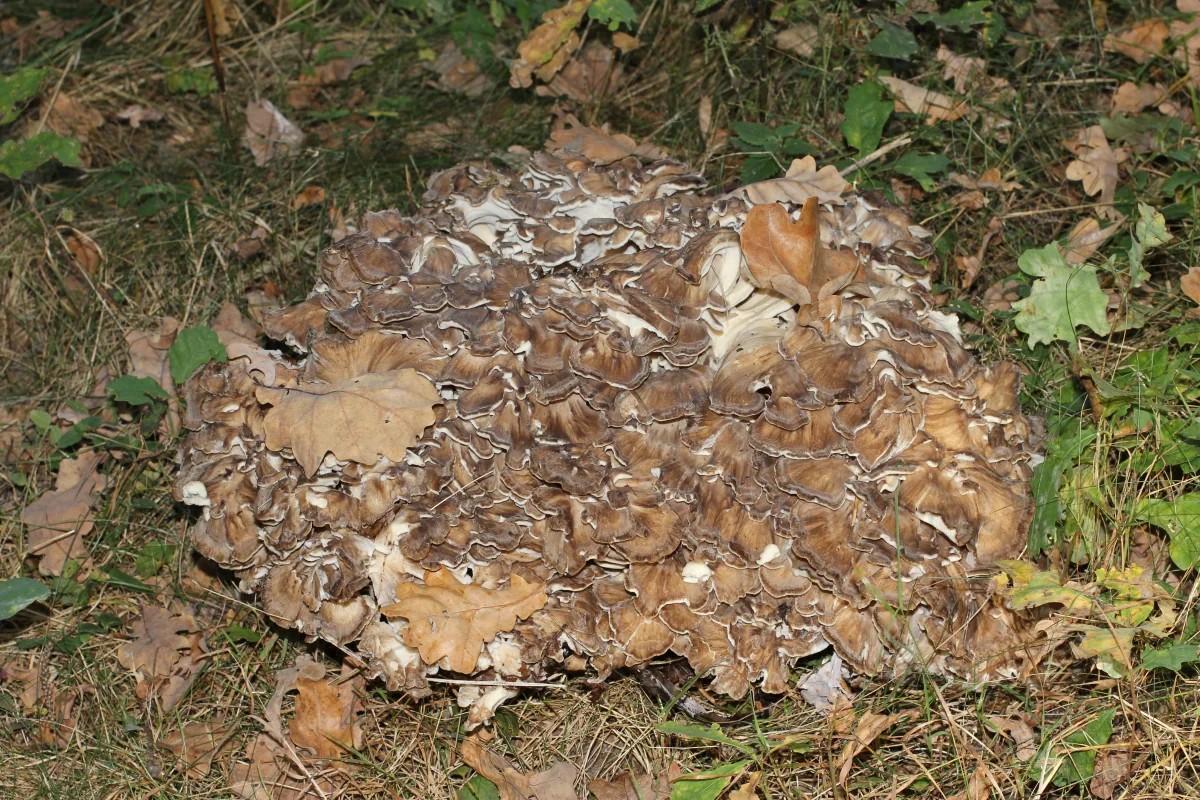
Maitake forms clusters of overlapping, fan-shaped caps. The visible mushroom is its fruiting body; mycelium is the network of fungal filaments that grows through a substrate. These starting materials are different. A product described as mycelial material may require clarification of whether the cultivation substrate remains in it.
A whole mushroom powder is produced by drying and milling the starting material. An extract uses a processing step to recover selected constituents, often followed by concentration and drying. The solvent, processing conditions and any added carrier influence the final composition. A powder-form extract therefore need not be the same material as a whole mushroom powder.
For a proposed maitake ingredient, confirm Grifola frondosa, the fungal material used, the extraction process and the full composition. This gives the formulation team a useful identity beyond a common product name.
Polysaccharides and beta-glucans: what makes maitake interesting?
Polysaccharides are chains of sugar units. The term covers a broad family, while beta-glucans refer specifically to glucose polymers with beta linkages. Their size, branching and accompanying components can vary with the starting material and preparation. These features help explain why research focuses on characterized fractions rather than a percentage alone.
A total-polysaccharide result is not a beta-glucan result. An analytical study of mushroom and mycelial products measured total glucan and alpha-glucan separately and calculated beta-glucan from the difference. It also demonstrated that analytical preparation affects results. Buyers comparing percentages should therefore compare the analyte, method and reporting basis together. Original analytical study.
Names such as D-fraction and SX-fraction refer to particular maitake preparations described in research or commercial literature. They are not alternative names for every maitake extract. A generic 20–30% total-polysaccharide specification does not establish equivalence to one of those preparations.
What benefits are being studied?
Immune responses: an exploratory human study
A three-week dose-escalation study evaluated a specific liquid maitake fruiting-body extract in 34 women who were disease-free after breast cancer treatment. Some immune measurements increased and others decreased; responses were not simply stronger at higher doses. This is evidence of immune modulation worth further investigation, rather than a demonstrated reduction in infections or proof of cancer treatment. The study was small, lacked a placebo group and tested a particular preparation, so it cannot establish a general “immune boost” from an ordinary bulk extract. Original human study.
Metabolic and gut-microbiota effects: a mouse study
A 2025 study tested a polysaccharide preparation from G. frondosa in mice fed a high-fat diet. Researchers reported improved insulin resistance, changes in gut microbial composition, higher short-chain fatty acid production and lower inflammatory and oxidative-stress signals. This makes the relationship between fungal carbohydrates, intestinal microbes and metabolism a useful development research direction. These were animal findings, not a demonstrated blood-sugar or weight-loss benefit in people, and the tested preparation cannot be assumed equivalent to the catalogue grade. Original 2025 study.
For a product brief, these findings support asking better questions about composition and evidence. They do not provide a ready-made health claim or dosage for a finished product. Match the ingredient to the actual preparation studied and evaluate the intended use in the destination market.
Which formulation directions can buyers evaluate?
- Capsules and tablets: a practical format for comparing constituent targets, particle size, powder flow, moisture and fill weight. Check blend uniformity and the proposed formulation with the actual sample.
- Mushroom blends and sachets: maitake can be evaluated alongside other mushroom ingredients. Compare the desired composition, taste, color and mouthfeel of the full blend; adding multiple mushrooms does not by itself prove a combined benefit.
- Beverage or food concepts: assess dispersibility, sediment, flavor and stability at the intended concentration, pH and processing temperature. Neither an extraction ratio nor a polysaccharide percentage guarantees a clear, fully soluble drink.
Start with the format you want to make and a short sample-evaluation plan. If your project depends on beta-glucan content, specify it separately. If taste or dispersion is the priority, compare candidate materials in the same base formulation. These are development checks, not verified performance claims for a particular supply.
How to compare 20–30% polysaccharide specifications
Our supplier reference catalogue lists maitake mushroom extract with 20–30% polysaccharides. This range is a reference for discussing candidate grades; availability and the offered specification require confirmation. It is not a 20–30% beta-glucan claim.
Agree the species, fruiting body or mycelial source, extraction process, carrier composition, assay method and reporting basis. Define any separate beta-glucan target and the relevant microbial, contaminant and residual-solvent requirements for the intended application. A higher broad-polysaccharide percentage is not automatically the better match for every formulation.
View the maitake extract catalogue entry. For comparison with another mushroom ingredient, see our reishi extract guide.
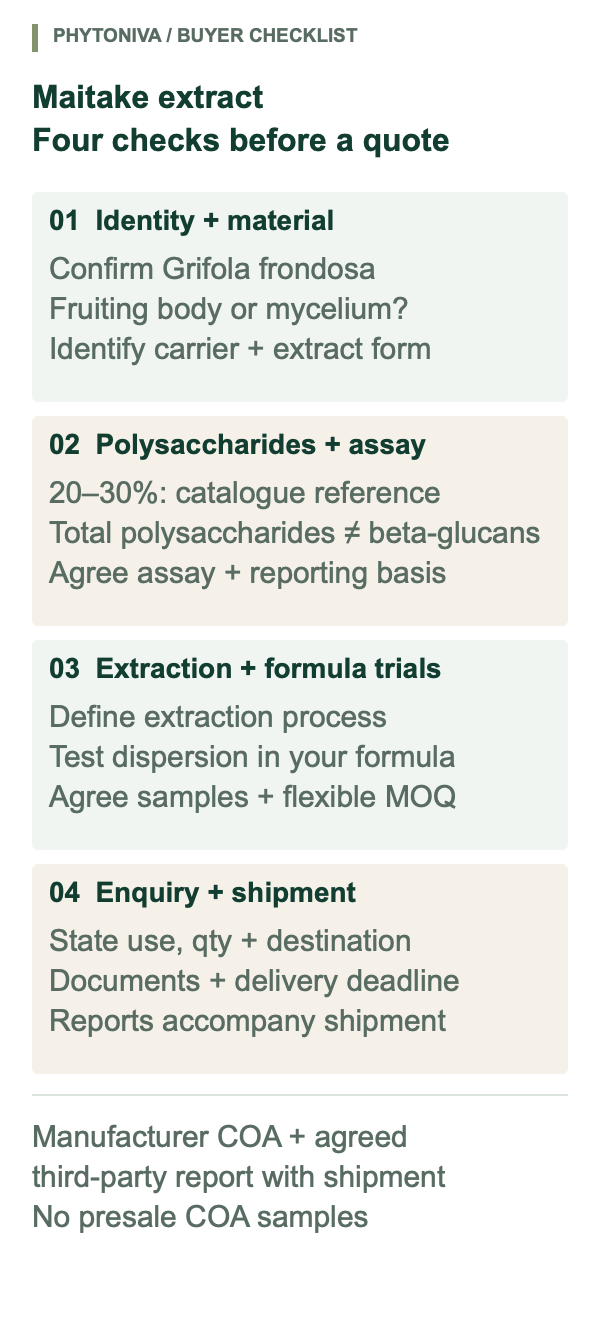
Maitake extract: four checks before a quote
Identity + material
Confirm Grifola frondosa identity, whether the source material is fruiting body or mycelium, the extract form, and any added carrier. These materials and formulations should not be treated as interchangeable.
Polysaccharides + assay
The catalogue reference is 20–30% total polysaccharides, not beta-glucan content or a guarantee that every grade is available. Agree the analytical method and reporting basis; define beta-glucans separately if they are the purchasing target.
Extraction + formula trials
Confirm the extraction process and evaluate dispersion in the intended formulation using a sample. Sample orders are welcome. MOQ, sample costs, packaging and supply conditions can be discussed for the project; sample availability and terms must be agreed.
Enquiry + shipment
Send the specification, intended application, quantity, destination, document needs and deadline. Before ordering, agree the sample or batch to be tested, test scope, methods, acceptance criteria and delivery terms. The manufacturer COA and agreed third-party test report accompany shipment. No presale COA sample or public COA download is currently offered.
Relevant safety considerations
Eating maitake as food is different from using a concentrated extract. People with mushroom allergies should avoid the ingredient. Memorial Sloan Kettering highlights potential interactions with warfarin and blood-glucose-lowering medicines. A qualified professional should review the intended user group, medication interactions and finished-product labeling. The research above is not dosing advice. Maitake safety information.
Frequently asked questions
Is maitake extract the same as whole maitake powder?
No. Milling retains the starting material in powder form; extraction recovers selected constituents. Confirm the process, material and carriers rather than relying on the word “powder.”
Does 30% polysaccharides mean 30% beta-glucan?
No. They are different analytical specifications. If beta-glucan is part of your purchasing requirement, state the target and appropriate testing method separately.
Can I place a sample or small trial order?
Sample-order enquiries are welcome. Share the evaluation purpose and required quantity. Sample charges, packaging and supply arrangements are agreed for the proposed grade; MOQ can be discussed according to those conditions.
Who handles quality testing and documents?
PHYTONIVA coordinates trade, procurement and supply resources. The manufacturer provides its COA, and we arrange third-party quality testing before procurement and dispatch. Before ordering, agree the sample or batch to be tested, scope, methods, acceptance criteria, document requirements and delivery conditions. The manufacturer COA and agreed third-party report accompany the shipment; we do not currently offer presale COA samples or public COA downloads. A report covers its stated sample and tests; certification is a separate matter tied to its holder and valid scope. Our quality coordination workflow.
Discuss your maitake extract requirements
Tell us the species and fungal material, target specification, intended use, quantity, budget, destination, document needs and timing. We help match a suitable product and supply arrangement to your project, whether you are evaluating a first sample or planning a larger purchase.
Request a quotation · sales@phytoniva.com · WhatsApp +86 19991898850
Sourcing coordination and quality checks
PHYTONIVA manages trade, sourcing and supplier coordination, matching ingredients and supply options to your specification, application and destination. The manufacturing partner provides its COA and relevant quality documents. Before procurement and dispatch, we arrange independent third-party quality testing and obtain the report for the agreed testing scope.
Specifications, sampling, test scope, methods and acceptance criteria are agreed before ordering. The manufacturer COA and agreed third-party test report accompany the shipment. Certification is checked separately for the named holder, product and valid scope.
See our quality and documentation process