Menu
Lion’s Mane Mushroom Extract: Benefits and Uses
Lion’s mane mushroom extract is made from Hericium erinaceus, the edible mushroom recognized by its hanging white spines. Its distinctive constituents and early cognitive research make it interesting to teams developing mushroom capsules, blended powders and other nutrition products. Understanding the starting material is especially useful here: whole mushroom powder, a polysaccharide-focused extract and an erinacine-enriched mycelial preparation describe different ingredients.
This guide introduces lion’s mane, explains what human studies have found and connects those findings to practical formulation choices. PHYTONIVA welcomes sample-order enquiries and can discuss MOQ according to the specification, packaging and supply conditions.
What is lion’s mane mushroom extract?
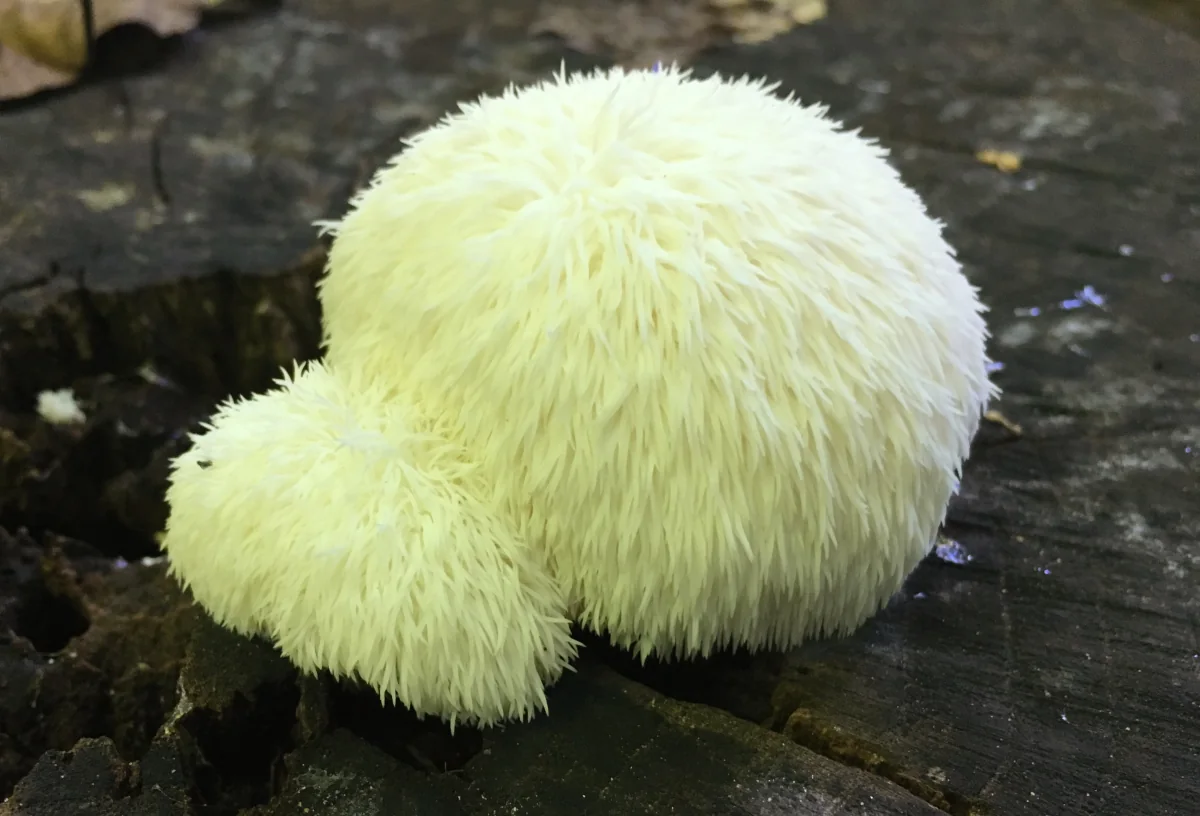
Lion’s mane, also called Hou Tou Gu or Yamabushitake, is a fungus rather than a plant. The familiar white, spine-covered mushroom is its fruiting body. Its mycelium consists of fungal filaments grown through a substrate or in a culture medium. When comparing materials, establish whether the ingredient comes from the fruiting body, mycelium or a mixture, and whether cultivation substrate remains.
A whole mushroom powder retains the dried, milled starting material. An extract recovers selected components through processing, often followed by concentration and drying. Added carriers, extraction media and processing conditions affect the final composition. Consequently, a capsule filled with whole powder does not necessarily provide the same ingredient as a capsule containing an extract.
The distinction helps buyers define a useful brief. A recipe built around mushroom identity, a specified carbohydrate fraction and a project targeting a named constituent each need different selection criteria.
Which constituents make lion’s mane distinctive?
Polysaccharides are chains of sugar units; beta-glucans are a particular group within this wider category. Hericenones and erinacines are separate groups of compounds studied for their neurological activity. Laboratory and animal research has investigated nerve-growth signaling, helping explain scientific interest in cognition. Such mechanisms do not establish nerve regeneration or a cognitive benefit from a generic commercial extract. Lion’s mane constituent background.
Starting material and cultivation matter. A 2025 analytical study found erinacine production differed between cultured mycelium and fruiting-body samples, and also varied with the mycelium’s growth medium. Erinacines were not detected in the fruiting bodies examined. This supports identifying and testing a proposed material rather than assuming its constituent profile from the mushroom name. It is a composition study, not evidence that one commercial grade improves memory. Original tissue and cultivation study.
A 20% polysaccharide specification does not establish beta-glucan, hericenone or erinacine content. If one of these is central to your product brief, list the exact target and suitable assay separately. An extraction ratio likewise describes a processing relationship, not a measured percentage of a particular active compound.
What benefits are researchers investigating?
Cognitive performance: a small longer-term trial
A placebo-controlled study in 30 adults aged 50–80 with mild cognitive impairment tested tablets containing 96% dried lion’s mane powder for 16 weeks. The tablet intake was 3 g daily. Cognitive-scale scores were higher than placebo at weeks 8, 12 and 16, then declined four weeks after intake stopped. This is an encouraging signal for further cognitive research, but the small trial did not demonstrate dementia prevention or establish lasting benefits. It tested dried mushroom powder, not the catalogue’s 20% polysaccharide extract. Mori and colleagues’ clinical trial.
Immediate effects: an extract trial gives a different picture
In a 2025 crossover study, 18 healthy young adults received a single 3 g dose of a 10:1 fruiting-body extract or placebo. At 90 minutes, the extract did not significantly improve overall cognitive or mood scores, although performance improved on an individual pegboard task. These results distinguish a task-specific finding from a general “instant focus” effect. A single-dose study also cannot answer whether a different preparation used for longer would have benefits. Original acute-extract study.
Mood research: the complete formula matters
A 2026 study assigned 84 young women to lion’s mane, a lion’s mane–reishi blend or placebo for four weeks. The blend had lower scores on the main anxiety measure than lion’s mane alone; secondary stress findings remained exploratory, and all groups improved on psychological measures. It does not establish an anxiety benefit from lion’s mane alone. This illustrates why results from a combination should be assessed for that formula, without attributing them to a single ingredient. Original mood and wellbeing trial.
For development teams, the evidence supports thoughtful evaluation of cognitive-wellness concepts. Match the fungal material, preparation and intended audience to the relevant research; study intakes are context, not a finished-product dosing recommendation.
How can buyers evaluate lion’s mane in a formula?
- Capsules and tablets: compare the chosen constituent target with particle size, flow, bulk density and moisture. Confirm that the proposed inclusion level works in the intended fill weight and manufacturing process.
- Mushroom blends and sachets: define the role and amount of each species. Evaluate flavor, color and mouthfeel in the complete blend; additional ingredients change both the recipe and the evidence needed for its claims.
- Coffee, cocoa or other beverage concepts: test the actual sample for dispersion, sediment and taste in the intended base. Check the effects of mixing, temperature and storage. “Extract” does not guarantee a clear or fully soluble drink.
Begin with a short sample plan and one consistent base formulation. Comparing candidates at the same inclusion level makes handling and sensory differences easier to assess. These are development suggestions; performance and the intended use need confirmation for the specific material and destination market.
What does the 20% polysaccharide reference mean?
The supplier reference catalogue lists lion’s mane mushroom extract with 20% polysaccharides. This is a reference for discussing a proposed grade, rather than a statement of current availability or a guarantee of other constituents.
Confirm Hericium erinaceus, the fungal material, extraction process, carrier composition, assay method and reporting basis. Specify any separate beta-glucan, hericenone or erinacine requirement. Agree the relevant microbial, contaminant and residual-solvent criteria for the actual process and intended application, together with packaging and acceptance conditions.
View the lion’s mane extract catalogue entry. Our shiitake extract guide offers a comparison with a different mushroom and its research focus.
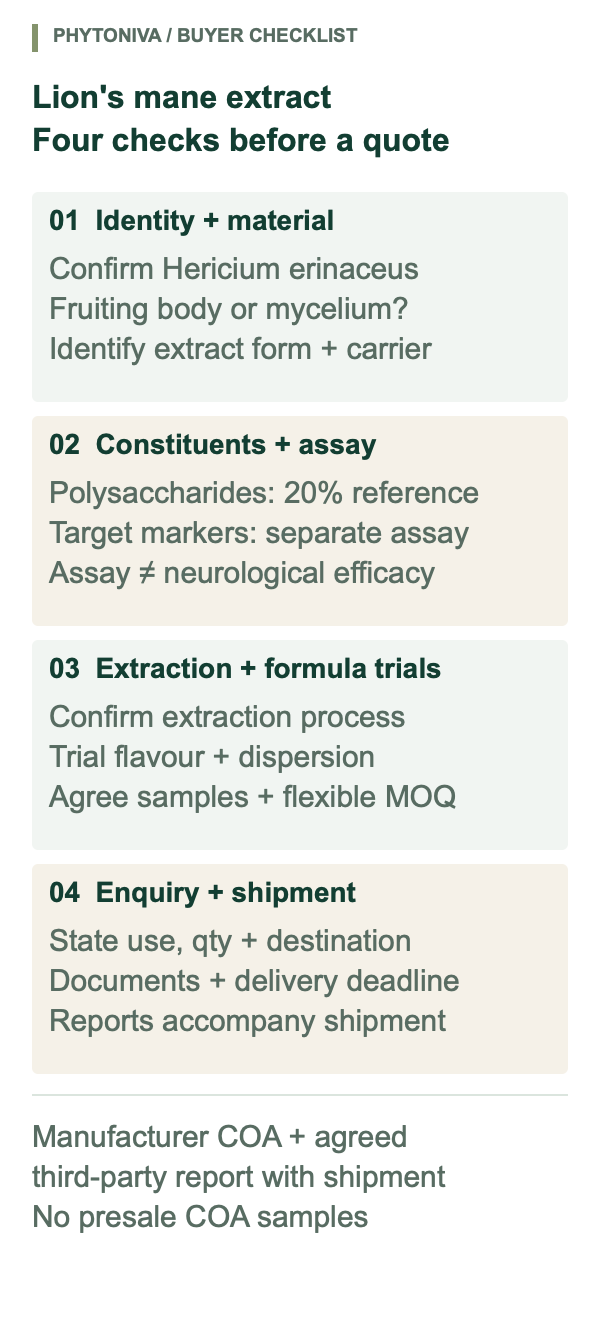
Lion's mane extract: four checks before a quote
Identity + material
Confirm Hericium erinaceus identity, whether the starting material is fruiting body or mycelium, the extract form and any added carrier. Whole mushroom powder and extract are different ingredient forms; do not assume materials or formulations are interchangeable.
Constituents + assay
The catalogue lists 20% polysaccharides as a reference specification. This is not a beta-glucan, hericenone or erinacine assay, does not guarantee neurological effects, and does not establish current availability. If a project specifies beta-glucans, hericenones or erinacines, define those markers and test methods separately, along with the reporting basis.
Extraction + formula trials
Confirm the extraction process, then use a sample to assess flavour, dispersion and settling in the intended formula. These are development checks, not a promise of water solubility or validated performance. Sample orders are welcome. MOQ, sample costs, packaging and supply conditions can be discussed for the project; sample availability and terms must be agreed.
Enquiry + shipment
Send the specification, intended application, quantity, destination, document needs and deadline. Before ordering, agree the sample or batch to be tested, test scope, methods, acceptance criteria and delivery terms. The manufacturer COA and agreed third-party test report accompany shipment. No presale COA sample or public COA download is currently offered.
Relevant safety considerations
Abdominal discomfort, nausea and skin rash have been reported with lion’s mane preparations. A history of eating the mushroom does not automatically establish the suitability of a concentrated extract for every user. People with mushroom allergies should avoid the ingredient, and those taking medicines should seek professional advice before supplement use. Product teams should review the intended users and labeling for the actual preparation. Lion’s mane safety information.
Frequently asked questions
Is fruiting body always preferable to mycelium?
The better fit depends on the target composition and formulation. Identify the material, any remaining cultivation substrate and its measured constituents. A source-material name alone cannot establish clinical equivalence or quality.
Can I place a sample or small trial order?
Sample-order enquiries are welcome. Tell us the evaluation purpose and required quantity. Sample charges, packaging, MOQ and supply arrangements are discussed for the proposed specification.
Who provides testing and quality documents?
PHYTONIVA coordinates trade, procurement and supply resources. The manufacturer provides its COA; we arrange third-party quality testing before procurement and dispatch. The manufacturer COA and agreed third-party report accompany the shipment. Presale COA samples and public downloads are not currently offered. Agree testing and document requirements before ordering. A COA, third-party report and certification are distinct; a report covers its stated samples, tests and results. Our quality coordination workflow.
Discuss your lion’s mane extract requirements
Share the target specification, intended use, quantity, budget, destination, document requirements and timing. We can help match a suitable product and supply arrangement to your project, from sample evaluation to bulk procurement.
Request a quotation · sales@phytoniva.com · WhatsApp +86 19991898850
Sourcing coordination and quality checks
PHYTONIVA manages trade, sourcing and supplier coordination, matching ingredients and supply options to your specification, application and destination. The manufacturing partner provides its COA and relevant quality documents. Before procurement and dispatch, we arrange independent third-party quality testing and obtain the report for the agreed testing scope.
Specifications, sampling, test scope, methods and acceptance criteria are agreed before ordering. The manufacturer COA and agreed third-party test report accompany the shipment. Certification is checked separately for the named holder, product and valid scope.
See our quality and documentation process