Menu
Buying Botanical Extracts for a Skincare Brand in Nigeria
When buying botanical extracts for skincare in Nigeria, start with the formula you are making. A supplier needs more than the plant name: share the product format, the phase in which you plan to add the extract, and your requirements for composition, colour, odour and documentation.
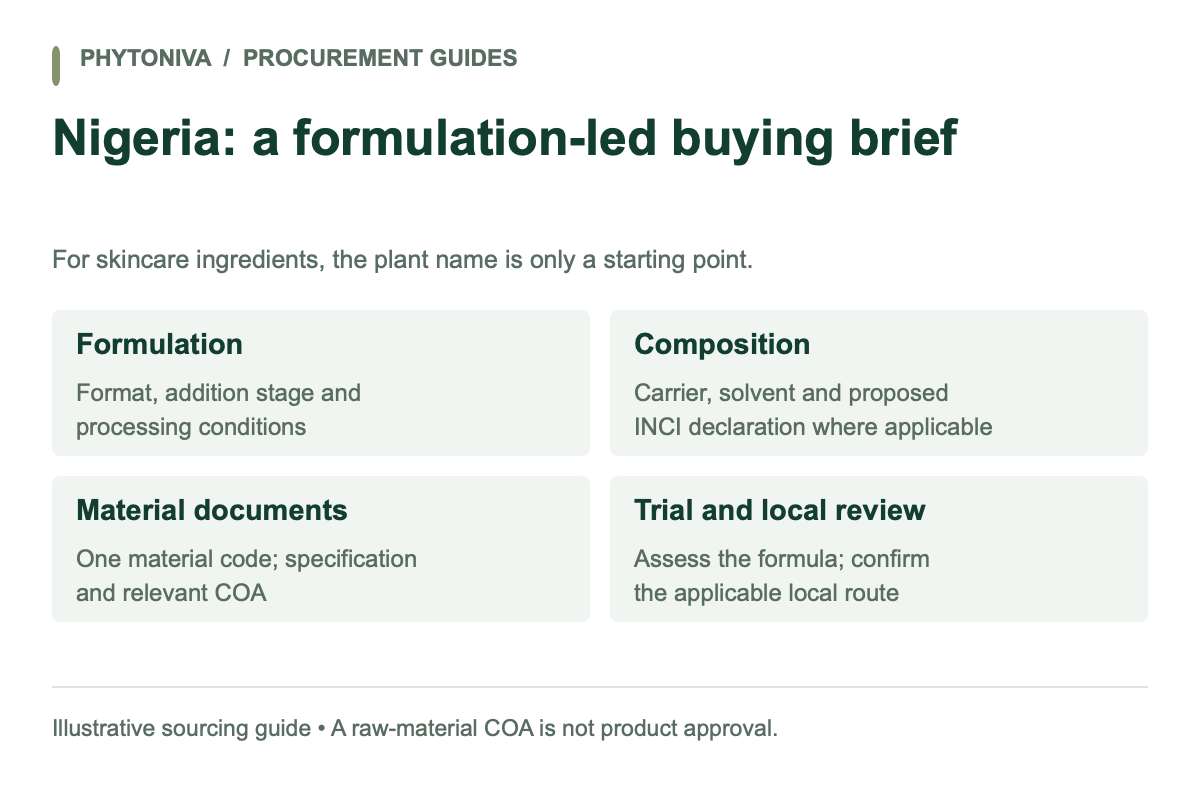
- Formulation: describe product format, addition stage and processing conditions.
- Composition: confirm the carrier or solvent system and proposed INCI declaration where applicable.
- Documents: keep the specification and relevant COA linked to one material code.
- Trial and local review: evaluate the intended formula and confirm the applicable local route; a raw-material COA does not approve the finished cosmetic.
For an independent skincare brand, a useful first order is one that can be evaluated and repeated. This guide helps you prepare a purchasing brief for a formulator, contract manufacturer or ingredient sourcing partner.
Describe the formulation before choosing an extract
Tell the supplier whether your project is a cleanser, cream, serum, soap or another format. Include the intended addition stage, processing conditions and any restrictions set by your formulator. Ask for the technical information relevant to that particular grade rather than assuming all extracts from the same plant behave alike.
For example, when enquiring about green tea extract or turmeric extract, specify that you are evaluating the material for a cosmetic formulation. The name alone does not confirm compatibility with your formula, cosmetic suitability or any finished-product performance claim.
Review the full composition and carrier
Ask what is supplied in the container: the extract, its carrier or solvent system, and any added ingredients. Request the proposed INCI declaration where applicable and check it against the full composition with the person responsible for your label.
- Is the proposed grade a powder, liquid or another form?
- What carrier, solvent or preservative is declared?
- What solubility or dispersion information is available for that grade?
- What storage and handling conditions does its documentation specify?
- Which changes in composition would require a fresh sample evaluation?
These questions give a supplier something specific to answer. A broad description such as “natural extract” leaves too much undecided for a purchase order.
Build the document file around one material code
Keep the technical specification, relevant COA and available safety information under the same material name or code. Review declared identity, appearance, analytical results and test methods. Ask for microbiological and contaminant information appropriate to your formulation review rather than relying on a single headline assay.
Where you need a certification or declaration, identify it in the enquiry. Confirm its scope and named holder. A supplier’s marketing image is not the same as the applicable document for the material you are buying. Our quality and documentation guide provides a starting checklist.
Use the sample in your actual development process
Agree what a successful trial will look like before ordering the sample. Your formulator can define the relevant observations and tests for the intended product, packaging and storage conditions. Record the sample identification, formula revision and evaluation results together.
Checking only the ingredient’s colour or smell does not establish that the finished formula is ready to sell. Ask your formulator what additional compatibility, stability, microbiological or safety assessment your product needs. Keep that assessment separate from the supplier’s raw-material COA.
Plan a trial order that you can realistically use
Estimate the material required for development and the first planned production run. Ask for sample terms and trial-order pricing separately from later reorder pricing. Confirm packing size, whether the quoted quantity is net material weight, and the remaining shelf-life information available for the offered batch.
For delivery to Lagos, Abuja or another destination, state the exact delivery point and ask for freight inclusions and exclusions. Have your local importing partner confirm the applicable requirements for the shipment before dispatch. Avoid committing to more material solely to reach a lower unit-price tier.
Keep Nigerian product and import checks distinct
NAFDAC provides official resources for product registration and import-permit services. Confirm the route applicable to your raw material and finished cosmetic with the responsible local party; one should not be assumed to cover the other. Use the NAFDAC service portal to locate the relevant current service. This guide does not assert NAFDAC approval for any PHYTONIVA ingredient.
Questions before you request a quote
Can I buy a food or supplement extract for a skincare formula?
Do not decide from the product name alone. Request the specific grade’s composition and technical documents, and have your cosmetic formulator review suitability for the intended use.
Can a small brand request a trial quantity?
Yes, you can state your actual requirement and ask which options can be quoted. Availability, MOQ and sample conditions need confirmation for the selected material.
Request a formulation-focused quotation
Send the ingredient name, product format, carrier restrictions, required documents, trial quantity and Nigerian delivery city. PHYTONIVA coordinates ingredient sourcing and trade; the offered grade and commercial conditions are confirmed individually.
Send your botanical extract enquiry, or explore the ingredient catalogue before preparing your brief.
Sourcing coordination and quality checks
PHYTONIVA manages trade, sourcing and supplier coordination, matching ingredients and supply options to your specification, application and destination. The manufacturing partner provides its COA and relevant quality documents. Before procurement and dispatch, we arrange independent third-party quality testing and obtain the report for the agreed testing scope.
Specifications, sampling, test scope, methods and acceptance criteria are agreed before ordering. The manufacturer COA and agreed third-party test report accompany the shipment. Certification is checked separately for the named holder, product and valid scope.
See our quality and documentation process