Menu
Rutin Powder: Features, Benefits and Uses
Rutin powder offers a defined flavonoid ingredient for teams developing botanical formulations and investigating antioxidant responses or cardiometabolic health. Rutin’s appeal is more specific than a broad “plant extract” label: it has an identifiable chemical structure, measurable content and formulation characteristics that can be compared between proposed supplies. Human research has produced both encouraging and neutral findings, making the preparation and intended application important.
PHYTONIVA helps small brands, ingredient distributors and formulation teams compare suitable products and supply options against their specification, application, budget and destination. Sample orders are welcome, and MOQ can be discussed according to the grade, packaging and supply conditions.
What is rutin?
Rutin, also called rutoside or quercetin-3-O-rutinoside, is a flavonol glycoside. Its structure combines a quercetin component with the sugar unit rutinose, which contains glucose and rhamnose. This distinguishes it from quercetin without that sugar group. ChEBI chemical identity record.
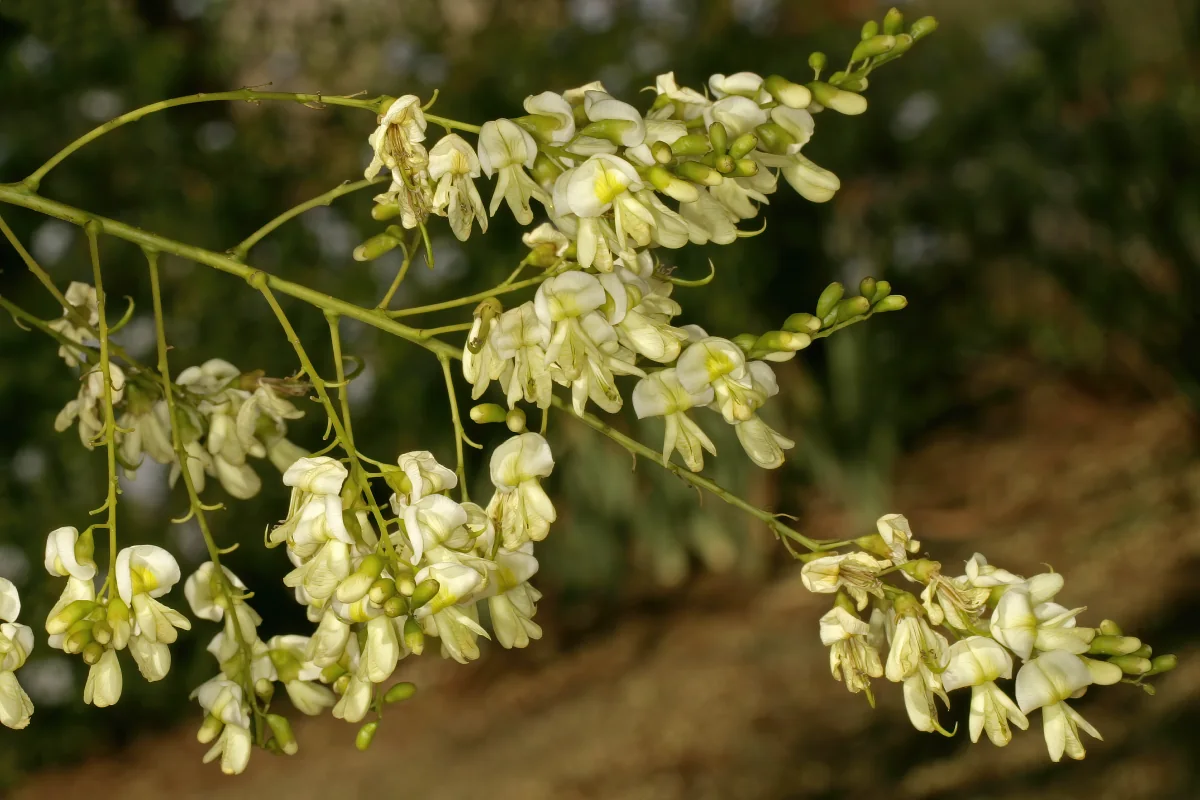
One botanical example is the flower bud of Styphnolobium japonicum, also known as Sophora japonica. The USP Japanese Sophora Flower Bud monograph identifies rutin among its constituents. A photograph of the flowering plant provides botanical context; it does not identify the source or harvested part of a proposed commercial batch. Confirm those details for the actual supply.
Concentrated rutin powder is also different from a whole botanical powder or a broad extract measured only for total flavonoids. Troxerutin and other hydroxyethylrutosides are chemically modified derivatives, not interchangeable names for unmodified rutin. Studies of those derivatives should not be used as direct evidence for ordinary rutin powder. Original analytical study on the derivatives.
What benefits are researchers investigating?
Blood pressure and antioxidant responses: a preliminary clinical signal
A double-blind trial in 50 adults with type 2 diabetes compared rutin with placebo for three months, alongside usual prescribed treatment. The methods describe tablets delivering 500 mg of rutin daily. Researchers reported more favorable changes in systolic and diastolic blood pressure and two antioxidant enzymes, SOD and GPx, with rutin. This small, short study supports further investigation in that population; it does not establish a general blood-pressure benefit or a replacement for prescribed medicines. Original clinical trial.
Antioxidant interest does not mean every human endpoint improves
In a separate six-week placebo-controlled study of 18 healthy women, 500 mg/day rutin increased measured plasma flavonoids but did not significantly change plasma antioxidant status. The useful distinction is between exposure to flavonoid metabolites and a demonstrated improvement in the selected health endpoint. A laboratory antioxidant label alone cannot answer the second question. Original human supplementation study.
Metabolic research: an important neutral result
A 12-week randomized trial enrolled 87 adults with overweight but without diabetes. Rutin at 500 mg/day, supplied in capsules or yoghurt, did not improve the pancreatic beta-cell response to an oral glucose challenge or significantly change overall gut bacterial community composition. This tested different people and outcomes from the blood-pressure trial. It is not evidence that rutin prevents diabetes, despite interest from earlier experimental research. Original metabolic-health trial.
For product development, these studies help define a research question rather than a ready-made finished-product claim. Match the ingredient identity, formulation, intended users and outcome to the supporting evidence. Study quantities are context, not directions for use; the cited trials do not establish long-term suitability for every population.
Why dissolution matters as much as assay
Rutin’s limited aqueous solubility makes formulation a practical selection issue. In a 2025 laboratory study, a lactose-based solid dispersion accelerated rutin dissolution compared with unformulated rutin. The work tested specific carriers and dissolution conditions, not clinical absorption in people. It illustrates how a formulation can change release behavior without making a higher assay percentage the answer to every development problem. Original formulation study.
A 95% content specification therefore does not mean “instant water-soluble.” Nor does a powder that disperses visually necessarily form a true solution. Ask what the proposed material does at your intended concentration and processing conditions, and distinguish a plain ingredient from a formulated dispersion with additional carriers.
How can buyers evaluate a rutin formulation?
- Capsules and tablets: compare assay, particle size, flow, blend uniformity and dissolution behavior. Check that the proposed grade and excipients fit the intended serving and manufacturing process.
- Powder blends or sachets: assess mixing uniformity, appearance, moisture behavior and sensory effects using a representative sample. Specify whether the intended product is swallowed as a powder, suspended or dissolved.
- Liquid development: test the actual concentration, pH, processing temperature and storage conditions. Monitor sedimentation and assay over time; do not describe an ordinary grade as beverage-ready without evaluation.
For a small launch, start with an achievable sample test plan: define the composition you need, the format you will make and the acceptance criteria. Compare candidates under the same conditions. Confirm the suitability of the ingredient, use and proposed claims for the destination market before commercializing the finished product.
Comparing a 95% rutin reference specification
Our supplier reference catalogue lists rutin 95%. This is a reference specification, not an inventory statement, extraction ratio or guarantee of a particular clinical effect. Confirm the actual offered assay, botanical source, plant part, extraction or purification process and any added carriers.
Specify the identity test, assay method, reference standard and reporting basis, including how moisture or hydration is treated. A dry-basis result and an as-supplied result should not be compared without that context. Discuss the impurity, residual-solvent and other quality requirements relevant to the intended order.
The legacy catalogue notation “NF-11” needs confirmation of its meaning and edition. It does not establish current USP–NF compliance. If a compendial grade is required, identify the exact standard and agree how conformity will be demonstrated.
View the rutin catalogue entry.
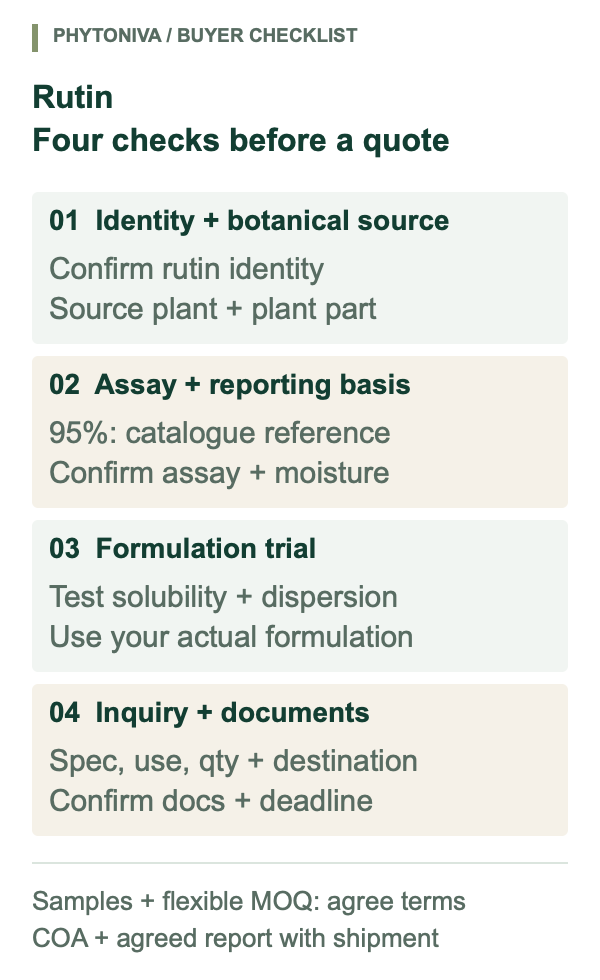
Rutin: four checks before a quote
Identity + botanical source
Confirm the proposed rutin identity (quercetin-3-O-rutinoside), source plant, plant part and extraction or purification process. Keep the specification distinct from quercetin or troxerutin and declare any carrier or other added ingredients.
Assay + reporting basis
Rutin 95% is a catalogue reference; confirm the offered specification and availability, assay method, reference standard and reporting basis. Check whether the result is reported on a dry or as-is basis and how water content or loss on drying is measured. The legacy catalogue label NF-11 is unverified and does not establish pharmacopoeial compliance. If that grade is required, agree the exact monograph, edition, tests and supporting documents.
Formulation trial
Evaluate dissolution and dispersion in the actual formulation. Define the solvent or matrix, concentration, pH, temperature and processing conditions for the sample trial, then assess sedimentation, appearance and stability against the project criteria.
Inquiry + documents
Send the specification, intended use, quantity, destination, required shipment documents and deadline. Sample orders are welcome; flexible MOQ, sample costs and packaging are agreed according to requirements and supply conditions. The manufacturer COA and agreed third-party test report accompany the shipment.
Frequently asked questions
Can I replace quercetin or troxerutin with rutin?
Not on a name or weight-for-weight assumption. These are different chemical materials. Reassess the formulation, evidence and specification rather than transferring a claim or dose between them.
Does a higher rutin assay guarantee better absorption?
No. Assay describes composition; absorption also depends on the preparation and biological context. Evaluate the formulation instead of using the content number as an absorption claim.
Can I begin with a sample or smaller order?
Yes, sample-order enquiries are welcome. Tell us what you need to evaluate. Sample quantity, charges, packaging and availability are agreed for the proposed option; subsequent MOQ is discussed around the specification and supply conditions.
Who handles quality testing and documents?
PHYTONIVA coordinates trade, procurement and supply resources; the manufacturer provides its COA. We arrange independent third-party quality testing before procurement and dispatch. Before ordering, agree sampling, test scope, methods and acceptance criteria. The manufacturer COA and agreed third-party report accompany the shipment; we do not currently provide presale COA samples or public COA downloads. A report covers its stated sample and test scope. Certification is checked separately for its holder, product and valid scope. See our quality coordination workflow.
Discuss your rutin powder requirements
Send your required identity and assay, intended formulation, quantity, destination, shipment-document needs and timing. Include any botanical-source or compendial requirements, so we can help match the ingredient and supply arrangement to your project.
Request a quotation · sales@phytoniva.com · WhatsApp +86 19991898850
Sourcing coordination and quality checks
PHYTONIVA manages trade, sourcing and supplier coordination, matching ingredients and supply options to your specification, application and destination. The manufacturing partner provides its COA and relevant quality documents. Before procurement and dispatch, we arrange independent third-party quality testing and obtain the report for the agreed testing scope.
Specifications, sampling, test scope, methods and acceptance criteria are agreed before ordering. The manufacturer COA and agreed third-party test report accompany the shipment. Certification is checked separately for the named holder, product and valid scope.
See our quality and documentation process