Menu
Rose Hip Extract: Benefits, Specifications and Wholesale Buying
Rose hip extract sourcing starts with the marker you need: polyphenols, flavonoids or vitamin C. A supplement brand, beverage developer or ingredient distributor may need a different specification from another buyer, even when both enquire about “rosehip.” PHYTONIVA helps match those requirements with manufacturing partners. Sample orders are welcome, with MOQ discussed according to the confirmed grade, packaging and supply conditions.
Rose hip extract benefits: separate the evidence from the ingredient name
A randomized, double-blind crossover trial enrolled 94 people with hip or knee osteoarthritis and tested a particular Rosa canina seed-and-shell powder at 5 g daily during three-month treatment periods. The researchers reported lower pain scores than placebo after three weeks. The original trial abstract describes the preparation and outcomes. This was a powder study in a defined patient population, not proof that a generic polyphenol-standardized extract treats joint disease.
The purchasing implication is straightforward: match species, plant parts, preparation and composition before connecting a commercial ingredient to a study. One relatively small trial cannot establish broad benefits for every rose hip grade, application or consumer. Laboratory antioxidant results also should not be presented as demonstrated human treatment effects.
Vitamin C has established roles in collagen formation, antioxidant protection and immune function, as explained by the NIH Office of Dietary Supplements. Those nutrient functions do not establish clinical benefits for a particular rose hip extract. Buyers need to know how much vitamin C the selected ingredient actually delivers in the finished formulation.
Polyphenols, flavonoids and vitamin C specifications
Our supplier reference catalogue lists rose hips extract with polyphenols at 5–20%, flavonoids at 5–10%, and vitamin C at 5–10%. Treat these as specification options for enquiry. They are not confirmation that every offered grade meets all three ranges simultaneously, that every concentration is available, or that stock is ready for dispatch.
Swipe or scroll horizontally to view the full table.
| Catalogue marker | Listed range | Clarify in your enquiry |
|---|---|---|
| Polyphenols | 5–20% | Analyte definition, test method, calibration standard and reporting basis. |
| Flavonoids | 5–10% | Exact assay definition and whether this is a separate grade or an additional specification. |
| Vitamin C | 5–10% | Test method, declared source, any added ascorbic acid and stability documentation. |
The catalogue alone does not identify the botanical species, seed inclusion, extraction solvent or carrier content for a proposed batch. Request these details rather than assuming that the ingredient is Rosa canina or matches a research preparation. A percentage without its method and basis is insufficient for comparing quotations.
If naturally occurring vitamin C is central to your product brief, state that explicitly and ask for composition documentation. Do not infer “no added vitamin C” from the words “rose hip extract.” Our extract carrier checklist helps clarify what is included in the supplied powder.
Choosing an extract, fruit powder or another form
Specify whether you want a standardized extract or a fruit powder; these are separate procurement briefs. An extraction ratio alone does not state the concentration of a particular marker. Likewise, do not substitute a rose hip oil specification for a dry extract specification. Compare the actual composition and process, not just the product name.
For beverage trials, ask for solubility or dispersibility information and evaluate taste, colour and sediment in your own formulation. For capsules or tablets, define the particle-size and powder-handling requirements relevant to production. These are evaluation questions, not claims that every rose hip grade performs the same way.
NIH notes that vitamin C can be reduced by heat and prolonged storage. If vitamin C content matters to your finished product, request supporting stability information and test under your intended processing, packaging and storage conditions. An ingredient’s initial assay does not by itself establish the finished product’s end-of-shelf-life content.
Quality documents, sample orders and flexible MOQ
Compare the technical specification and agree the testing scope before ordering. The manufacturer COA and agreed third-party test reports are provided with the shipment. Agree botanical identity, assay, microbiological, heavy-metal, pesticide and residual-solvent requirements with your quality team. Where a certification is required, confirm the certificate holder, validity and scope for the selected factory and product.
Sample orders are welcome for formulation assessment or independent testing. Send the sample quantity and expected commercial volume together. MOQ depends on the grade, packaging, production arrangements and supplier conditions; it can be discussed against your brief. Sample charges, freight, availability and timing are confirmed individually, and samples are not automatically free.
For US buyers and buyers in African markets, specify the destination country, intended use and required documents. Suitability and finished-product claims require market-specific review. Our MOQ and sample-order guide explains how to prepare a useful request.
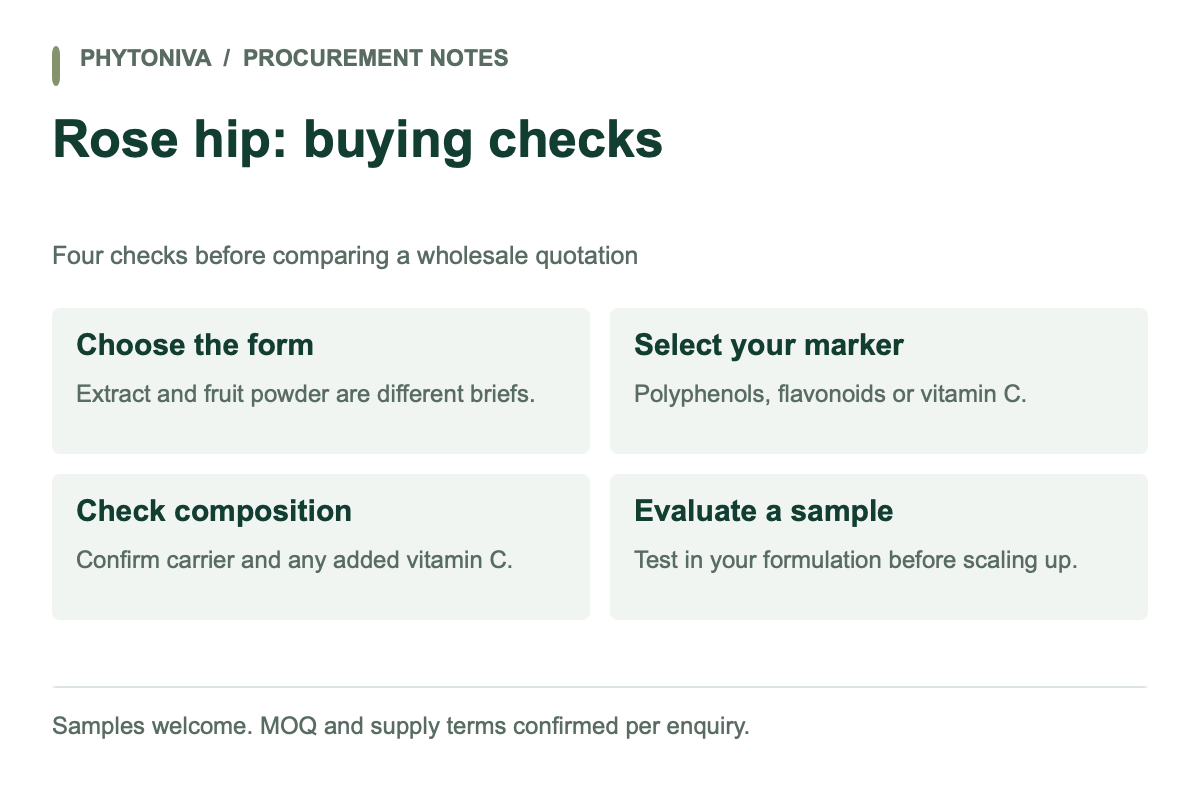
- Choose the form: Extract and fruit powder are different briefs.
- Select your marker: Polyphenols, flavonoids or vitamin C.
- Check composition: Confirm carrier and any added vitamin C.
- Evaluate a sample: Test in your formulation before scaling up.
Frequently asked questions
Does a 20% polyphenol extract also contain 10% vitamin C?
Not necessarily. Confirm each required marker separately in the agreed specification and COA. The catalogue ranges are not a combined formula.
Can I use a rose hip powder study to claim benefits for an extract?
Not automatically. The tested preparation and proposed ingredient must be compared, and any intended claim needs appropriate evidence and review. A shared botanical name is not proof of equivalence.
Can I start with a small sample order?
Yes, sample-order enquiries are welcome. Share the target specification, application, quantity and destination so sample terms and a suitable sourcing option can be discussed.
What information is needed for a wholesale quotation?
Provide the species and plant-part requirements, desired form, marker target and method, use, sample and commercial quantities, packaging, destination, documents and deadline. Identify requirements that are still undecided.
Request a rose hip extract quotation
Browse our rose hip extract in the ingredient catalogue, email sales@phytoniva.com, or message PHYTONIVA on WhatsApp. A clear purchasing brief helps us discuss suitable manufacturing partners, sample arrangements and a specification-based quotation.
Sourcing coordination and quality checks
PHYTONIVA manages trade, sourcing and supplier coordination, matching ingredients and supply options to your specification, application and destination. The manufacturing partner provides its COA and relevant quality documents. Before procurement and dispatch, we arrange independent third-party quality testing and obtain the report for the agreed testing scope.
Specifications, sampling, test scope, methods and acceptance criteria are agreed before ordering. The manufacturer COA and agreed third-party test report accompany the shipment. Certification is checked separately for the named holder, product and valid scope.
See our quality and documentation process