Menu
Rhodiola Rosea Extract: Research, Salidroside and Bulk Buying
Rhodiola rosea extract is often considered for botanical formulations positioned around stress and fatigue. For an ingredient buyer, the useful questions are more specific: which species and plant part are offered, what does the marker assay measure, and how closely does the material match the preparation studied? Research findings do not make all rhodiola extracts interchangeable.
PHYTONIVA’s sourcing reference lists salidroside grades of 1%, 2% and 3%. These are catalogue references, not a stock commitment or a guarantee of rosavins content. We help small brands, distributors and formulation teams compare suitable manufacturers and products. MOQ is negotiable according to specification, packaging and supply conditions; sample-order enquiries are welcome.

Confirm Rhodiola rosea identity and the actual plant part
“Rhodiola” alone is not a complete purchasing specification. State the required Latin name, such as Rhodiola rosea L., rather than treating different Rhodiola species as interchangeable. Salidroside can occur in other species; its percentage alone cannot authenticate R. rosea. A primary analytical study of several Rhodiola species and commercial products illustrates why identity and chemical-profile assessment matter alongside marker quantification.
The European Medicines Agency monograph concerns rhizome and root preparations. Our catalogue does not confirm the actual part used in each offered grade. Confirm the source species, root/rhizome or other declared part, extraction solvent, extract ratio and carrier composition in the technical data sheet (TDS). The photograph is a licensed reference of dried root material, not evidence of our offered batch or manufacturing process.
See the rhodiola extract catalogue entry, then request the identity and specification of the proposed material.
Rhodiola extract benefits research: useful signals, limited certainty
Stress-related fatigue is a research area, not a guaranteed result
EMA’s 2024 monograph describes traditional use of particular rhodiola root and rhizome preparations for relief of stress symptoms such as fatigue and exhaustion. It is based on long-standing use, rather than sufficient clinical evidence to establish efficacy. NCCIH’s rhodiola overview likewise states that reliable evidence is insufficient to determine whether rhodiola is useful for any health-related purpose.
A 2009 randomized placebo-controlled study enrolled 60 adults with stress-related fatigue for 28 days. The specific SHR-5 root extract showed advantages over placebo on a burnout/fatigue measure and some attention measures. This is a finding for that preparation, population and short study period; it does not establish the same effects for a generic salidroside-standardized ingredient.
Results have not been uniformly positive. In a 2014 randomized trial involving 48 nursing students, the 42-day fatigue outcomes favoured placebo over the study’s rhodiola preparation. These trials should not be pooled informally into a universal efficacy claim. A higher marker percentage is not proof of a stronger clinical effect.
Safety review belongs in formulation development
NCCIH reports possible adverse effects including dizziness, headache and insomnia, and notes reported interactions with losartan. Information during pregnancy and breastfeeding is limited. A finished-product team should assess the actual preparation, intended users, co-ingredients and proposed claims. This article supports ingredient purchasing; it does not provide treatment or dosing instructions.
Salidroside and rosavins: ask for separate specifications
Salidroside and rosavins are different specifications. Rosavins commonly refers to rosavin, rosarin and rosin; a primary chromatography study quantified those compounds separately from salidroside and other rhodiola constituents. Ask the supplier to define which compounds are included in a reported total and which method is used.
- Listed salidroside grades: our reference lists 1%, 2% and 3%. Confirm the offered grade, acceptance limit and assay method; do not assume every intermediate strength is available.
- Rosavins requirement: specify it separately if your formulation needs it. The listed salidroside grades do not establish a rosavins guarantee or a combined 3% rosavins / 1% salidroside specification.
- Reporting basis: establish dry basis or as-supplied basis, treatment of moisture, reference standards and the method’s ability to distinguish the markers.
- Complete composition: confirm the extract ratio where relevant, solvent, carriers and other ingredients. Evaluate colour, flavour, particle properties and dispersion in your own formulation.
- Identity evidence: ask how the botanical source and chemical profile are checked. One assay result, a photograph or a familiar trade name cannot establish the whole identity and quality case.
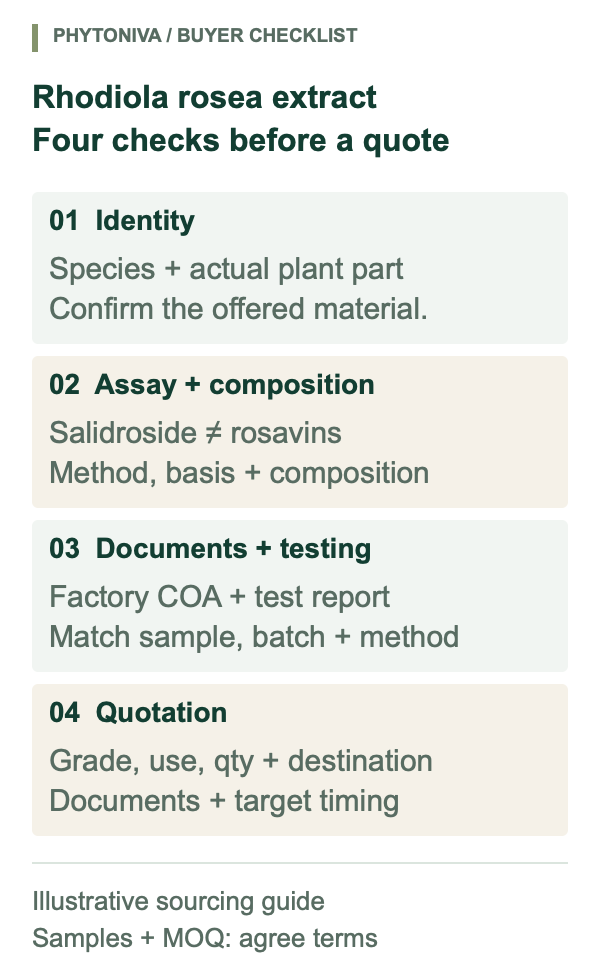
Rhodiola rosea extract: four checks before a quote
Identity
Confirm the identity of the offered Rhodiola rosea material and its actual plant part, including whether roots, rhizomes or another part are used. Check the relevant supplier documents; do not assume that other Rhodiola species or different plant parts are interchangeable.
Assay + composition
The supplier catalogue lists salidroside at 1%, 2% and 3% as sourcing references, not guaranteed available grades or stock. A salidroside specification does not establish a rosavins specification. Define each required marker separately, and confirm the analytical method, reference standard and reporting basis. Also confirm extraction solvent, extraction ratio, any carrier and full composition.
Documents + testing
The manufacturer provides the relevant batch certificate of analysis (COA) and technical data sheet (TDS). PHYTONIVA arranges independent third-party quality testing before procurement and dispatch and obtains the test report. Confirm the sample, batch, test items, methods and acceptance criteria in advance, and match the report to that agreed scope. A factory COA, an independent test report and a certification-body certificate are different documents.
Quotation
Provide the target specification, intended use, quantity, destination country, required documents and timing. Sample orders are welcome. MOQ and sample terms depend on the grade, packaging and supply conditions; sample charges, freight and availability are confirmed individually, without a promise of free samples.
Factory COA, third-party testing and PHYTONIVA’s role
PHYTONIVA manages trade, sourcing coordination and the integration of supply resources. We match manufacturers and products to your specification, application, budget and destination requirements. The manufacturing partner provides its COA and relevant technical documents; these are not COAs independently issued by PHYTONIVA.
Before procurement and dispatch, we commission independent third-party quality testing and obtain the report for the agreed scope. Sampling arrangements, the sample or batch, test items, methods, acceptance criteria, fees and timing are confirmed for the project. This describes our purchasing workflow; it is not a statement that the catalogue grades or all future batches have already passed testing.
A factory COA, an independent test report and a certification document are different records. Match the report to the stated material and tests, and compare the results with the agreed specification. Certification documents must correspond to their holder, product or site scope and validity. Discuss relevant identity, assay, microbiological, contaminant and residue requirements rather than assuming that all possible tests are included. See our quality and documentation process.
Check source and cross-border documentation before shipment
Rhodiola species are listed in CITES Appendix II with annotation #2. The retail-finished-product exception should not be assumed to cover bulk extract. Review the official listing and annotation against the actual species, material form, source and trade route, and confirm the applicable export, re-export and destination requirements before committing to shipment. We do not claim that a catalogue listing establishes a permit or that a COA replaces trade documentation.
For a US purchasing project or a project in a particular African country, identify the destination and finished-product category early. Ingredient eligibility, finished-product claims and shipment documents need their own review. An EMA traditional-use conclusion or sales in another country do not establish authorization for the proposed product in your market.
Flexible MOQ and sample orders for a defined project
Tell us whether you need a laboratory evaluation sample, a formulation trial quantity or a bulk quotation. Explain the target species and part, marker requirements, application, quantity, pack size, destination, documents and timing. If the specification is still being developed, describe what your team wants to evaluate so suitable supply options can be compared.
MOQ, sample charges, freight and delivery timing depend on the agreed specification and supply arrangements. Sample orders are welcome; free samples and immediate stock are not promised. After sample evaluation, record which identity, composition, analytical methods and acceptance limits must carry through to the commercial order.
Rhodiola extract purchasing FAQ
Does salidroside content prove that an extract is Rhodiola rosea?
No. Confirm the botanical identity, actual part and appropriate analytical evidence separately. Salidroside alone is not a complete species-authentication test.
Does a 3% salidroside grade also contain 3% rosavins?
Not necessarily. They are separate measurements. Our listed salidroside grades do not establish any rosavins level; request the required marker combination and the corresponding documents.
Can I request a small sample order?
Yes, sample-order enquiries are welcome. State the evaluation purpose, required specification, quantity and destination. We confirm the supply option, charges, packaging and timing for the project.
Who provides the COA and who arranges independent testing?
The manufacturing partner supplies its COA. PHYTONIVA coordinates procurement and commissions independent third-party testing before procurement and dispatch, obtaining a report for the agreed scope. The two documents must be checked against their respective samples or batches and methods.
Request a rhodiola extract sourcing proposal
Send your requirements through the B2B enquiry form, email sales@phytoniva.com, or contact WhatsApp +86 19991898850. A clear technical brief and destination let us compare more suitable products, manufacturers and purchasing arrangements.
Sourcing coordination and quality checks
PHYTONIVA manages trade, sourcing and supplier coordination, matching ingredients and supply options to your specification, application and destination. The manufacturing partner provides its COA and relevant quality documents. Before procurement and dispatch, we arrange independent third-party quality testing and obtain the report for the agreed testing scope.
Specifications, sampling, test scope, methods and acceptance criteria are agreed before ordering. The manufacturer COA and agreed third-party test report accompany the shipment. Certification is checked separately for the named holder, product and valid scope.
See our quality and documentation process