Menu
Horse Chestnut Extract: Benefits, Specifications and Wholesale Buying
Horse chestnut extract sourcing requires more than an aescin percentage. Small brands, contract manufacturers and ingredient distributors need to establish botanical identity, seed material, processing and safety documentation before comparing quotations. PHYTONIVA helps match purchasing requirements with suitable manufacturing partners. Sample orders are welcome, and MOQ can be discussed against the confirmed specification, packaging and supply conditions.
Horse chestnut extract benefits: evidence and limits
The most relevant human research concerns standardized horse chestnut seed extracts for chronic venous insufficiency, a condition affecting blood return from the legs. NCCIH summarizes a review of 17 studies that suggested improvement in symptoms, while noting the need for larger, more rigorous trials. Evidence for other promoted applications is insufficient for firm conclusions. This does not establish that every commercial horse chestnut powder has equivalent effects. See the NCCIH evidence and safety summary.
The European Medicines Agency monograph concerns Aesculus hippocastanum L., seed. Its assessment is not approval of a PHYTONIVA ingredient or a substitute for checking the proposed grade. A buyer should match species, part, extraction and standardization to the evidence being considered. Do not transfer findings to another species, an unprocessed powder or a different plant part.
Aescin specifications: what does 20–40% mean?
Our supplier reference catalogue lists horse chestnut extract with an aescin specification range of 20–40%, using the spelling “Aescine.” This is a catalogue indication for enquiry, not a guarantee of every concentration in that range, current stock or a confirmed batch result. The catalogue alone does not establish the exact botanical species, seed-only status, analytical method or toxic-component control for a particular grade.
Swipe or scroll horizontally to view the full table.
| Specification item | What to request | Why it matters |
|---|---|---|
| Botanical identity and part | Full Latin name and a seed-material statement | Confirms whether the proposed material matches the purchasing brief and relevant evidence. |
| Aescin assay | Exact analyte definition, method, reference standard and acceptance limit | Makes quotations and COA results comparable. |
| Reporting basis | Whether the percentage describes the supplied powder, dry matter or another basis | Avoids comparing unlike concentration figures. |
| Composition and processing | Extraction solvent, carrier content and product-specific safety controls | Defines what is actually supplied beyond the marker percentage. |
A higher printed assay is not automatically the better formulation choice. Agree the analytical specification and review representative documentation first. Our extract carrier checklist helps buyers clarify carrier content and assay basis.
Safety documentation is a purchasing requirement
NCCIH warns that raw horse chestnut seeds, bark, flowers and leaves are unsafe to take orally because of a toxic component. Its short-term safety discussion concerns standardized seed extracts with that component removed, not untreated material. Reported side effects include digestive upset, dizziness, headache and itching; pregnancy and breastfeeding safety is uncertain. These distinctions must remain visible when evaluating an ingredient.
Before an oral-use project proceeds, ask for product-specific evidence of appropriate processing and toxic-component control, with agreed test methods and limits reviewed by your qualified safety or regulatory adviser. A high aescin result alone is not that evidence. Do not assume the catalogue grade is ready for oral use without this review.
During evaluation, confirm the technical specification and testing scope before ordering. The manufacturer COA and agreed third-party test reports are provided with the shipment. Agree relevant microbiological, heavy-metal, pesticide and residual-solvent requirements. Where certification is needed, check the certificate holder, validity and scope for the proposed factory and product; do not treat one certificate as coverage of every grade.
Sample orders and flexible MOQ for small buyers
Start with your intended application and evaluation plan. A capsule, tablet or topical formulation may require different technical checks. Describe powder-handling, particle-size, dispersibility or other requirements relevant to your project, and evaluate the proposed sample in your own formulation. Do not infer solubility or suitability for a particular route of use from the ingredient name.
PHYTONIVA welcomes sample-order enquiries. MOQ depends on the confirmed grade, packaging, production arrangements and supplier conditions. Share both your sample quantity and expected commercial volume so practical options can be discussed. Sample charges, freight, availability and timing are confirmed per enquiry; samples are not automatically free.
For US buyers and buyers in African markets, name the specific destination country and intended use. Documentation and finished-product claims need to be evaluated for that market. See our MOQ and sample-order guide to prepare your request.
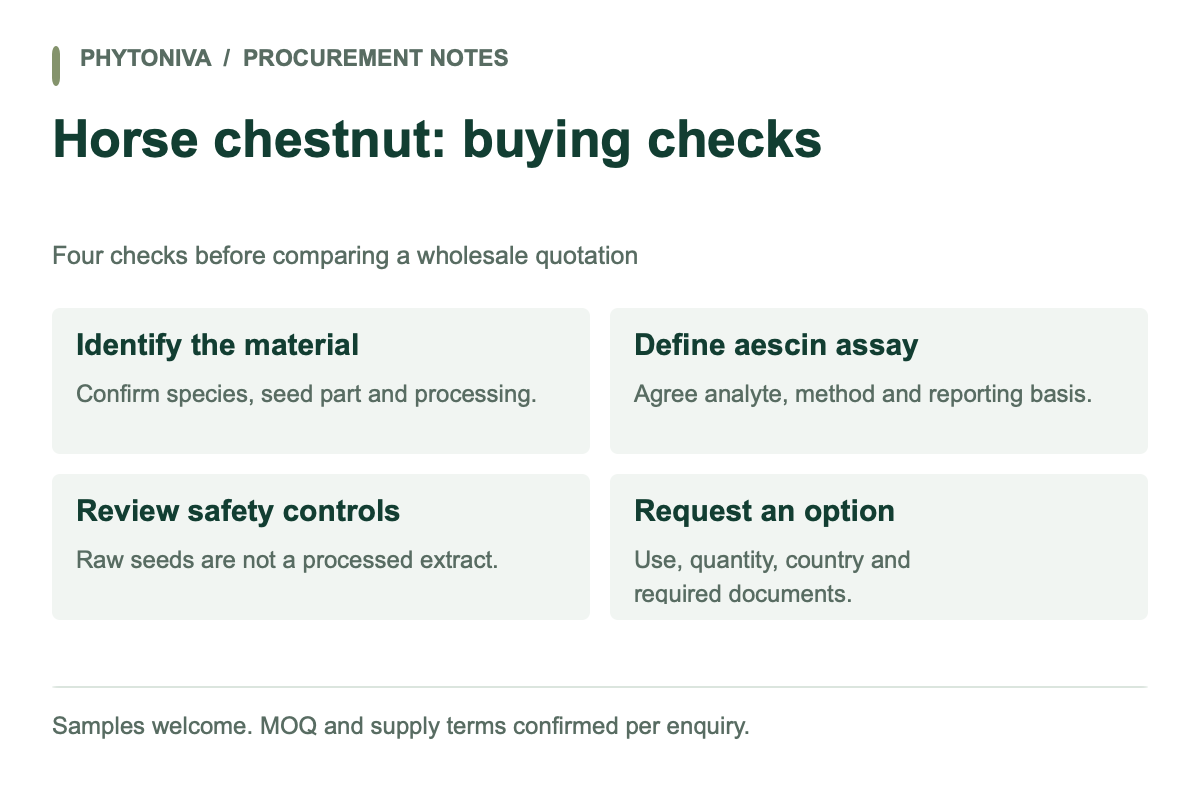
- Identify the material: Confirm species, seed part and processing.
- Define aescin assay: Agree analyte, method and reporting basis.
- Review safety controls: Raw seeds are not a processed extract.
- Request an option: Use, quantity, country and required documents.
Frequently asked questions
Can I replace standardized seed extract with raw horse chestnut powder?
No. Raw material is not interchangeable with a processed extract, particularly for oral use. The safety distinction described above is essential, not just a difference in concentration.
Does 20% aescin prove that a product matches clinical research?
No. Species, plant part, extraction, composition, analytical method and safety controls must also be assessed. A marker percentage is not proof of clinical equivalence or a treatment claim.
Can I order a small sample before a commercial purchase?
Yes, sample orders are welcome for discussion. Send your target specification, use, quantity, destination and documents required. Supply and sample arrangements remain subject to confirmation.
What should I include in a wholesale enquiry?
Provide botanical species and seed-part requirements, aescin target and method, intended use, sample and commercial quantities, packaging, destination country, required documentation and deadline. Identify requirements that are still undecided so options can be evaluated.
Request a horse chestnut extract quotation
Browse our botanical ingredient catalogue, email sales@phytoniva.com, or contact PHYTONIVA on WhatsApp. Clear requirements let us discuss a documented sourcing option, suitable sample arrangements and realistic order conditions with you.
Sourcing coordination and quality checks
PHYTONIVA manages trade, sourcing and supplier coordination, matching ingredients and supply options to your specification, application and destination. The manufacturing partner provides its COA and relevant quality documents. Before procurement and dispatch, we arrange independent third-party quality testing and obtain the report for the agreed testing scope.
Specifications, sampling, test scope, methods and acceptance criteria are agreed before ordering. The manufacturer COA and agreed third-party test report accompany the shipment. Certification is checked separately for the named holder, product and valid scope.
See our quality and documentation process