Menu
Hawthorn Leaf Extract: Benefits, Specifications and Wholesale Buying
Buying hawthorn leaf extract starts with the plant part and test method—not just a percentage. For small supplement brands, formulators and ingredient distributors, a useful quotation identifies the botanical species, leaf-only material, extraction process and marker assay before comparing price. PHYTONIVA helps buyers match their requirements with suitable manufacturing partners; MOQ and sample orders can be discussed against the requested specification and supply conditions.

Hawthorn leaf extract benefits: what the research actually supports
Hawthorn has been investigated for cardiovascular applications, but evidence is not a blanket endorsement of every hawthorn ingredient. The US National Center for Complementary and Integrative Health reports conflicting findings in heart failure and insufficient evidence for several other cardiovascular conditions. It also finds no evidence supporting weight loss. These findings do not establish clinical benefits for a generic commercial leaf extract. See the NCCIH hawthorn evidence and safety summary.
Plant part matters when interpreting research. The European Medicines Agency assessment concerns hawthorn leaf and flower preparations from specified Crataegus species. A leaf-only ingredient should not automatically inherit conclusions about a leaf-and-flower preparation, and neither should be treated as interchangeable with fruit extract.
For a purchasing team, the practical question is whether the material in a study matches the proposed ingredient in species, plant part, extraction and standardization. A marker assay is useful for quality control; it does not by itself prove a health outcome. Avoid turning laboratory observations or traditional use into a guaranteed benefit for a finished product.
Which hawthorn leaf extract specifications should you compare?
Our supplier reference material lists the following specification options for enquiry. These are catalogue indications, subject to confirmation of the actual grade, test method and current supply; they are not a promise that every concentration in a range is available or that all three markers are guaranteed in one product.
Swipe or scroll horizontally to view the full table.
| Catalogue marker | Listed specification | What to confirm before ordering |
|---|---|---|
| Total flavonoids, catalogue wording “Flavones” | 25–80% | Exact analyte definition, analytical method, reference standard and reporting basis. |
| Vitexin-2-rhamnoside | 2–9% | Exact chemical identity, assay method and whether this is a separate grade. |
| Vitexin | 2% | Marker identity, acceptance limit and representative certificate of analysis. |
Do not add these percentages together or compare them as equivalent measures. Ask whether results apply to the supplied powder or a dry/native-extract basis, and request a composition statement identifying any carrier. Our botanical extract carrier checklist explains the purchasing questions to ask.
A purchasing checklist for a comparable quotation
- Identity: specify the full botanical name and leaf-only material. If your formulation requires leaf and flower or fruit, state that separately.
- Process and composition: request extraction solvent information, extract ratio where applicable, carrier content and a technical data sheet.
- Quality criteria: agree marker assay, test method and limits for microbiology, heavy metals, pesticides and residual solvents appropriate to your intended use and destination.
- Formulation fit: describe the intended capsule, tablet or other formulation. Request relevant powder properties and test a representative sample in your own process; do not assume beverage solubility.
- Documentation: agree the specification and test requirements before ordering. The manufacturer COA and agreed third-party test reports are provided with the shipment. Where certification is required, confirm the certificate holder, validity and product scope.
For US buyers and buyers in African markets, include the actual destination country and intended use in the enquiry. A certificate or an existing sale in another country does not establish suitability for your project. Your importer or regulatory adviser should assess the proposed ingredient and finished-product claims for that destination.
Flexible MOQ and sample orders
PHYTONIVA welcomes sample-order enquiries and small trial-order discussions. MOQ depends on the confirmed grade, packaging, production arrangements and supplier conditions. We do not publish one universal minimum or promise free samples. Tell us your evaluation quantity and expected commercial volume so the sample cost, shipping, packaging and possible next-order options can be discussed together.
Use our MOQ, samples and trial-order guide to prepare a clear request. Browse the botanical ingredient catalogue for related sourcing needs.
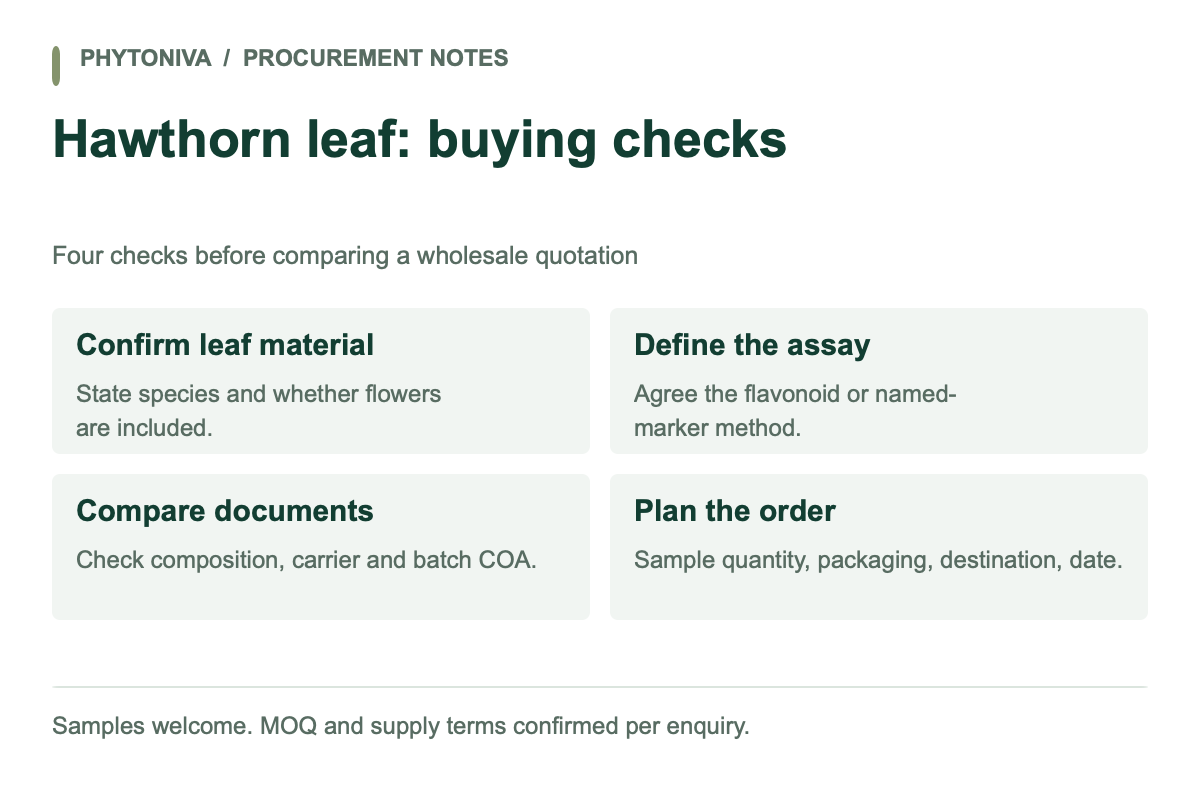
- Confirm leaf material: State species and whether flowers are included.
- Define the assay: Agree the flavonoid or named-marker method.
- Compare documents: Check composition, carrier and batch COA.
- Plan the order: Sample quantity, packaging, destination, date.
Frequently asked questions
Is hawthorn leaf extract the same as hawthorn fruit extract?
No. They use different plant parts. Request separate specifications and supporting evidence rather than substituting one because both are called hawthorn.
Does a higher flavonoid percentage mean a better ingredient?
Not necessarily. First align the method, reporting basis and formulation requirements. The preferred grade is the one that meets your agreed specification and application, not simply the highest printed percentage.
Can this ingredient be promoted as a heart-disease treatment?
This procurement guide does not support that claim. Evidence is preparation-specific and uncertain. NCCIH also notes possible adverse effects and medicine interactions; professional safety assessment is important, especially for products intended for people taking medicines.
What should I send to receive a useful quotation?
Send your species and plant-part requirement, marker specification, application, sample and commercial quantities, packaging, destination country, required documents and delivery timeline. If a detail is undecided, explain the intended product so options can be evaluated.
Request a hawthorn leaf extract quotation
Email sales@phytoniva.com or contact PHYTONIVA on WhatsApp. Include your requirements and purchasing conditions; we will use them to discuss suitable sourcing options, sample arrangements and an achievable order specification.
Sourcing coordination and quality checks
PHYTONIVA manages trade, sourcing and supplier coordination, matching ingredients and supply options to your specification, application and destination. The manufacturing partner provides its COA and relevant quality documents. Before procurement and dispatch, we arrange independent third-party quality testing and obtain the report for the agreed testing scope.
Specifications, sampling, test scope, methods and acceptance criteria are agreed before ordering. The manufacturer COA and agreed third-party test report accompany the shipment. Certification is checked separately for the named holder, product and valid scope.
See our quality and documentation process