Menu
Hawthorn Fruit Extract: Benefits, Specifications and Wholesale Buying
Hawthorn fruit extract is a separate purchasing category from hawthorn leaf extract and ordinary fruit powder. If you are sourcing for a small supplement brand, a formulation project or ingredient distribution, start by defining the fruit material, processing method and test specification. PHYTONIVA helps match your requirements with suitable manufacturing partners, with sample orders welcomed and MOQ discussed against the actual specification and supply conditions.

Hawthorn fruit extract benefits: research and limitations
Hawthorn fruit has attracted interest for its polyphenols and traditional use in digestion-related preparations. That background is not proof that a commercial powder treats digestive or cardiovascular disease. A 2024 randomized, double-blind crossover trial studied a sweetened Crataegus pinnatifida fruit extract drink in people with mildly elevated blood pressure and/or blood lipids. The researchers did not find significant effects compared with placebo. The beverage formulation and additional calories also limit how the results can be applied to another ingredient. See the original hawthorn fruit drink trial.
The broader NCCIH hawthorn summary reports limited quality evidence for most health conditions and conflicting findings in heart failure. It does not establish weight-loss benefits. Research on a particular preparation, leaf-and-flower extract or multi-ingredient formula cannot substantiate the same claims for an unrelated fruit-only ingredient.
For procurement, separate three questions: what compounds are measured, whether the supplied material matches the preparation studied, and what claims are appropriate for your finished product. An assay percentage answers only part of the first question. Laboratory antioxidant activity does not by itself establish a benefit in people.
Fruit extract, fruit powder or leaf extract?
Swipe or scroll horizontally to view the full table.
| Ingredient form | Purchasing distinction | Key question |
|---|---|---|
| Hawthorn fruit extract | Extracted fruit material; composition depends on the process and specification. | Which species, fruit fraction, extraction solvent and marker method define the grade? |
| Hawthorn fruit powder | A separate form whose manufacturing process and composition must be described. | Is it milled fruit, juice-derived powder or another preparation, and does it contain a carrier? |
| Hawthorn leaf extract | A different plant part with its own specification and evidence. | Does the project actually require fruit or leaf material? |
See our hawthorn leaf extract buying guide if leaf material is required. A shared common name is not enough to justify substitution. Confirm the full botanical name on the technical documents; do not assume all hawthorn sources are the same species.
Components and specification checks before a quotation
Polyphenols, flavonoid-related markers and fruit acids may be relevant to a hawthorn fruit sourcing brief, but they are not interchangeable measurements. State the required analyte and test method rather than requesting only “high active content.” We are not quoting a guaranteed marker percentage here: the supplier catalogue entry contains inconsistent leaf/fruit wording, so numeric fruit specifications must be confirmed against product-specific documentation before quotation.
- Identity and plant part: request botanical identification and a clear statement of which fruit material is used.
- Composition: ask for the extraction process, any carrier or processing aid, and whether the assay is reported on the supplied powder or another basis.
- Analytical definition: agree the marker, method, reference standard and acceptance limits. Total flavonoids and a single named compound are different specifications.
- Batch documentation: agree the specification and test requirements before ordering. The manufacturer COA and agreed third-party test reports are provided with the shipment.
- Quality requirements: agree relevant microbiological, heavy-metal, pesticide and residual-solvent limits for your application and destination.
Our carrier-content checklist helps structure composition questions. A concentration ratio alone should not replace a defined assay or ingredient statement.
Application testing, flexible MOQ and sample orders
Tell us whether your project is a capsule, tablet, beverage or another formulation. Test the proposed sample in that application before committing to commercial volume. For a beverage, ask about dispersibility, sediment, taste, colour and stability in your actual formulation; do not assume that a powder is fully water-soluble. For solid dosage forms, discuss particle size and handling requirements with your manufacturer.
Sample orders are welcome. MOQ can be discussed according to grade, packaging, supplier conditions and production arrangements. Sample pricing, freight and availability are confirmed for the particular enquiry; samples are not automatically free. Sharing both the evaluation quantity and possible commercial volume helps make the discussion practical. Read our sample and trial-order guide.
US buyers and buyers in African markets should name the actual destination country and intended use. Document needs and finished-product claims should be assessed for that market. Where certification is requested, confirm the certificate holder, valid scope and relevance to the proposed product; certification does not automatically cover every ingredient.
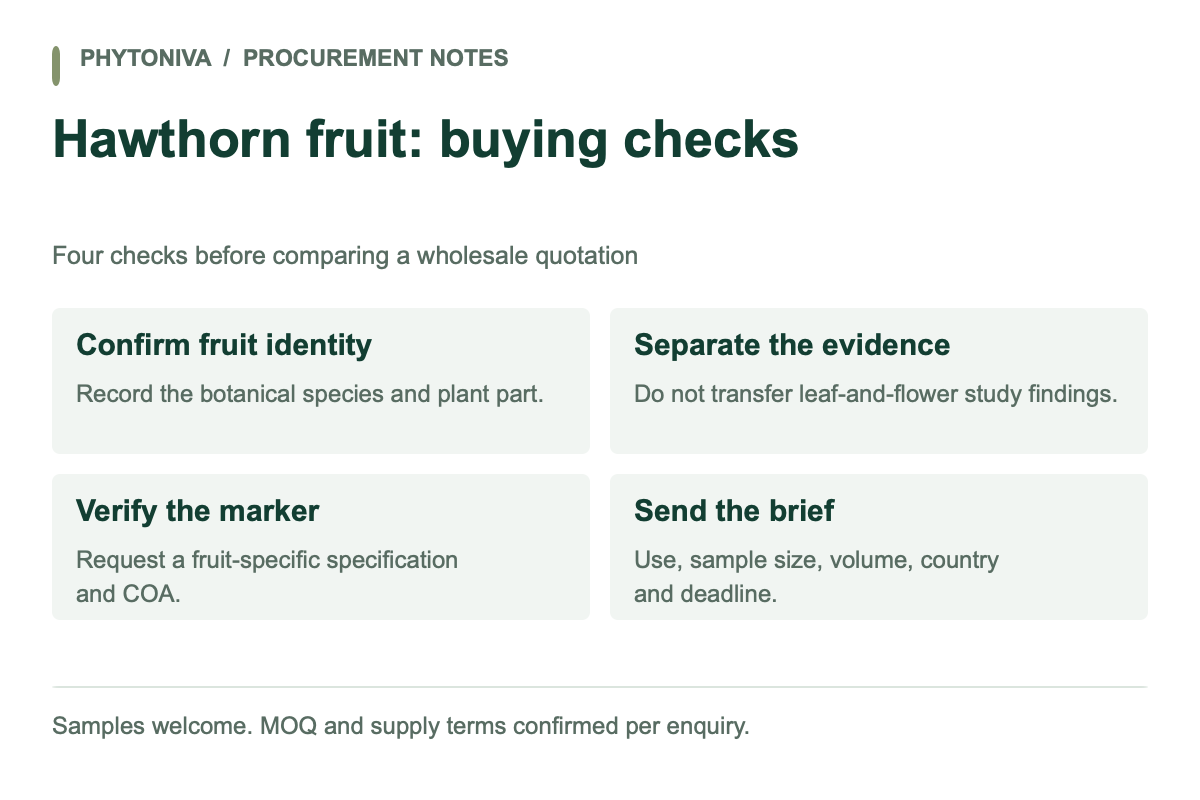
- Confirm fruit identity: Record the botanical species and plant part.
- Separate the evidence: Do not transfer leaf-and-flower study findings.
- Verify the marker: Request a fruit-specific specification and COA.
- Send the brief: Use, sample size, volume, country and deadline.
Frequently asked questions
Can a fruit extract use evidence from hawthorn leaves?
Not automatically. The plant part, species, preparation and composition must be compared. A fruit-only procurement brief should remain separate from a leaf or leaf-and-flower brief.
Can you quote a standard flavonoid percentage immediately?
Send your target percentage and method. We need to confirm the fruit-specific grade and supporting documents before offering a guaranteed specification; we will not transfer a leaf assay into a fruit quotation.
Is hawthorn fruit extract suitable for everyone?
No universal safety conclusion follows from the ingredient name. NCCIH notes adverse effects and potential medicine interactions for hawthorn. A qualified professional should assess the actual preparation, formulation and intended users; this guide is not medical advice.
What information makes a sample request useful?
Include species and fruit-part requirements, marker and method, application, sample quantity, expected commercial quantity, packaging, destination, required documents and deadline. Explain any undecided requirement so sourcing options can be evaluated.
Request a hawthorn fruit extract quotation
Browse our botanical ingredient catalogue, email sales@phytoniva.com, or message PHYTONIVA on WhatsApp. We can discuss your specification, sample order and purchasing conditions, then work toward a documented sourcing option appropriate to the project.
Sourcing coordination and quality checks
PHYTONIVA manages trade, sourcing and supplier coordination, matching ingredients and supply options to your specification, application and destination. The manufacturing partner provides its COA and relevant quality documents. Before procurement and dispatch, we arrange independent third-party quality testing and obtain the report for the agreed testing scope.
Specifications, sampling, test scope, methods and acceptance criteria are agreed before ordering. The manufacturer COA and agreed third-party test report accompany the shipment. Certification is checked separately for the named holder, product and valid scope.
See our quality and documentation process