Menu
Freeze-Dried Purple Sweet Potato: Research and Buying
Freeze-dried purple sweet potato brings a purple food color, root-vegetable character and a starch-containing base to product development. For brands considering bakery blends, desserts or beverage powders, its appeal is the combination of an identifiable vegetable ingredient and anthocyanin pigments. The right preparation depends on whether the recipe needs a cooked, thickening powder or a different texture after processing.
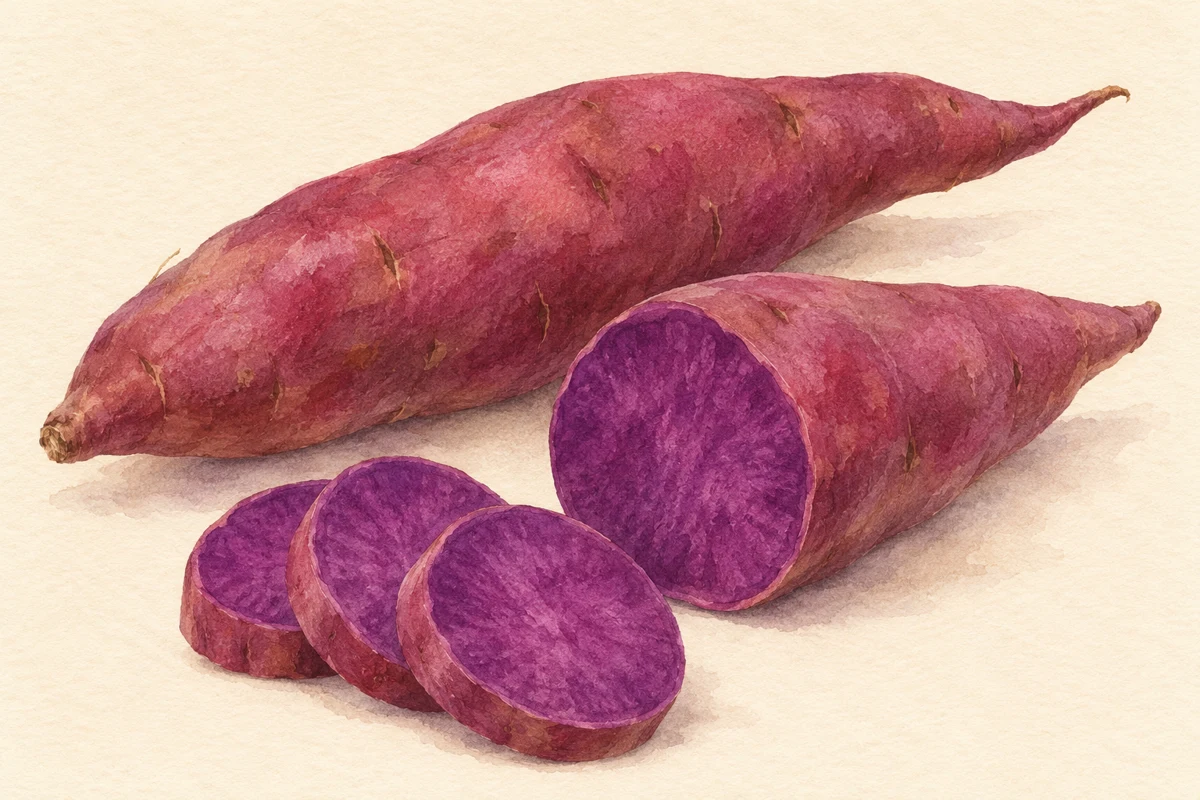
Purple sweet potato and its preparation
Purple sweet potato is a purple-fleshed form of Ipomoea batatas. The ingredient comes from the storage root, not a botanical fruit. Confirm cultivar, peeling and whether the feedstock is root tissue, cooked mash or juice-derived material. The illustration is a botanical schematic, not the offered cultivar, cut or batch.
The catalogue lists freeze-dried purple sweet potato with an ambiguous “Fruit/Powder” form, while the English site says “Whole / powder.” Powder is a sourcing reference; the non-powder shape and availability need confirmation rather than assuming whole roots or particular pieces. Freeze-drying removes water from frozen material under reduced pressure. It does not by itself establish whether the root was cooked first, or make the powder a standardized anthocyanin extract.
Starch, fiber and purple pigments
Sweet potato supplies starch and fiber as well as plant pigments. Purple-fleshed varieties contain anthocyanins; the amount depends on cultivar and processing. For a developer, starch-containing solids make hydration, viscosity and mouthfeel useful sample tests. Anthocyanin content and visible color are different specifications: neither can be inferred reliably from a photograph.
A 2024 food-composition study compared hot-air drying and freeze-drying in three sweet potato varieties, including purple NP1648. Variety influenced the bioactive profile more strongly than drying method, and freeze-drying did not provide a general advantage in retaining the measured compounds. This laboratory comparison supports choosing by measured composition and process history rather than by the freeze-dried label alone. Its antioxidant assays are not human health outcomes, and the tested cultivar and conditions do not establish our offered powder’s composition. Pereira and colleagues, 2024.
What the human research explored
A small double-blind placebo-controlled pilot study enrolled 40 adults aged 41–69 with borderline liver biomarker elevations. Participants consumed three 125-mL bottles daily of an anthocyanin-rich purple sweet potato beverage or placebo for eight weeks. At day 43, GGT, AST and ALT were lower in the purple sweet potato group than in the placebo group. Thirty-nine participants completed the study; two were excluded from the statistical analysis. This is an exploratory signal for research on food formulations and liver-related biomarkers, not proof of treating liver disease. A specific beverage was tested, not this freeze-dried powder; the small study, selected population and biomarker endpoints limit generalization. Its experimental intake is not a serving recommendation. Oki and colleagues, 2017.
Applications to evaluate with samples
- Bakery and cereal blends: compare color, water demand and finished texture at the intended inclusion rate. Confirm whether the powder is raw or precooked before adjusting the recipe.
- Desserts and fillings: assess viscosity, root flavor and color through the actual heating, cooling and storage cycle.
- Beverage powders: test dispersion, sedimentation and thickening. A whole-root powder should not be assumed to produce a clear solution.
These are development suggestions, not verified performance or shelf-life claims. A purple ingredient is not automatically a low-sugar or low-carbohydrate ingredient; the finished recipe needs its own composition and labeling assessment.
Specifications that help compare offers
Request the species and cultivar, root part and peeling, raw versus cooked preparation, full ingredient declaration and any carriers. Agree particle size, moisture, water activity and the packaging format. If anthocyanins are a purchasing criterion, define the analyte, method, reporting basis and acceptance limit; total anthocyanins, total phenolics and a named individual pigment are not interchangeable results.
Evaluate color and flow after opening, and compare samples at the same recipe concentration. Confirm the required heat treatment and intended use: freeze-drying is not a sterilization guarantee. Agree microbiological and contaminant testing, storage and shelf-life evidence relevant to the destination and finished application.
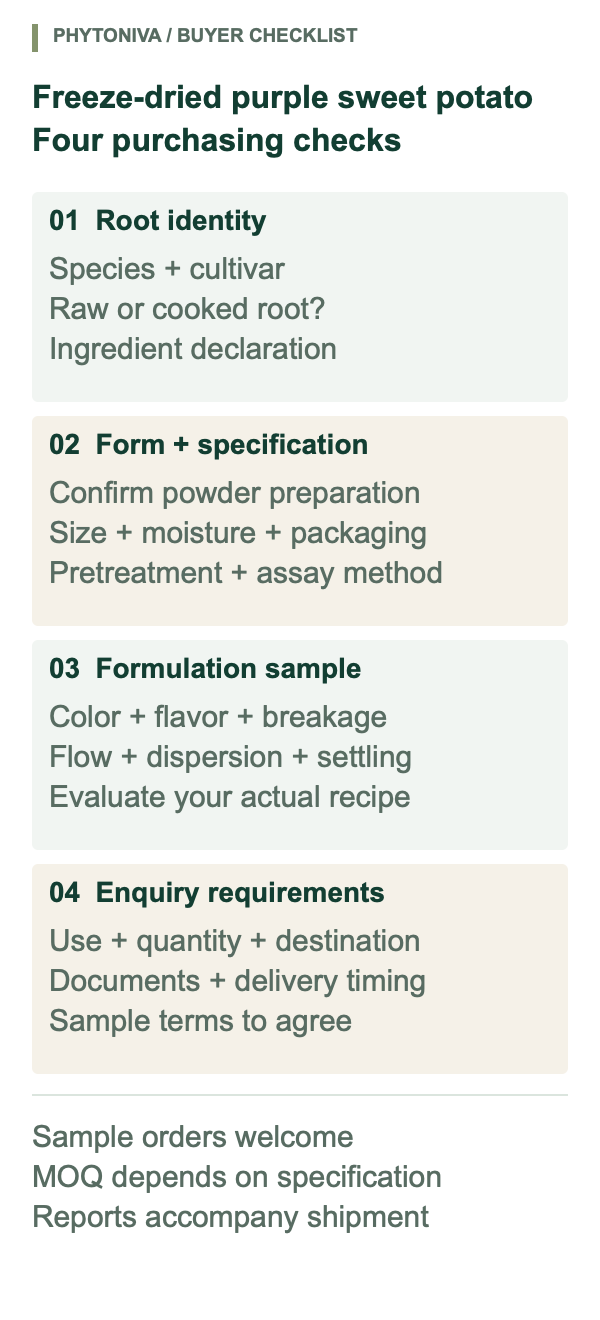
Freeze-dried purple sweet potato purchasing checks
Root identity
Confirm root identity, cultivar, peeling and raw or cooked preparation and the full ingredient declaration.
Form + specification
Choose the required form; agree size, moisture, water activity, packaging and relevant assays, including the named anthocyanin analyte, method and reporting basis if specified. Catalogue forms are not stock guarantees.
Formulation sample
Test the chosen sample in the actual recipe for color, flavor, breakage, flow, dispersion and settling as relevant.
Enquiry requirements
Provide specification, intended use, quantity, destination, document needs and timing; agree sample terms and delivery conditions.
Quality responsibilities and documents
PHYTONIVA coordinates trading, sourcing and supply resources. The manufacturing factory supplies its manufacturer COA and relevant production and quality documents. PHYTONIVA commissions third-party product-quality testing before procurement and shipment and obtains the corresponding reports. Before ordering, agree the proposed specification, sample or batch to be tested, scope, methods, acceptance criteria, document requirements and delivery conditions. The manufacturer COA and agreed third-party reports accompany shipment; presale COA samples and public COA downloads are not currently offered.
A manufacturer COA, an independent test report and a certification certificate serve different purposes. A test report covers only its listed sample, tests and results; it is not proof of efficacy, market authorization or certification. No completed testing or universal batch-pass claim is made here. Ingredients and finished-product claims still need assessment for the specific destination and use.
See our quality workflow.
Buyer questions
Is freeze-dried purple sweet potato a standardized extract?
No. A freeze-dried vegetable powder and an extract have different processing and composition. Specify the preparation you need.
Is powder guaranteed to dissolve clearly?
No. Root solids, particle size and added ingredients affect dispersion; evaluate the actual sample in your recipe.
Can I order samples or negotiate MOQ?
Sample orders are welcome; sample charges and delivery terms are agreed in advance. MOQ can be negotiated according to specification, packaging and supply conditions. Free samples are not promised.
Discuss your purple sweet potato requirement
Send the form, specification, intended use, quantity, destination, budget, document requirements and timing. PHYTONIVA can help match suitable products and supply options. For the United States or an African destination, identify the actual country and intended application for assessment.
View purple sweet potato catalogue references · Request a quotation · sales@phytoniva.com · WhatsApp +86 19991898850
Sourcing coordination and quality checks
PHYTONIVA manages trade, sourcing and supplier coordination, matching ingredients and supply options to your specification, application and destination. The manufacturing partner provides its COA and relevant quality documents. Before procurement and dispatch, we arrange independent third-party quality testing and obtain the report for the agreed testing scope.
Specifications, sampling, test scope, methods and acceptance criteria are agreed before ordering. The manufacturer COA and agreed third-party test report accompany the shipment. Certification is checked separately for the named holder, product and valid scope.
See our quality and documentation process