Menu
Freeze-Dried Kale: Components, Research and Bulk Buying
Freeze-dried kale is a vegetable ingredient for developers who want leafy flavor, green color and a plant-food component in dry blends or foods. Its appeal comes from the combination of leaf solids, fiber and naturally occurring compounds rather than one isolated active. Choosing a suitable preparation starts with the recipe: a beverage powder needs different sensory and particle-size evaluation from a savory seasoning or snack.
Kale identity and the preparation being purchased
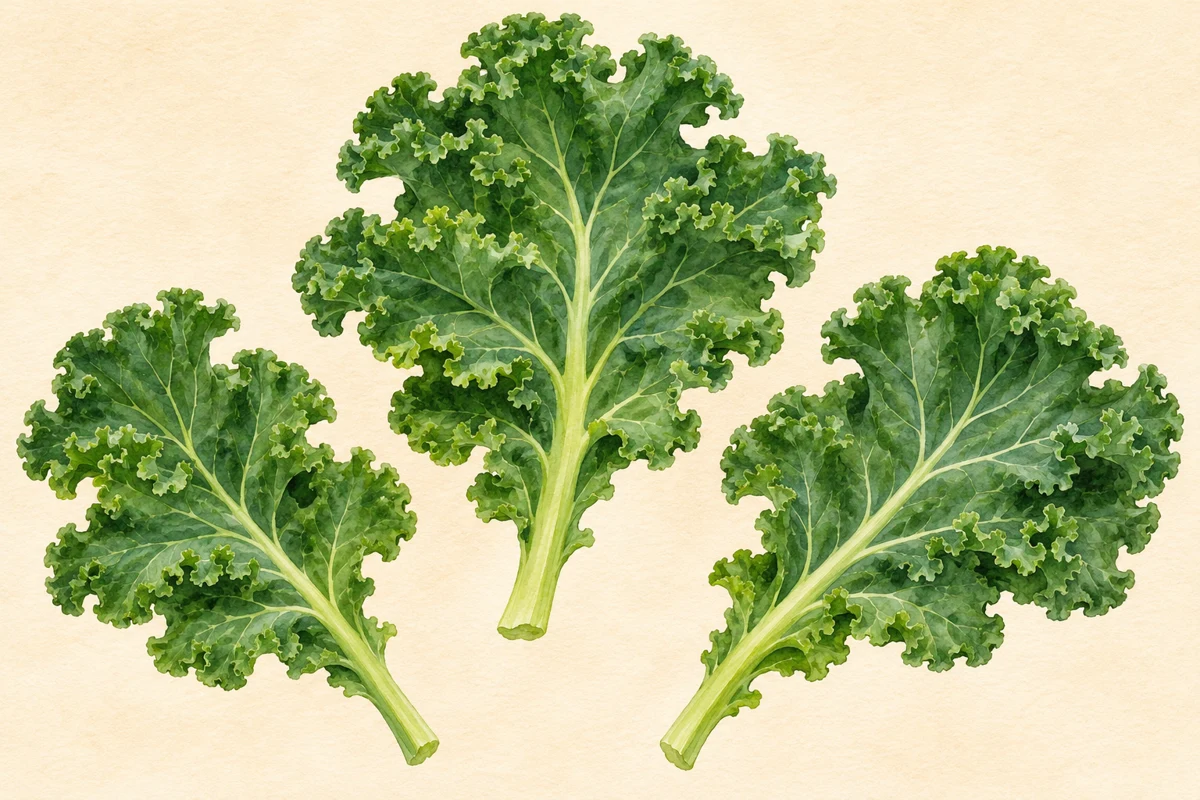
Kale is a leafy Brassica vegetable, commonly described as Brassica oleracea var. acephala. The illustration shows curly leaves as a botanical reference, not the cultivar or material being offered. Confirm the cultivar, harvested part, proportion of leaf blade and stalk, and whether the powder comes from whole vegetable tissue or juice before selecting a grade.
The sourcing catalogue includes freeze-dried kale, but its non-powder form is described ambiguously as “Fruit/Powder”; the English website uses “Whole / powder.” This is not evidence of a fruit ingredient or a confirmed leaf-piece format. Powder can be discussed as a catalogue reference; the exact feedstock, cut and availability must be confirmed in the offer. Freeze-drying removes water from frozen material under reduced pressure. It does not make a vegetable powder equivalent to a purified extract.
Components that matter in a formulation
Kale contains dietary fiber and glucosinolates. Fiber-containing leaf solids can contribute body and suspended particles, so developers should test mouthfeel and settling rather than assume clear solubility. Glucosinolates are a family of compounds characteristic of Brassica vegetables; processing changes their profile. A total-glucosinolate result is not interchangeable with a result for a named individual compound or for its breakdown products.
A food-processing study compared kale leaves and preserved preparations and found different glucosinolate levels after processing and storage. Freeze-dried preparations had higher mean levels than hot-air-dried preparations under that study’s conditions. This is a compositional comparison, not evidence of a human health effect or a guaranteed retention percentage for another supplier’s powder. It makes processing history and analytical methods useful purchasing questions. Kale processing and glucosinolates study.
What a human study found
A randomized crossover trial enrolled 42 Japanese adults with moderately elevated post-meal glucose; the reported efficacy figures used 40 participants. Kale-containing test foods at 7 or 14 g were taken with a high-carbohydrate meal. Average peak glucose was 163 and 162 mg/dL, compared with 176 mg/dL after placebo; the two-hour glucose response was also lower, while insulin did not differ significantly. This points to further study of vegetable ingredients in meal formulations. It was an acute meal test, not proof of diabetes treatment, long-term benefit or efficacy of our freeze-dried material; preparation equivalence has not been established. These experimental amounts are not intake recommendations. Kondo and colleagues, 2016.
Applications worth evaluating
- Green beverage blends: assess leaf flavor, bitterness, particle sensation and settling at the intended inclusion level. Compare mixing conditions and sweetness balance; do not assume an instant, clear drink.
- Soups and savory seasonings: test flavor balance, dispersibility and color after the actual cooking process.
- Snack or bakery prototypes: evaluate how the vegetable ingredient changes moisture balance, texture and color during processing and storage. These are development suggestions, not validated performance or shelf-life claims.
Vitamin K and the intended consumer
Kale is a source of vitamin K. People taking warfarin need consistent vitamin K intake and should discuss changes in concentrated vegetable products with their clinician or pharmacist. A freeze-dried ingredient should not be assumed to be vitamin-K-free. When this is relevant to the intended product, agree a suitable assay and labeling review; general food-composition information does not establish the amount in the offered batch. NIH vitamin K information.
Set specifications around your recipe
For a powder enquiry, specify botanical identity, part and feedstock, pretreatment such as blanching, full ingredient declaration and any carriers. Agree particle size, moisture, water activity, packaging and storage conditions. Review relevant microbiological and contaminant requirements for the intended use and destination. Freeze-drying is not a sterilization guarantee.
If glucosinolates, fiber or vitamin K are purchase criteria, define the analyte or fraction, method, reporting basis and acceptance limit. Color alone cannot establish nutrient content. Compare samples at the same recipe concentration and request supporting shelf-life information before committing to a packaging format.
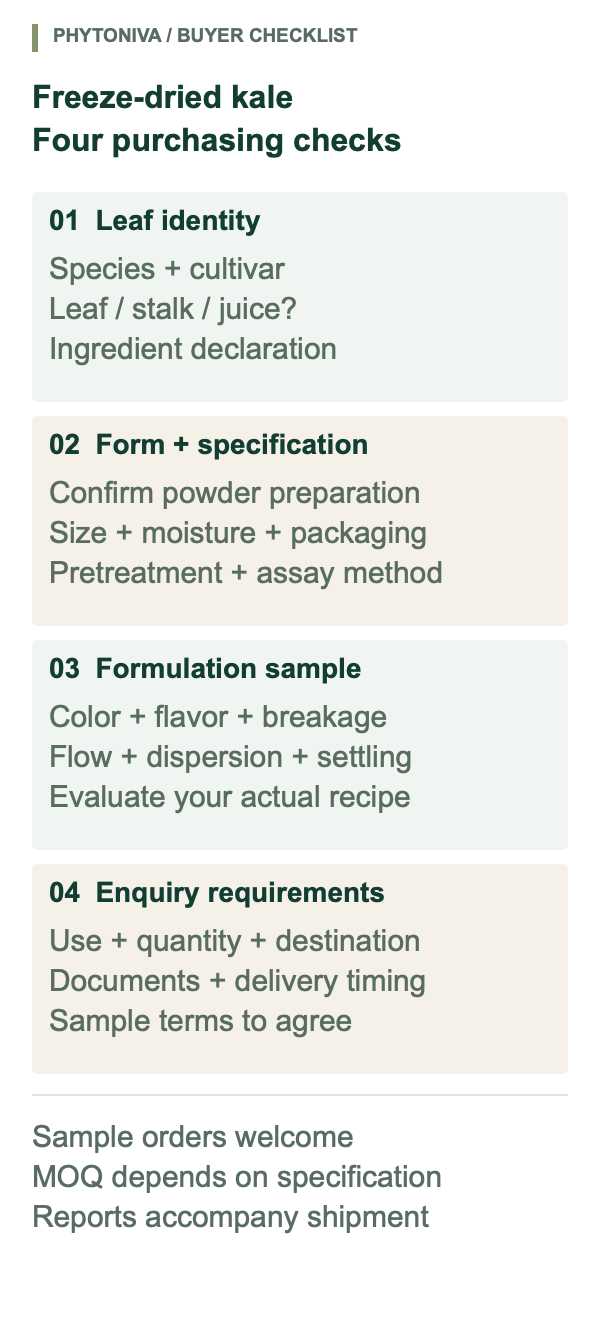
Freeze-dried kale purchasing checks
Leaf identity
Confirm leaf identity, cultivar, leaf/stalk and tissue/juice origin and the full ingredient declaration.
Form + specification
Choose the required form; agree size, moisture, water activity, packaging and relevant assays, including the named glucosinolate analyte, method and reporting basis if specified. Catalogue forms are not stock guarantees.
Formulation sample
Test the chosen sample in the actual recipe for color, flavor, breakage, flow, dispersion and settling as relevant.
Enquiry requirements
Provide specification, intended use, quantity, destination, document needs and timing; agree sample terms and delivery conditions.
Quality responsibilities and documents
PHYTONIVA coordinates trading, sourcing and supply resources. The manufacturing factory supplies its manufacturer COA and relevant production and quality documents. PHYTONIVA commissions third-party product-quality testing before procurement and shipment and obtains the corresponding reports. Before ordering, agree the proposed specification, sample or batch to be tested, scope, methods, acceptance criteria, document requirements and delivery conditions. The manufacturer COA and agreed third-party reports accompany shipment; presale COA samples and public COA downloads are not currently offered.
A manufacturer COA, an independent test report and a certification certificate serve different purposes. A test report covers only its listed sample, tests and results; it is not proof of efficacy, market authorization or certification. No completed testing or universal batch-pass claim is made here. Ingredients and finished-product claims still need assessment for the specific destination and use.
See our quality workflow.
Buyer questions
Is freeze-dried kale a standardized extract?
No. A freeze-dried vegetable powder and an extract have different processing and composition. Specify the preparation you need.
Is powder guaranteed to dissolve clearly?
No. Leaf solids, particle size and added ingredients affect dispersion; evaluate the actual sample in your recipe.
Can I order samples or negotiate MOQ?
Sample orders are welcome; sample charges and delivery terms are agreed in advance. MOQ can be negotiated according to specification, packaging and supply conditions. Free samples are not promised.
Discuss your kale requirement
Send the form, specification, intended use, quantity, destination, budget, document requirements and timing. PHYTONIVA can help match suitable products and supply options. For the United States or an African destination, identify the actual country and intended application for assessment.
View kale catalogue references · Request a quotation · sales@phytoniva.com · WhatsApp +86 19991898850
Sourcing coordination and quality checks
PHYTONIVA manages trade, sourcing and supplier coordination, matching ingredients and supply options to your specification, application and destination. The manufacturing partner provides its COA and relevant quality documents. Before procurement and dispatch, we arrange independent third-party quality testing and obtain the report for the agreed testing scope.
Specifications, sampling, test scope, methods and acceptance criteria are agreed before ordering. The manufacturer COA and agreed third-party test report accompany the shipment. Certification is checked separately for the named holder, product and valid scope.
See our quality and documentation process