Menu
Freeze-Dried Grapefruit: Flavor, Research and Bulk Buying
Freeze-dried grapefruit brings a recognizable citrus aroma, tartness and a bitter edge to fruit inclusions and powder blends. For food and beverage developers, the first choice is the desired fruit experience: visible segments or pieces, or a powder that can be distributed through a recipe. Grapefruit flavanones also attract research interest, but fruit ingredients should be specified separately from isolated flavonoids or concentrated extracts.
Fruit identity and ingredient form
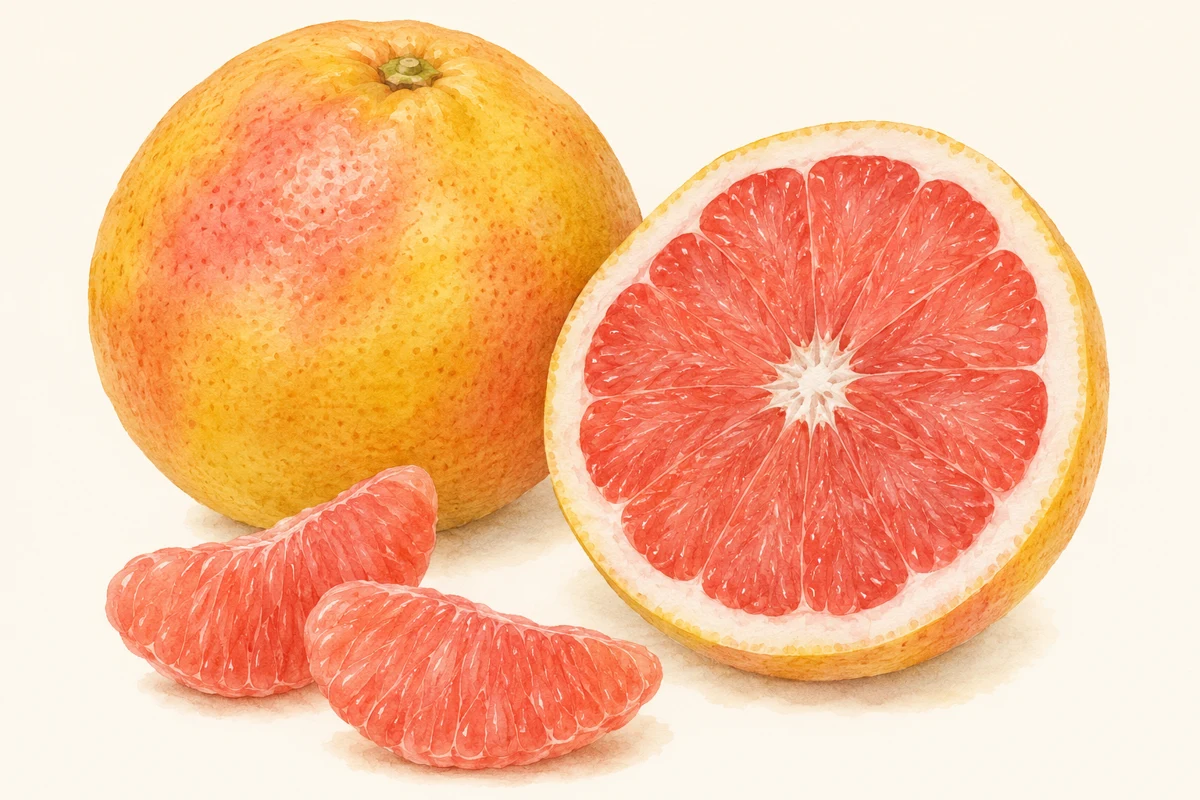
Grapefruit is commonly identified as Citrus × paradisi. Confirm the offered cultivar, flesh color and fruit source; grapefruit should not be confused with grape or treated as identical to pomelo. The supplier catalogue lists fruit, diced and powder forms as enquiry references. Ask what “fruit” means in the actual offer: segments, slices or another preparation. Availability and the exact cut require confirmation.
Freeze-drying removes water from frozen material under reduced pressure. For powder, establish whether the feedstock is fruit flesh, whole-fruit material or juice, and whether peel, sugar or a carrier is included. These choices affect the ingredient declaration, flavor and recipe behavior. A freeze-dried fruit powder is not automatically a grapefruit seed extract or a standardized naringin extract.
Components and the characteristics buyers notice
Grapefruit contains flavanones, including naringin, a glycoside related to naringenin. Naringin contributes to grapefruit’s bitter character; organic acids contribute tartness. Vitamin C is another constituent of the fruit, but an offered dried ingredient needs its own assay if a vitamin specification is required. Fruit solids and the amount of pulp or peel can also change mouthfeel and dispersion. Neither color nor taste establishes an active-compound concentration.
A useful sample review therefore combines sensory assessment with composition: compare bitterness and acidity at the intended addition level, inspect the full ingredient declaration, and agree analytical methods if flavanones or vitamin C are purchase criteria. Do not assume all freeze-dried products retain the same nutrient levels or produce a clear beverage.
What human research has explored
A randomized crossover trial completed by 48 healthy postmenopausal women compared 340 mL of grapefruit juice daily, providing 210 mg of naringenin glycosides, with a matched drink without flavanones. Each treatment lasted six months, separated by a two-month washout. A measure of central arterial stiffness was lower after grapefruit juice: pulse-wave velocity averaged 7.36 versus 7.70 m/s. However, the primary endothelial-function measure did not improve, and blood pressure and several metabolic and inflammatory measures were unaffected. This supports further research into citrus flavanones and vascular function, not a claim that grapefruit prevents cardiovascular disease. The population and juice preparation were specific; the findings do not establish efficacy or a recommended dose for a commercial freeze-dried powder. Habauzit and colleagues, 2015.
For a research-led concept, the practical next step is to characterize the actual ingredient and formulation. A catalogue form does not demonstrate equivalence to the trial juice. Research amounts above describe the experiment, not instructions for consumption.
A product-specific issue: medicine interactions
Grapefruit can change the absorption or metabolism of certain medicines, raising exposure to some drugs and reducing absorption of others. FDA examples include some statins, blood-pressure medicines and fexofenadine; the effect does not apply to every medicine in these categories. People using medicines should check the drug instructions and ask their pharmacist or clinician. Do not assume freeze-drying removes the interaction potential. When developing a product, assess the actual ingredient, intended audience and appropriate labeling; a naringin result alone is not proof that interactions are absent. FDA grapefruit interaction information.
Application directions to evaluate
- Fruit inclusions: evaluate segments or pieces in cereals, snack mixes and confectionery for cut size, breakage, bitterness and texture after contact with other ingredients.
- Dry beverage blends: evaluate powder flow, clumping, dispersion and settling in the actual liquid. Adjust recipe acidity and sweetness through trials rather than assuming instant solubility.
- Bakery or dessert prototypes: test aroma, flavor and color after the intended process and during storage. These are development suggestions, not validated heat stability or shelf-life claims.
Build specifications around the actual preparation
For pieces, agree cut dimensions, acceptable broken material and sensory limits. For powder, add particle size and the complete composition, including carriers. Agree moisture, water activity, packaging, storage conditions and shelf-life evidence, along with relevant microbiological and contaminant requirements. Freeze-drying is not itself a sterilization guarantee.
If a constituent assay is needed, identify the analyte, method, reporting basis and acceptance criterion. Naringin and naringenin are different analytical targets; neither should be silently substituted for total flavonoids. Compare samples under the same preparation conditions before selecting a grade.
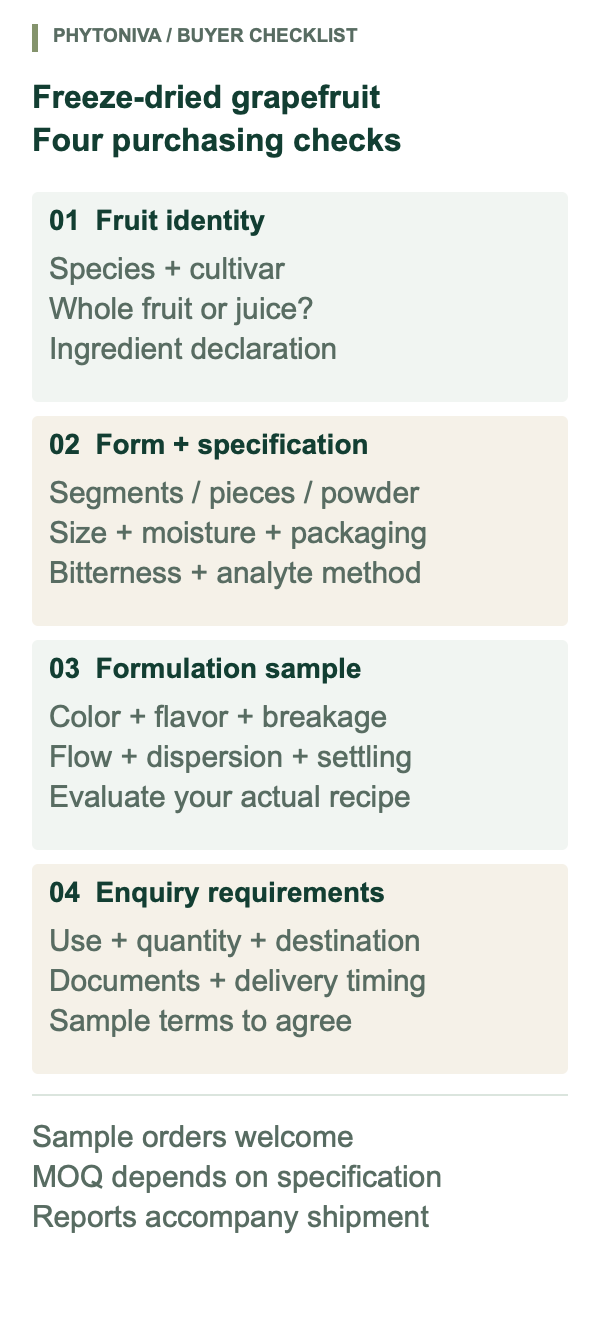
Freeze-dried grapefruit purchasing checks
Fruit identity
Confirm fruit identity, cultivar, whole-fruit or juice origin and the full ingredient declaration.
Form + specification
Choose the required form; agree size, moisture, water activity, packaging and relevant assays, including the named flavanone analyte, method and reporting basis if specified. Catalogue forms are not stock guarantees.
Formulation sample
Test the chosen sample in the actual recipe for color, flavor, breakage, flow, dispersion and settling as relevant.
Enquiry requirements
Provide specification, intended use, quantity, destination, document needs and timing; agree sample terms and delivery conditions.
Quality responsibilities and documents
PHYTONIVA coordinates trading, sourcing and supply resources. The manufacturing factory supplies its manufacturer COA and relevant production and quality documents. PHYTONIVA commissions third-party product-quality testing before procurement and shipment and obtains the corresponding reports. Before ordering, agree the proposed specification, sample or batch to be tested, scope, methods, acceptance criteria, document requirements and delivery conditions. The manufacturer COA and agreed third-party reports accompany shipment; presale COA samples and public COA downloads are not currently offered.
A manufacturer COA, an independent test report and a certification certificate serve different purposes. A test report covers only its listed sample, tests and results; it is not proof of efficacy, market authorization or certification. No completed testing or universal batch-pass claim is made here. Ingredients and finished-product claims still need assessment for the specific destination and use.
See our quality workflow.
Buyer questions
Is freeze-dried fruit the same as a naringin extract?
No. Fruit formats, juice-derived powders, seed extracts and isolated or standardized flavonoid ingredients require different identity and composition specifications.
Is powder guaranteed to dissolve clearly?
No. Pulp, particle size and added ingredients affect dispersion; evaluate the actual sample in your recipe.
Can I order samples or negotiate MOQ?
Sample orders are welcome; sample charges and delivery terms are agreed in advance. MOQ can be negotiated according to specification, packaging and supply conditions. Free samples are not promised.
Discuss your grapefruit requirement
Send the form, specification, intended use, quantity, destination, budget, document requirements and timing. PHYTONIVA can help match suitable products and supply options. For the United States or an African destination, identify the actual country and intended application for assessment.
View grapefruit catalogue references · Request a quotation · sales@phytoniva.com · WhatsApp +86 19991898850
Sourcing coordination and quality checks
PHYTONIVA manages trade, sourcing and supplier coordination, matching ingredients and supply options to your specification, application and destination. The manufacturing partner provides its COA and relevant quality documents. Before procurement and dispatch, we arrange independent third-party quality testing and obtain the report for the agreed testing scope.
Specifications, sampling, test scope, methods and acceptance criteria are agreed before ordering. The manufacturer COA and agreed third-party test report accompany the shipment. Certification is checked separately for the named holder, product and valid scope.
See our quality and documentation process