Menu
Freeze-Dried Cranberry: Components, Research and B2B Buying
Freeze-dried cranberry offers a sharp berry flavor and red fruit character in whole, piece and powder formats. Food developers can use its tartness to shape a flavor profile, evaluate visible fruit inclusions, or explore fruit-based dry blends. Its polyphenols also attract research interest, but a whole-fruit ingredient and a concentrated cranberry extract require different purchasing specifications.
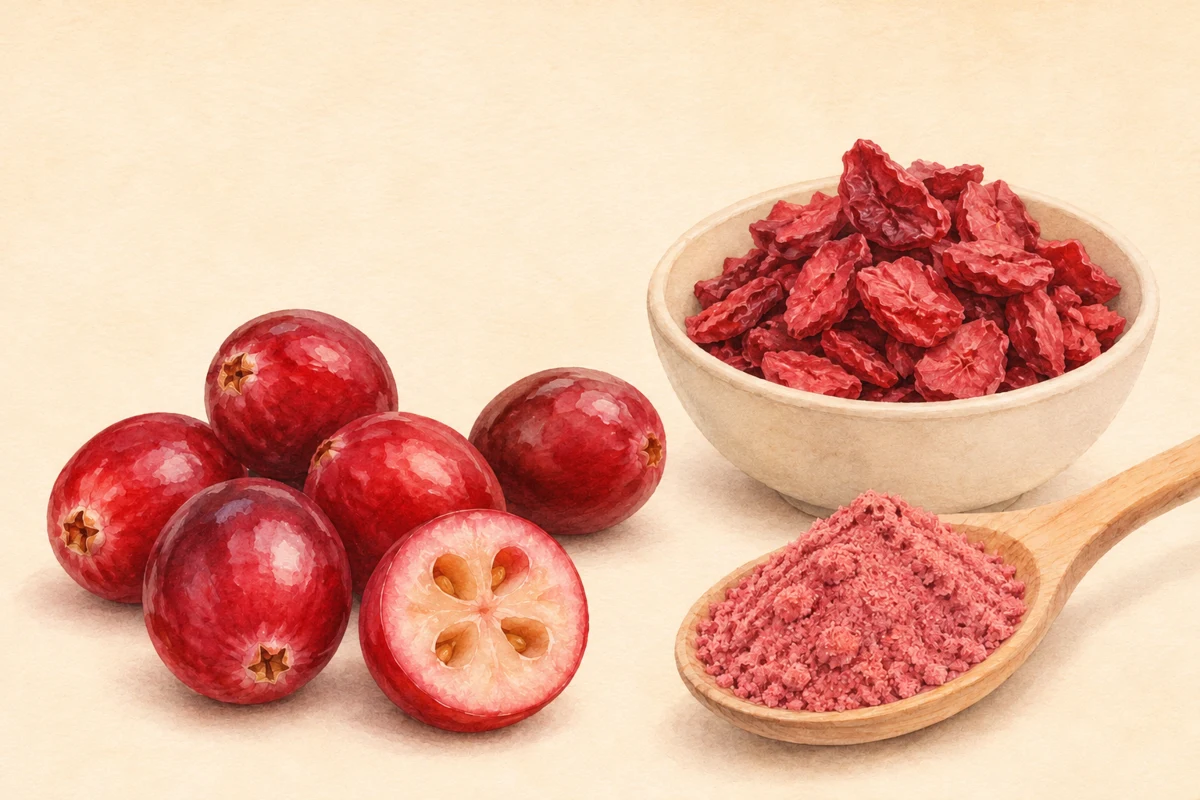
What is freeze-dried cranberry?
American cranberry is Vaccinium macrocarpon; the name cranberry can also refer to other species, including Vaccinium oxycoccos. This guide uses American cranberry as its research and illustration reference. Confirm the species, cultivar or source description of the actual offered fruit. The catalogue lists whole fruit, pieces and powder as enquiry references, not confirmation that every form is currently available.
Freeze-drying removes water from frozen fruit under reduced pressure. Confirm whether a proposed powder comes from whole fruit or juice, and whether sugar, carriers or other ingredients are added. Sweetened dried cranberries, freeze-dried fruit powder and a PAC-standardized extract are not interchangeable. A full ingredient declaration is necessary before specifying pure fruit or no added sugar.
Constituents and formulation characteristics
Anthocyanins contribute red color. Proanthocyanidins, often shortened to PACs, are a different polyphenol group; cranberry contains A-type and B-type structures. Flavonols and phenolic acids add to its polyphenol profile. Fruit acids contribute tartness, and whole-fruit solids affect texture and dispersion. A red color is not a PAC assay, and neither a total-polyphenol nor an anthocyanin result substitutes for a PAC result.
These distinctions help separate two development goals: choosing fruit for flavor and texture, and choosing an analytically specified ingredient for a research-led concept. The amount and profile in a research powder do not define a catalogue powder. For drinks, test the actual liquid and pH for color, tartness, dispersion and sediment; whole-fruit powder should not be assumed to form a clear solution.
Research findings and what they mean for product development
Human vascular study: a randomized trial enrolled 45 healthy men to consume 9 g of freeze-dried whole-cranberry powder daily or placebo for one month. Blood-vessel dilation improved, while blood pressure, arterial stiffness measures, blood lipids and glucose did not. This supports further vascular-function research, not a claim of disease prevention. The small, short trial and its specific powder cannot establish an effective dose for every offered ingredient. Heiss and colleagues, 2022.
Human memory study: a 12-week feasibility trial in 60 cognitively healthy adults aged 50–80 found improvements in visual episodic memory and regional brain perfusion with freeze-dried cranberry powder versus placebo. BDNF, a measured signaling protein, did not change significantly between groups. This is an exploratory healthy-aging lead; it does not demonstrate dementia prevention or treatment, and larger confirmatory studies are needed. Flanagan and colleagues, 2022.
Urinary-health context: NCCIH reports that cranberry products may reduce recurrent symptomatic urinary tract infections in some women, with inconsistent findings across studies and populations. PAC-related anti-adhesion mechanisms are one research interest, but evidence from different juices, capsules or extracts cannot be assigned automatically to an untested freeze-dried fruit. Cranberry is not a treatment for an existing UTI. NCCIH evidence summary.
Application directions to evaluate
- Cereal and snack inclusions: compare whole fruit and pieces for size, tartness, breakage and texture after exposure to surrounding ingredients. Confirm whether the intended recipe needs sweetening rather than assuming the ingredient is sweetened.
- Powder blends and beverage prototypes: check particle size, flow, clumping and settling. Compare flavor at the intended inclusion level and balance the whole recipe’s acidity and sweetness.
- Bars, bakery and confectionery: assess color and flavor after the actual process, as well as moisture migration during storage. These are proposed sample evaluations, not verified heat stability or shelf-life claims.
Set specifications around the ingredient form
For whole fruit or pieces, agree size distribution, acceptable broken material, sensory criteria and protective packaging. For powder, add particle size and full composition. For every form, agree moisture, water activity, relevant microbiological and contaminant requirements, storage conditions and shelf-life evidence. Freeze-drying does not itself guarantee sterilization.
If PAC content is important, specify the analytical method, reference standard, reporting basis and acceptance criterion. Different methods or reference standards can produce results that are not directly comparable. A catalogue constituent reference is not a standardized percentage, a batch result or a clinical efficacy claim.
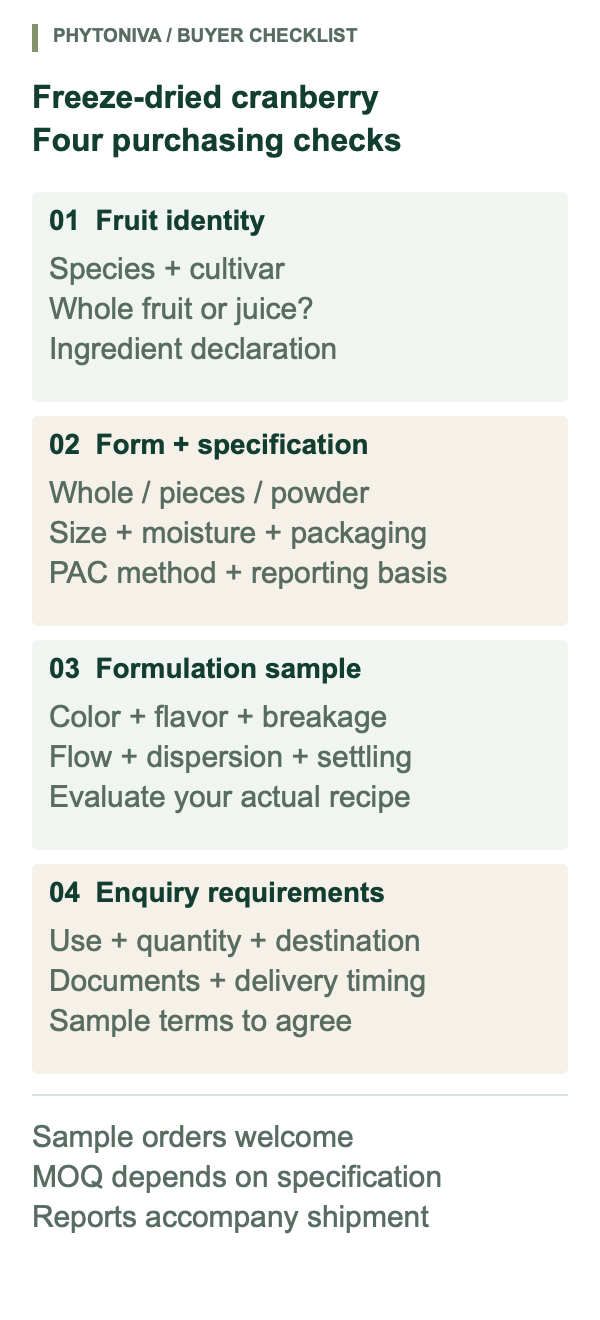
Freeze-dried cranberry purchasing checks
Fruit identity
Confirm fruit identity, cultivar, whole-fruit or juice origin and the full ingredient declaration.
Form + specification
Choose the required form; agree size, moisture, water activity, packaging and relevant assays, including PAC method, reference standard and reporting basis if specified. Catalogue forms are not stock guarantees.
Formulation sample
Test the chosen sample in the actual recipe for color, flavor, breakage, flow, dispersion and settling as relevant.
Enquiry requirements
Provide specification, intended use, quantity, destination, document needs and timing; agree sample terms and delivery conditions.
Relevant safety considerations
Large amounts can cause stomach upset or diarrhea. Evidence for interaction with warfarin is conflicting, so users of anticoagulants should seek clinical advice before using cranberry supplements. Safety evidence for amounts above ordinary food intake during pregnancy or breastfeeding is limited. Suspected UTI symptoms need medical assessment; cranberry must not replace proven treatment. These considerations matter when selecting the intended audience and use. NCCIH safety information.
Quality responsibilities and documents
PHYTONIVA coordinates trading, sourcing and supply resources. The manufacturing factory supplies its manufacturer COA and relevant production and quality documents. PHYTONIVA commissions third-party product-quality testing before procurement and shipment and obtains the corresponding reports. Before ordering, agree the proposed specification, sample or batch to be tested, scope, methods, acceptance criteria, document requirements and delivery conditions. The manufacturer COA and agreed third-party reports accompany shipment; presale COA samples and public COA downloads are not currently offered.
A manufacturer COA, an independent test report and a certification certificate serve different purposes. A test report covers only its listed sample, tests and results; it is not proof of efficacy, market authorization or certification. No completed testing or universal batch-pass claim is made here. Ingredients and finished-product claims still need assessment for the specific destination and use.
See our quality workflow.
Buyer questions
Is this a standardized PAC extract?
Not by name alone. This guide concerns freeze-dried fruit forms. If a standardized extract is required, agree a separate process and analytical specification.
Can the trial dose become a recommended intake?
No. The amounts above describe research conditions, not consumption advice. Assess the actual ingredient, formulation and intended audience separately.
Can I order samples or negotiate MOQ?
Sample orders are welcome; sample charges and delivery terms are agreed in advance. MOQ can be negotiated according to specification, packaging and supply conditions. Free samples are not promised.
Discuss your cranberry requirement
Send the form, specification, intended use, quantity, destination, budget, document requirements and timing. PHYTONIVA can help match suitable products and supply options. For the United States or an African destination, identify the actual country and intended application for assessment.
View cranberry catalogue references · Request a quotation · sales@phytoniva.com · WhatsApp +86 19991898850
Sourcing coordination and quality checks
PHYTONIVA manages trade, sourcing and supplier coordination, matching ingredients and supply options to your specification, application and destination. The manufacturing partner provides its COA and relevant quality documents. Before procurement and dispatch, we arrange independent third-party quality testing and obtain the report for the agreed testing scope.
Specifications, sampling, test scope, methods and acceptance criteria are agreed before ordering. The manufacturer COA and agreed third-party test report accompany the shipment. Certification is checked separately for the named holder, product and valid scope.
See our quality and documentation process