Menu
Astragalus Extract: Constituents, Benefits Research and Uses
Astragalus extract is a botanical ingredient made from huang qi, a root with a long history in Chinese herbal practice. It is interesting to formulators because its polysaccharides, saponins and flavonoids offer distinct chemical profiles. Research has examined immune-cell responses, oxidative stress and, more recently, activity-related knee discomfort in people.
The useful starting point is to understand which material a project needs: a root extract with a defined overall profile, a polysaccharide-focused grade, or a grade measured for a particular astragaloside. PHYTONIVA helps small brands, distributors and development teams compare suitable options. Sample orders are welcome; MOQ is discussed according to specification, packaging and supply conditions.
What is astragalus extract?
Huang qi is commonly described in herbal references as Astragalus membranaceus, with the root used as the starting material. Botanical naming can differ between references: Kew’s current classification accepts Astragalus mongholicus and lists A. membranaceus Fisch. ex Bunge among its synonyms. The plant belongs to the legume family, Fabaceae.
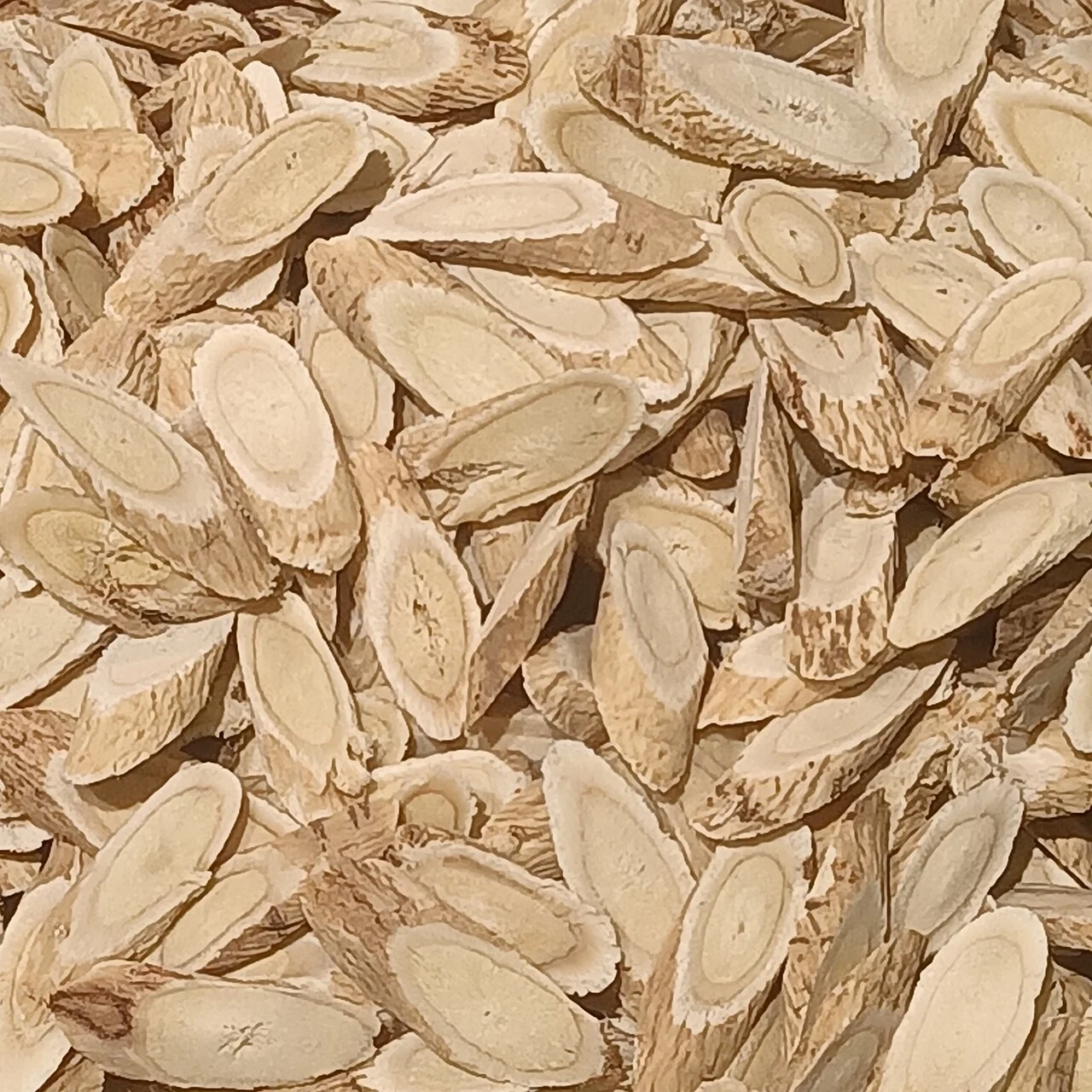
This naming detail matters when comparing documents and studies. Confirm the intended botanical identity and root material in the supplier’s technical documents; a photograph or the broad word “Astragalus” does not authenticate an offered extract. Dried root slices, ground root powder and extracted ingredients are different processing forms.
Polysaccharides, astragalosides and flavonoids
These constituent groups help explain why two astragalus extracts may suit different development briefs:
- Polysaccharides: carbohydrate chains studied for interactions with immune cells and other biological systems. A polysaccharide percentage describes an assay result, while the composition and molecular-size distribution require further characterization.
- Astragalosides: triterpene saponins, including individually named compounds such as astragalosides I, II, III and IV. “Astragaloside” without a suffix needs clarification; it should not automatically be relabelled astragaloside IV.
- Flavonoids: another chemical group, including isoflavonoids such as calycosin and formononetin. These are different analytical targets from either polysaccharides or saponins.
An original analytical study measured calycosin, formononetin and astragalosides I–IV separately. Another study of separated polysaccharide fractions found that fractions with different molecular sizes did not produce identical immune responses in its cell and animal tests. For product selection, a higher headline percentage is therefore only one part of the comparison.
Astragalus benefits research: three informative directions
Immune-cell activity
Immune-response research is one reason astragalus attracts attention in botanical formulation. In an original laboratory study, researchers isolated a polysaccharide preparation from Astragali Radix and tested it in mouse macrophages. They observed increases in signalling molecules including TNF-alpha, GM-CSF and nitric oxide, with involvement of the NF-kappaB pathway.
This shows an interaction with immune-cell signalling, rather than a simple “more immunity is better” result. It is cell evidence, not proof that a commercial 50% polysaccharide extract prevents infections in people. The extraction and fractionation used in research also matter when comparing ingredients.
Oxidative stress and mitochondrial experiments
A 2012 experimental study examined astragalus polysaccharides in chemical assays, isolated mouse mitochondria and a mouse model. The preparation reduced measures of lipid oxidation in the laboratory and increased measured antioxidant-enzyme activities in the animal experiment. These observations help explain interest in oxidative-stress research.
These experimental findings do not establish an anti-aging benefit in people; their value is in identifying mechanisms for further research.
A specific root extract and activity-related knee discomfort
A 2025 randomized, double-blind, placebo-controlled trial studied a particular hydroalcoholic root extract in 90 adults aged 18–60 with functional knee pain. After 28 days, the reported mean pain score following a six-minute walk fell from 6.7 to 1.2 in the extract group, versus 6.7 to 5.6 with placebo. The researchers also reported better knee-function and stair-climb results at days 14 and 28.
This is a promising human finding for the tested preparation, from a short, single-centre trial sponsored by its owner. It does not establish long-term effects, treatment of osteoarthritis or equivalent results from our catalogue grades. For a joint-comfort development project, the study is a useful starting point for examining a preparation’s evidence, rather than a ready-made claim for any astragalus powder.
Traditional use provides additional context: Health Canada’s astragalus monograph describes Chinese herbal uses associated with qi deficiency and fatigue. Those traditional concepts are distinct from the measured outcomes in the studies above.
Turning the ingredient into a practical formulation brief
For a small brand or an ingredient distributor, sample evaluation should answer questions that affect the actual finished product:
- Capsules and tablets: compare the desired marker profile with carrier content, bulk density, flow and the proposed serving format. A polysaccharide-focused material and a saponin-focused material need not occupy the same place in a formula.
- Powder blends and sachets: assess taste, colour, mixing uniformity and moisture behaviour in the complete blend. Set acceptance criteria using the same preparation and method that will be used for the pilot batch.
- Liquid or beverage concepts: evaluate dispersion, clarity, sedimentation and stability at the intended pH and processing temperature. Do not assume a high polysaccharide assay also guarantees complete solubility.
- Multi-botanical concepts: match each ingredient to its purpose and consider the complete formula. Studies on an isolated molecule, an injectable preparation or a combination do not establish the effect of a different oral extract.
Share the actual destination and product category at enquiry stage. Requirements for a US supplement project and for a project in an individual African country may differ; the suggestions above are development questions, not a blanket statement of eligibility.
Safety considerations that belong in the brief
NCCIH advises people with autoimmune diseases to avoid astragalus and notes possible interactions with medicines that suppress the immune system. Pregnancy and breastfeeding safety are not established, and a thorough safety evaluation is lacking. Review the proposed preparation, target users and concurrent medication with an appropriately qualified professional. A short trial of one extract cannot settle safety for every grade or population.
Choosing a grade and arranging samples
The astragalus extract catalogue entry can start the discussion. Our sourcing references include polysaccharides 50% and a separately listed Astragaloside 0.3–10% range. These are references to clarify with the supplier, not a combined specification for one SKU or a stock guarantee. The precise astragaloside marker, botanical identity, plant part and analytical method still need confirmation.
Agree the assay’s reporting basis, extraction solvent, carrier information and any additional identity or contaminant tests needed for the application. Evaluate a representative sample against those agreed criteria before selecting a purchasing option.
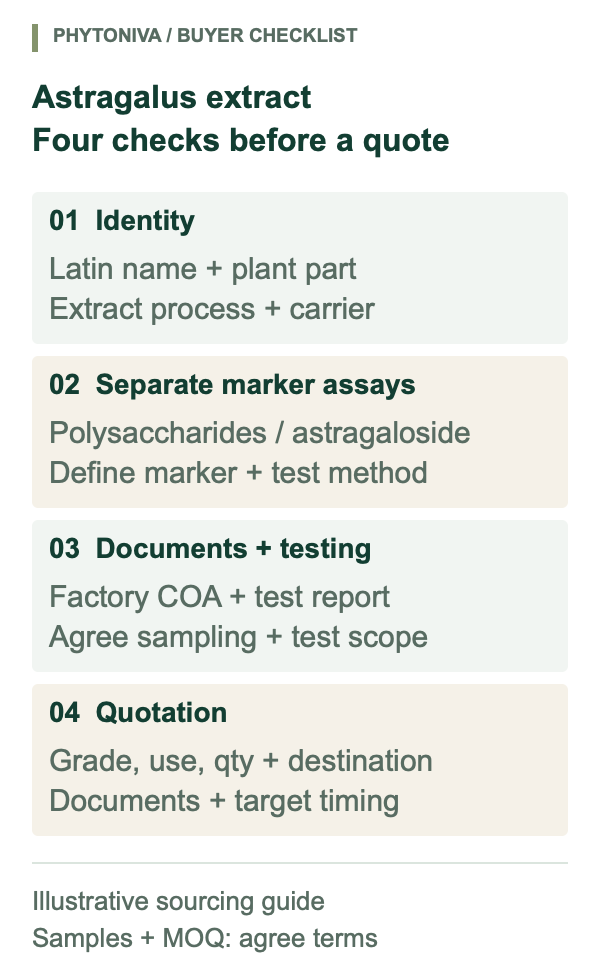
Astragalus extract: four checks before a quote
Identity
Confirm the botanical identity, plant part, extraction process and carrier in the supplier’s technical documents. If the project calls for root extract, state that requirement explicitly; the catalogue does not by itself confirm the offered species or plant part.
Separate marker assays
Supplier catalogue references list polysaccharides 50% and “Astragaloside” 0.3–10% as separate sourcing entries. Confirm the exact analyte, assay method and reporting basis; do not assume the English term means astragaloside IV or total saponins. These references do not guarantee combined specifications, every concentration in the range, availability or stock.
Documents + testing
The manufacturer provides its batch certificate of analysis (COA) and technical data sheet (TDS). Before procurement and dispatch, PHYTONIVA commissions independent third-party testing and obtains a report for the agreed tests. Agree sampling, test scope, methods and acceptance criteria for the order.
Quotation
Send the specification, intended use, quantity, destination, required documents and timing. Sample orders are welcome; MOQ, sample charges, freight, availability and timing are agreed for each order.
PHYTONIVA manages trade, sourcing and supplier coordination. The manufacturing partner provides its COA and relevant quality documents. Before procurement and dispatch, PHYTONIVA arranges independent third-party quality testing and obtains a report for the agreed scope. Sampling, methods, acceptance criteria, testing costs and timing are confirmed for the order. The manufacturer’s COA, test report and applicable certification records serve different purposes. Learn more about our quality and documentation process.
Product and purchasing FAQ
Is a 50% polysaccharide extract the same as an astragaloside IV extract?
No. They refer to different groups of compounds and different measurements. A polysaccharide assay does not state the astragaloside IV content.
Does the catalogue’s Astragaloside range guarantee astragaloside IV?
No. Ask which named compound or defined group the specification measures, with the method and reporting basis. We confirm those details for the proposed grade rather than infer them from a shortened catalogue term.
Can a small buyer place a sample order first?
Yes, sample-order enquiries are welcome. Explain whether you need the sample for identity and assay checks, sensory assessment or a formulation trial. Quantity, charges, freight, timing and subsequent MOQ are agreed for the proposed order.
Discuss your astragalus extract project
Send the specification, intended use, quantity, destination, required documents and timing through our B2B enquiry form, email sales@phytoniva.com, or WhatsApp +86 19991898850. A clear brief helps us compare suitable products, manufacturers and supply arrangements for your project.
Sourcing coordination and quality checks
PHYTONIVA manages trade, sourcing and supplier coordination, matching ingredients and supply options to your specification, application and destination. The manufacturing partner provides its COA and relevant quality documents. Before procurement and dispatch, we arrange independent third-party quality testing and obtain the report for the agreed testing scope.
Specifications, sampling, test scope, methods and acceptance criteria are agreed before ordering. The manufacturer COA and agreed third-party test report accompany the shipment. Certification is checked separately for the named holder, product and valid scope.
See our quality and documentation process