Menu
Chaga Mushroom Extract: Benefits and Buying Guide
Chaga mushroom extract is an ingredient made from Inonotus obliquus, a fungus associated with birch trees and recognizable by its dark, cracked conk. Its polysaccharides and phenolic constituents have attracted interest in antioxidant and immune-signaling research. For formulation teams, chaga offers a distinctive fungal ingredient to evaluate in capsules, blended powders and beverage concepts.
This guide explains what makes chaga different, what research actually shows, and how to compare extracts. PHYTONIVA welcomes sample-order enquiries, with MOQ discussed according to specification, packaging and supply conditions.
What is chaga mushroom extract?
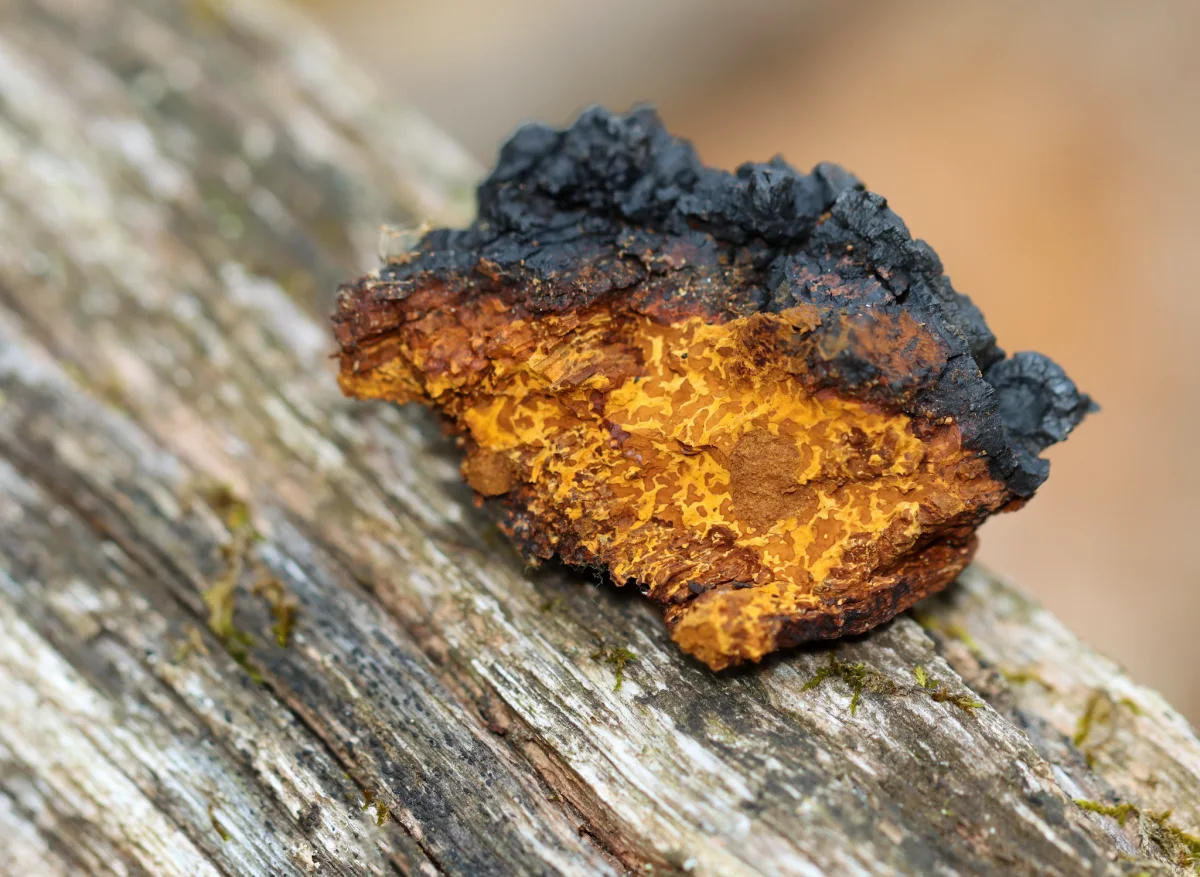
The familiar black chaga growth is a sterile conk, rather than a conventional cap-and-stem mushroom. Cultivated mycelium is another possible starting material. A 2021 analytical study compared conks, cultivated mycelium and colonized birch wood, finding different polysaccharide structures and molecular profiles. Conk fractions also contained bound phenolic compounds. This makes the source material part of the specification, rather than an interchangeable detail. Original material-comparison study.
Whole chaga powder is dried and milled material. An extract is produced by recovering selected components, followed by concentration and often drying. Extraction medium, processing and any added carrier affect the ingredient that reaches your formulation. Ask whether the proposed extract uses conk or mycelium and how remaining substrate or wood is controlled.
Which constituents matter?
- Polysaccharides: a broad carbohydrate category. Beta-glucans are a more specific group; a total-polysaccharide result does not establish their percentage.
- Phenolic constituents: investigated alongside polysaccharides in laboratory work on oxidation and immune-cell responses. Their measured profile depends on the material and extraction.
- Triterpenoids: another research-relevant constituent class. A polysaccharide-focused specification does not quantify these compounds; any project requiring a named marker needs a separate assay.
Define the constituent that matters to the project before comparing percentages. Two materials both described as “chaga extract” can be quite different in composition and handling. See the chaga catalogue entry and constituent references.
What effects are researchers investigating?
Antioxidant activity
A 2015 study compared water and ethanol extracts from chaga samples of different origins and reported antioxidant activity in laboratory assays. This helps explain interest in its chemical composition and in comparing extraction approaches. However, a laboratory oxidation result does not show that consuming a commercial extract prevents aging or provides a clinical antioxidant benefit. The preparation and assay must remain attached to the finding. Original chemical and biological study.
Immune and inflammatory signaling
In a 2022 study using mouse macrophage cells, a water-derived, ethanol-precipitated chaga extract affected resting and inflammation-stimulated cells differently. It increased some signaling markers in resting cells, while reducing several inflammatory markers in stimulated cells. The finding suggests context-dependent immune modulation, rather than a simple universal “immune boost.” It is a cell experiment, not proof of improved immunity or treatment of inflammation in people. Original macrophage study.
What this means for product development
These findings give researchers reasons to investigate defined chaga preparations and their constituent profiles. They do not establish a human benefit or dose for the catalogue grade. A useful development brief identifies the intended product concept, actual extract and measurable formulation goals, then evaluates the evidence for that preparation. Avoid converting laboratory results into disease-treatment claims.
How can chaga be evaluated in a formula?
- Capsules and tablets: check particle size, flow, bulk density, moisture and the intended fill weight. Compare the relevant constituent specification with the amount your format can accommodate.
- Coffee, cocoa and other beverage concepts: use an actual sample to assess color, flavor, dispersion and sediment in the chosen base. Test at intended preparation temperatures; an extract label alone does not guarantee clear dissolution.
- Mushroom blends and sachets: define each ingredient’s purpose and amount. Assess the complete blend for taste and physical stability, rather than assuming that a result from one ingredient applies to the combination.
These are evaluation directions, not confirmed performance or market-approval claims. A small sample trial using the same base and inclusion level can make differences between candidate grades easier to compare. For another fungal ingredient with a different research focus, see our lion’s mane extract guide.
Understanding the 10–30% polysaccharide reference
The reference catalogue lists chaga extract with 10–30% polysaccharides. This range is a starting point for discussing a grade, not confirmation that every percentage is available. Specify the assay method, reporting basis and carrier composition, and list a beta-glucan or triterpenoid requirement separately if needed.
For chaga, the purchasing brief should also address oxalate assessment and relevant microbial, contaminant and residual-solvent requirements for the actual process and intended use. A higher polysaccharide percentage alone does not resolve these other questions.
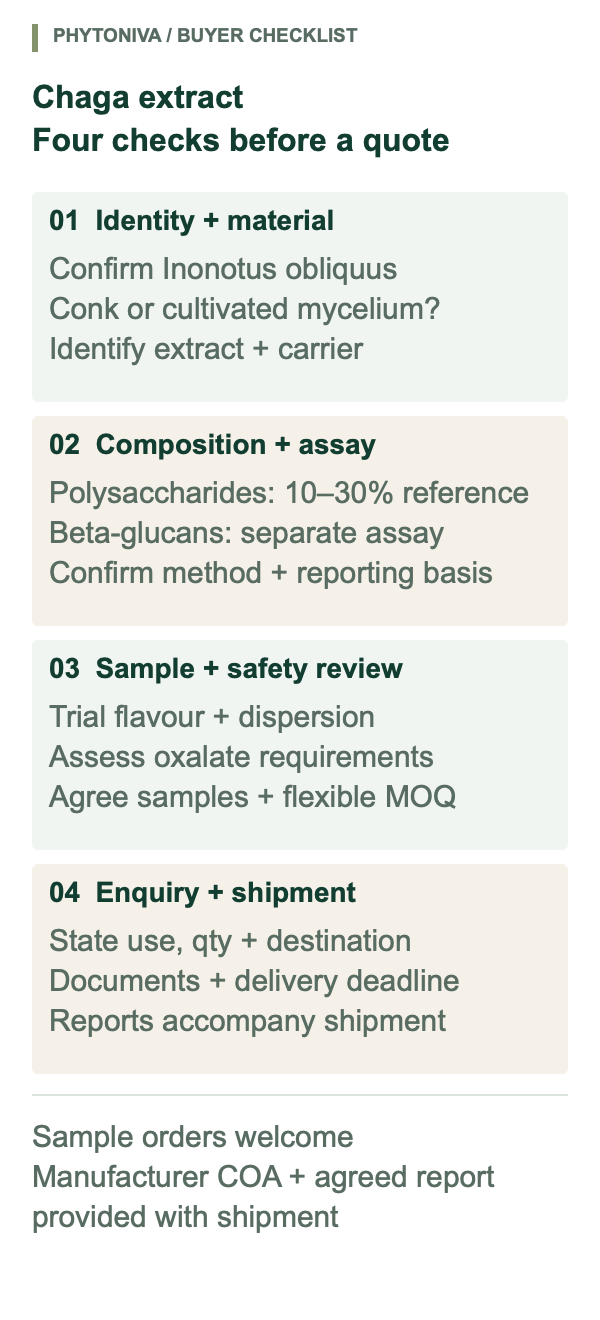
Chaga extract: four purchasing checks
Identity + material
Confirm the species, source material, extraction process and carrier. Identify whether the ingredient comes from a sterile conk or cultivated mycelium, and how substrate or wood is controlled.
Composition + assay
The catalogue lists 10–30% polysaccharides as a reference, not current stock or a beta-glucan result. Define the specific analyte, method, reporting basis and any separate marker requirement.
Sample + safety review
Evaluate the sample in the intended formula for flavor, color, dispersion and settling. Agree relevant oxalate, microbial, contaminant and process-related testing requirements. Sample costs and MOQ depend on the specification, packaging and supply conditions.
Enquiry + shipment
Provide specification, intended use, quantity, budget, destination, required documents and timing. Before ordering, agree the sample or batch to be tested, test scope, methods, acceptance criteria and delivery conditions. Manufacturer COA and the agreed third-party report accompany shipment.
Chaga-specific safety considerations
Oxalate deserves particular attention. A published case described kidney injury in a person taking substantial daily chaga powder together with vitamin C for three months, with calcium oxalate deposits identified in the kidneys. A case report cannot establish the risk from every extract, but it supports evaluating oxalate exposure and avoiding assumptions that concentrated chaga is automatically suitable for everyone. Original kidney-injury case report.
People with kidney disease or a history of oxalate stones should seek clinical advice before supplement use. MSK also flags possible interactions with anticoagulant/antiplatelet and blood-sugar-lowering medicines based on preclinical findings; the clinical significance is uncertain. These issues belong in the finished-product safety review. Chaga safety and interaction information.
Frequently asked questions
Is chaga powder equivalent to chaga extract?
No. Powder and extract describe different processing forms. Compare the starting material, extraction process, carrier and measured composition before substituting one for another.
Does 30% polysaccharides mean 30% beta-glucans?
No. Ask for the exact analyte and method. A total-polysaccharide specification is not a beta-glucan assay or proof of a particular biological effect.
Who provides the quality documents?
PHYTONIVA coordinates trade, procurement and supply resources. The manufacturer provides its COA; we arrange third-party quality testing before procurement and dispatch. The manufacturer COA and agreed third-party report accompany shipment. Presale COA samples and public COA downloads are not currently offered. A COA, third-party report and certification are distinct; a report covers its stated sample, tests and results. Our quality coordination workflow.
Request a chaga extract sample or quotation
Tell us your target specification, intended use, quantity, budget, destination, document requirements and timing. Sample orders are welcome; costs, MOQ, packaging and supply conditions are agreed for the project. We help match products and supply arrangements to those requirements.
Request a quotation · sales@phytoniva.com · WhatsApp +86 19991898850
Sourcing coordination and quality checks
PHYTONIVA manages trade, sourcing and supplier coordination, matching ingredients and supply options to your specification, application and destination. The manufacturing partner provides its COA and relevant quality documents. Before procurement and dispatch, we arrange independent third-party quality testing and obtain the report for the agreed testing scope.
Specifications, sampling, test scope, methods and acceptance criteria are agreed before ordering. The manufacturer COA and agreed third-party test report accompany the shipment. Certification is checked separately for the named holder, product and valid scope.
See our quality and documentation process