Menu
Yucca Extract: Saponins, Functions and Uses
Yucca extract is a botanical ingredient worth evaluating when a project needs saponin functionality, foam development or an animal-nutrition research ingredient. Its appeal is practical: researchers have investigated how Yucca preparations behave at liquid interfaces, stabilize selected formulations and affect feed-related outcomes. Understanding the preparation helps a buyer turn that research into a useful product-development brief.
PHYTONIVA helps ingredient distributors, small brands and formulation teams match products and supply options to their application, specification, budget and destination. Sample orders are welcome, and MOQ can be discussed according to the grade, packaging and supply conditions.
What is Yucca extract?
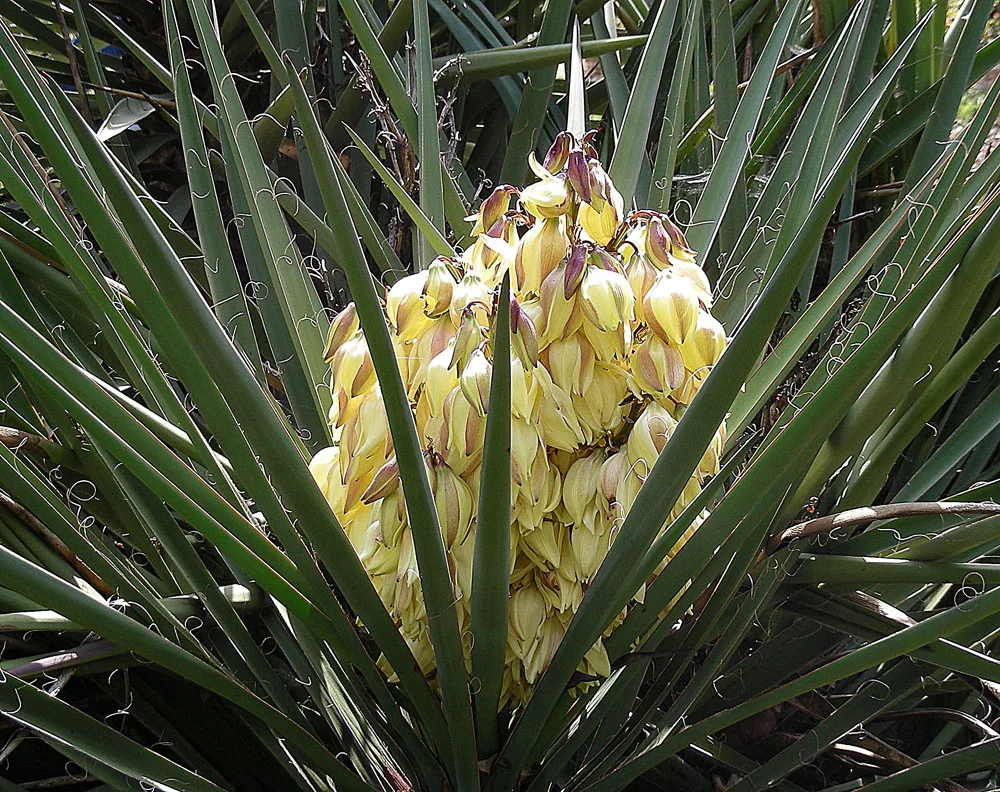
Yucca schidigera, often called Mojave yucca, is one species studied for these applications. Kew recognizes it in the Asparagaceae family. It is different from yuca or cassava, Manihot esculenta, the starch-producing plant recorded by Kew in Euphorbiaceae.
The name “Yucca extract” is not a complete specification. Whole-plant powder, liquid extract and a concentrated saponin powder are different materials. Confirm the proposed species, plant part and extraction process. The research species discussed here does not establish the identity or plant part of every option in a supplier catalogue.
Why are saponins the main selection point?
Yucca saponins include steroidal glycosides, with a sugar-containing region and a less water-compatible backbone. This structure helps explain their behavior at interfaces between water, oil and air. The useful purchasing question is which composition produces the desired behavior in your formulation, rather than whether the ingredient simply makes foam.
Also distinguish saponins from sapogenins, their sugar-free portions. A primary analytical study identified sarsasapogenin and smilagenin among the principal sapogenins obtained from its Yucca sample. Its hydrolysis and analytical procedures matter when interpreting the result: a sapogenin value is not automatically the same as intact total saponins. Original analytical study.
What functions and benefits have studies observed?
Emulsion development: useful surface activity
A laboratory study of a Y. schidigera extract containing 9.5% saponins produced small oil-in-water droplets. Its model emulsions remained stable at pH 5–9 and showed only minor droplet growth up to 90°C, while salt and freeze–thaw conditions caused instability. These findings support formulation screening, not a stability promise for every grade or finished product. Original emulsion study.
Foam structure: a food-formulation experiment
In a sugar-candy foam experiment, a water extract of Y. schidigera powder was added at levels equivalent to 50 or 100 ppm saponins. Researchers observed improvements in foam-product structure and oxidative stability during the study. This illustrates a technical application worth investigating; it does not establish a universal shelf life, a human antioxidant benefit or authorization for a proposed food use. Original foam study.
Animal nutrition: preparation-specific findings
A 56-day trial involving 480 broilers compared separate preparations, including a ≥30% Yucca-saponin powder and whole-plant Yucca powder, each at 500 mg/kg feed. Both Yucca groups showed higher average daily gain over the trial and lower fecal ammonia nitrogen at day 56 than controls. These were animal feeding results; fecal ammonia nitrogen is not a measurement of barn-air ammonia. The tested preparations and dose cannot be transferred directly to another grade. Original broiler study.
Pet-food research provides another application lead. A dog-and-cat study reported reduced fecal-aroma intensity assessed by a human panel, but also increased blood urea in treated cats. That combination makes species-specific formulation and tolerability assessment important. It is not a guarantee of odor reduction or suitability for all pets. Original pet-feeding study.
Turn the research into a development brief
The studies above concern formulation systems and animals; they do not establish a human treatment benefit. Buyers can still use them to define practical experiments. Start with the intended function and a measurable outcome, then test the proposed commercial sample against a control in the actual formulation.
- Foaming or emulsification projects: specify whether you want foam generation, foam persistence or oil dispersion. Assess behavior at your actual pH, mineral content, processing temperature and storage conditions. Record color, odor and compatibility with the other ingredients.
- Feed premixes: identify the target animal, diet, delivery form and evaluation endpoint. Ask a qualified animal-nutrition specialist to establish inclusion levels and assess feed intake, performance and tolerance. A study inclusion level is context, not a dosing instruction.
- Pet-food development: assess palatability, stool characteristics and tolerance as well as the intended odor endpoint. Keep animal species and the finished diet in the trial design instead of treating a saponin percentage as proof of efficacy.
For a small development team, a focused sample trial can be more informative than immediately choosing the highest percentage. Agree the evaluation plan before scaling up, including how the result will be judged. Confirm that the proposed ingredient and intended use are appropriate for the destination market.
Comparing Yucca extract specifications
One of our supplier reference catalogues lists saponins 20–60%. This is a reference range for possible specifications, not a statement that every grade is available or in stock. It is neither an extraction ratio nor proof that the material matches a published study preparation.
Ask for the proposed species and plant part, extraction solvent, physical form, carrier composition, assay method, reference standard and reporting basis. A dry-basis result and an as-supplied result need clear identification before comparison. Keep compositional tests separate from performance checks: percentage alone does not describe foam persistence, dispersion or behavior in a complete feed.
View the Yucca extract catalogue entry.
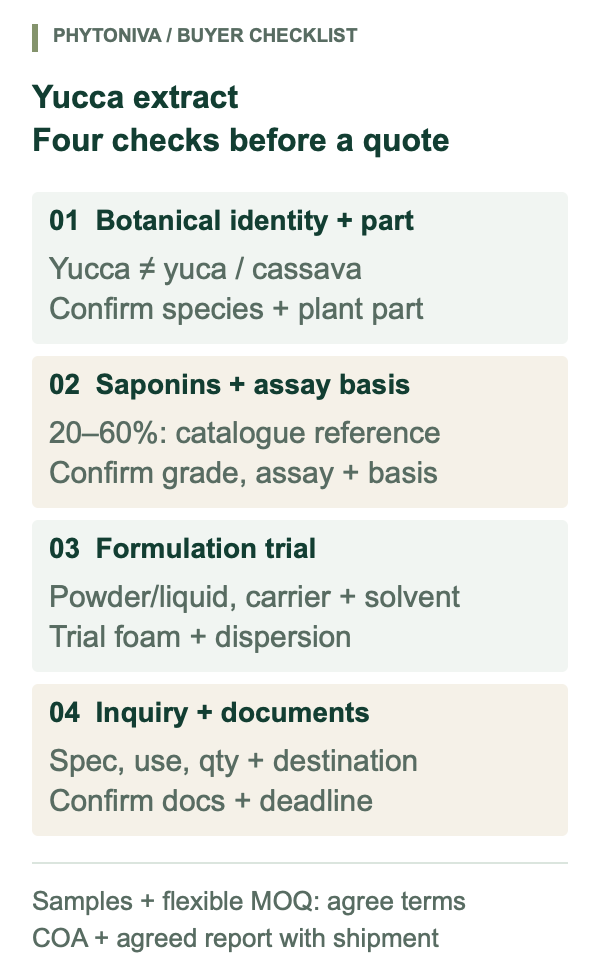
Yucca extract: four checks before a quote
Botanical identity + part
Confirm the offered botanical species and plant part. Yucca is distinct from cassava (yuca, Manihot esculenta). Yucca schidigera is a research reference here; the directory entry alone does not confirm that the offered material is this species or specify its plant part.
Saponins + assay basis
Saponins 20–60% is a directory reference, not a promise that every grade is available. Confirm the offered specification, assay method, reference standard and reporting basis, including whether the result is on a dry or as-is basis. Do not treat differing assays as interchangeable or interpret the percentage as therapeutic potency.
Formulation trial
Confirm whether the offered form is powder or liquid, and identify the carrier, extraction solvent and relevant formulation conditions. Evaluate foaming and dispersion in your actual formulation matrix and process.
Inquiry + documents
Send the specification, intended use, quantity, destination, required shipment documents and deadline. Sample orders are welcome; flexible MOQ, sample costs and packaging are agreed according to requirements and supply conditions. The manufacturer COA and agreed third-party test report accompany the shipment.
Frequently asked questions
Is Yucca extract the same as cassava powder?
No. They are different botanical materials. Include the Latin name, plant part and form in your purchasing brief so a common-name mix-up does not enter the specification.
Is a 60% saponin grade always better than 20%?
No. Compare the analytical basis and the outcome you need. The preferred grade is the one that fits the formulation and agreed evaluation criteria; a higher declared content does not automatically establish better performance or tolerance.
Can I order a sample or begin with a smaller quantity?
Yes, sample-order enquiries are welcome. Specify the tests you plan to run. Sample quantity, charges, packaging and supply availability are agreed for the proposed option, with subsequent MOQ discussed around your requirements.
Who handles quality testing and shipment documents?
PHYTONIVA coordinates trade, procurement and supply resources; the manufacturer provides its COA. We arrange independent third-party quality testing before procurement and dispatch. Before ordering, agree sampling, test scope, methods and acceptance criteria. The manufacturer COA and agreed third-party report accompany the shipment; we do not currently provide presale COA samples or public COA downloads. Reports cover their stated samples and test scope. Certification is checked separately for its holder, product and valid scope. See our quality coordination workflow.
Discuss your Yucca extract project
Send the required botanical identity, saponin specification, application, quantity, destination, document requirements and timing. Tell us whether the priority is a formulation trial, a feed project or distribution of a defined grade, so we can help match the product and supply arrangement.
Request a quotation · sales@phytoniva.com · WhatsApp +86 19991898850
Sourcing coordination and quality checks
PHYTONIVA manages trade, sourcing and supplier coordination, matching ingredients and supply options to your specification, application and destination. The manufacturing partner provides its COA and relevant quality documents. Before procurement and dispatch, we arrange independent third-party quality testing and obtain the report for the agreed testing scope.
Specifications, sampling, test scope, methods and acceptance criteria are agreed before ordering. The manufacturer COA and agreed third-party test report accompany the shipment. Certification is checked separately for the named holder, product and valid scope.
See our quality and documentation process