Menu
Cassia Seed Extract: Constituents, Benefits and Uses
Cassia seed extract, also known as Semen Cassiae or Jue Ming Zi extract, brings the chemistry of a familiar Asian botanical seed into a concentrated ingredient format. Its anthraquinones and related compounds have attracted research into lipid metabolism and retinal-cell responses to oxidative stress. For a buyer, the interesting question is how a clearly identified seed preparation fits the intended product—not simply which offer has the highest marker percentage.
PHYTONIVA helps small brands, ingredient distributors and formulation teams compare suitable products and supply options against their specifications, application, budget and destination. Sample orders are welcome, and MOQ can be discussed according to the grade, packaging and supply conditions.
What is Cassia seed extract?
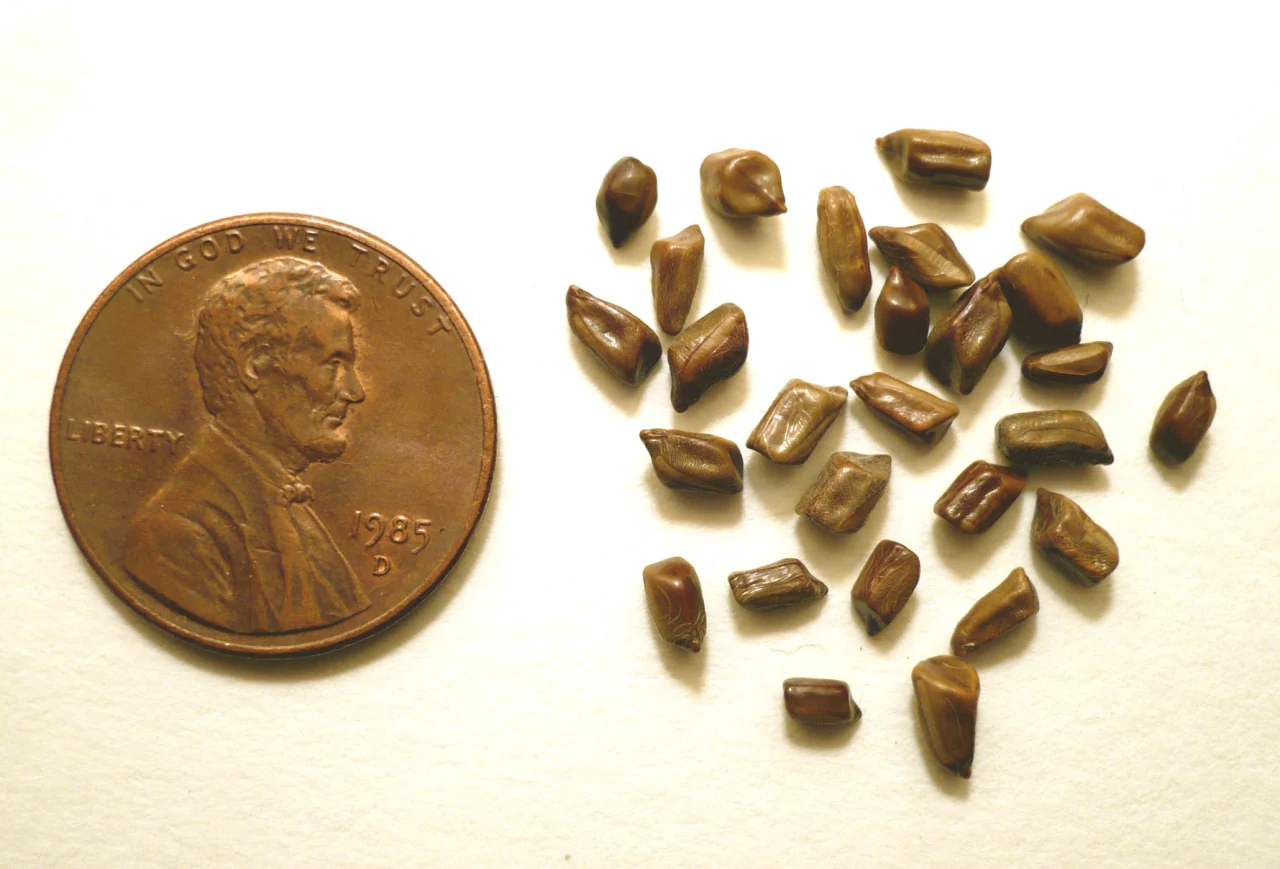
The starting material is the seed, rather than the leaf. Health Canada’s Semen Cassiae ingredient record lists seeds of Senna obtusifolia and Senna tora. These are also encountered under the older names Cassia obtusifolia and Cassia tora, respectively, as documented by Kew’s medicinal plant names database. Confirm the actual species in the proposed supply.
Whole or ground seed, roasted seed and a standardized seed extract are different preparations. “Cassia” alone is too broad an identification: this ingredient is not cinnamon bark or senna laxative leaf. It is also distinct from cassia gum, a purified seed-endosperm ingredient used for thickening.
Anthraquinones and the wider seed profile
Anthraquinones are a family of compounds, not one molecule. The Thai Herbal Pharmacopoeia’s Cassia Seed monograph describes anthraquinone aglycones and their glycosides, including chrysophanol, emodin and rhein, alongside other constituents such as toralactone and mucilage. The composition of an extract depends on the starting seed and processing.
A total-anthraquinone result summarizes a defined assay; it does not tell you the amount of each compound. Individual-marker measurements and a broader chemical profile can therefore answer different selection questions. Ask which compounds or reference standard the reported total represents before treating two percentages as interchangeable.
What benefits are researchers investigating?
Lipid metabolism and waist circumference: preliminary human evidence
A 2022 randomized, double-blind study assigned 94 overweight or obese patients with schizophrenia to processed C. obtusifolia seed powder at 3.0 g or 0.3 g daily for 36 weeks; 74 completed the study. Researchers reported lower waist circumference relative to baseline in the higher-dose group at weeks 24 and 36, and more favorable total-cholesterol and LDL changes than the low-dose group at week 36. Read the original trial.
These findings explain interest in metabolic-health research. They concern processed seed powder in a specific clinical population, with an active low-dose comparator. They do not establish general weight-loss efficacy or the same effects for a 1–5% anthraquinone extract. The study dose is not a dosing instruction for a different ingredient.
Eye-health research: a retinal-cell finding
In a 2023 laboratory study, C. tora seed extract and isolated chrysophanol reduced cell death in human retinal pigment epithelial cells exposed to a blue-light/A2E stress model. The researchers also examined changes in apoptosis-related gene expression. This provides a mechanistic reason to investigate seed constituents in eye-health research. The cells were grown in culture: the experiment did not demonstrate improved eyesight or protection from eye disease in people taking an extract. Original cell study.
Processing and antioxidant assays: why preparation matters
A food-processing study found that roasting time and temperature changed C. tora seed color, measured polyphenols and electron-donating activity. More heating was not uniformly better: an intensive roasting condition reduced measured polyphenols. This is useful formulation context, because processing belongs in the specification. Laboratory antioxidant assays do not establish a health benefit in consumers. Original roasting study.
How can buyers evaluate a formulation?
Botanical brands assessing metabolic-wellness or eye-health research concepts should start with the actual preparation and the claims supported for their intended market. A study on one seed powder or isolated constituent is a starting point for evaluation, not a ready-made claim for a finished product.
- Capsules and tablets: evaluate the proposed marker profile, serving mass, flow and moisture behavior. Confirm any carriers and other formulation ingredients.
- Powder blends or sachets: assess taste, color, particle size and mixing uniformity in a sample of the proposed grade. Confirm whether the seed was roasted before extraction.
- Liquid or beverage development: test dispersion, sedimentation, flavor and marker stability at the intended pH and temperature. Neither the word “extract” nor a higher assay guarantees water solubility.
Include gastrointestinal tolerability in development: the Thai monograph records a laxative use for the seed. Safety also depends on preparation and exposure. A 28-day rat study of S. obtusifolia aqueous seed extract found liver changes in its high-dose group and investigated anthraquinones as contributors. This animal finding does not quantify human risk, but it makes “higher concentration is always better” an unsuitable selection rule. Have a qualified reviewer assess the proposed serving, duration, medicines and intended users; the studies above do not establish suitability for pregnancy, breastfeeding or children. Original toxicology study.
Comparing Cassia seed extract specifications
Our supplier reference catalogue lists total anthraquinones 1–5%. This is a reference range across possible grades, not a statement that every concentration is in stock. It is neither an extraction ratio nor a guaranteed amount of chrysophanol or another individual constituent.
Compare species and seed identity, raw or roasted processing, extraction solvent, carrier content, assay method, reference standard and reporting basis. Where relevant, clarify whether the assay measures free compounds, glycosides or a total after hydrolysis. Establish which results and acceptance criteria will apply to the actual order.
View the Cassia seed extract catalogue entry.
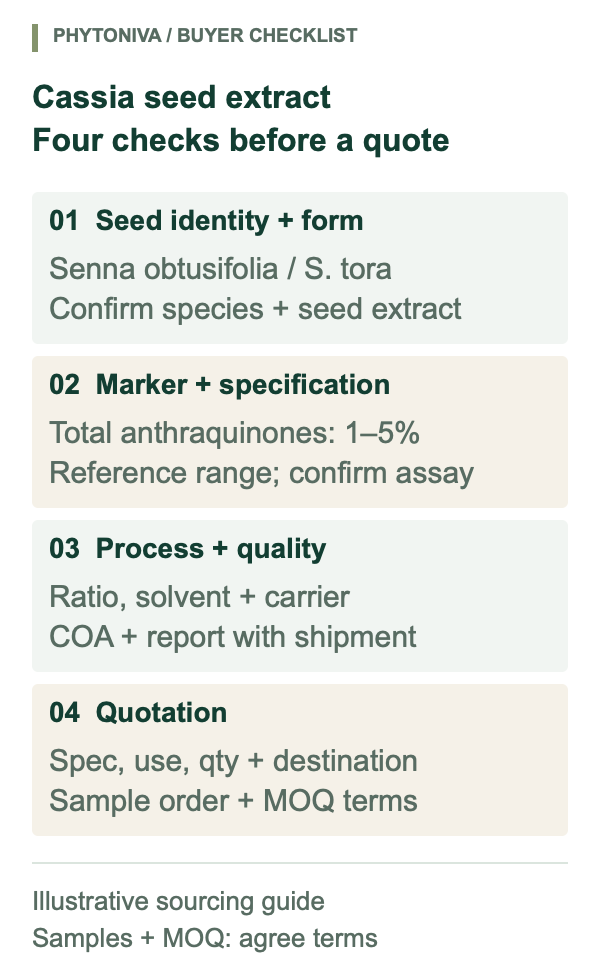
Cassia seed extract: four checks before a quote
Seed identity + form
Confirm the offered species: Senna obtusifolia or Senna tora, with seed as the plant part. Older names include Cassia obtusifolia and Cassia tora. Specify an extract rather than seed powder; do not substitute senna leaf, cinnamon or purified cassia gum.
Marker + specification
Total anthraquinones 1–5% is a catalogue reference, not a promise that every grade is available. Agree the offered percentage, assay method, reference substance and reporting basis. The percentage is not an extraction ratio, a single-compound content or a measure of therapeutic potency.
Process + quality
Define the extract ratio, extraction solvent and any carrier. Before ordering, agree the sample or batch, test scope, methods, acceptance criteria and shipment documents. PHYTONIVA coordinates sourcing and arranges independent third-party testing before procurement and dispatch; the manufacturer COA and agreed third-party report accompany the shipment.
Quotation
Send the specification, intended use, quantity, destination, required shipment documents and deadline. Sample orders are welcome; MOQ, sample costs and packaging are agreed for your requirements and supply conditions.
Frequently asked questions
Is Cassia seed extract the same as seed powder?
No. Powder retains the ground seed material, while extraction selects and concentrates constituents according to the process. Do not transfer the quantity or outcome from a seed-powder study directly to an extract.
Does a 5% total-anthraquinone grade automatically outperform a 1% grade?
No. A higher assay changes the marker delivery, but does not establish better efficacy, safety, taste or dispersion. Select the grade against the intended formulation and a comparable assay method.
Can I begin with a sample or a small order?
Yes, sample-order enquiries are welcome. Tell us what you need to evaluate. Sample quantity, charges, packaging and availability are agreed for the proposed option; subsequent MOQ is discussed around the specification and supply conditions.
Who handles quality testing and documents?
PHYTONIVA coordinates trade, procurement and supply resources; the manufacturer provides its COA. We arrange independent third-party quality testing before procurement and dispatch. Before ordering, agree sampling, test scope, methods and acceptance criteria. The manufacturer COA and agreed third-party report accompany the shipment; we do not currently provide presale COA samples or public COA downloads. A report covers its stated sample and test scope. Certification is checked separately for its holder, product and valid scope. See our quality coordination workflow.
Discuss your Cassia seed extract requirements
Send your required species and seed preparation, anthraquinone specification, application, quantity, destination, document needs and timing. We can help match these requirements to a suitable product and supply arrangement.
Request a quotation · sales@phytoniva.com · WhatsApp +86 19991898850
Sourcing coordination and quality checks
PHYTONIVA manages trade, sourcing and supplier coordination, matching ingredients and supply options to your specification, application and destination. The manufacturing partner provides its COA and relevant quality documents. Before procurement and dispatch, we arrange independent third-party quality testing and obtain the report for the agreed testing scope.
Specifications, sampling, test scope, methods and acceptance criteria are agreed before ordering. The manufacturer COA and agreed third-party test report accompany the shipment. Certification is checked separately for the named holder, product and valid scope.
See our quality and documentation process