Menu
Angelica Sinensis Extract: Constituents, Benefits Research and Uses
Angelica sinensis extract, often called dong quai extract, brings a long history of traditional herbal use together with an interesting constituent profile. Its root contains compounds such as ligustilide and ferulic acid, while different extraction processes produce different mixtures. For a formulation team, understanding those differences is the starting point for selecting a useful sample.
This guide explains the ingredient, its main constituents, the effects researchers have investigated and practical formulation questions. PHYTONIVA helps small brands, distributors and development teams compare suitable supply options. Sample orders are welcome; MOQ can be discussed according to the specification, packaging and supply conditions.
What is dong quai extract?
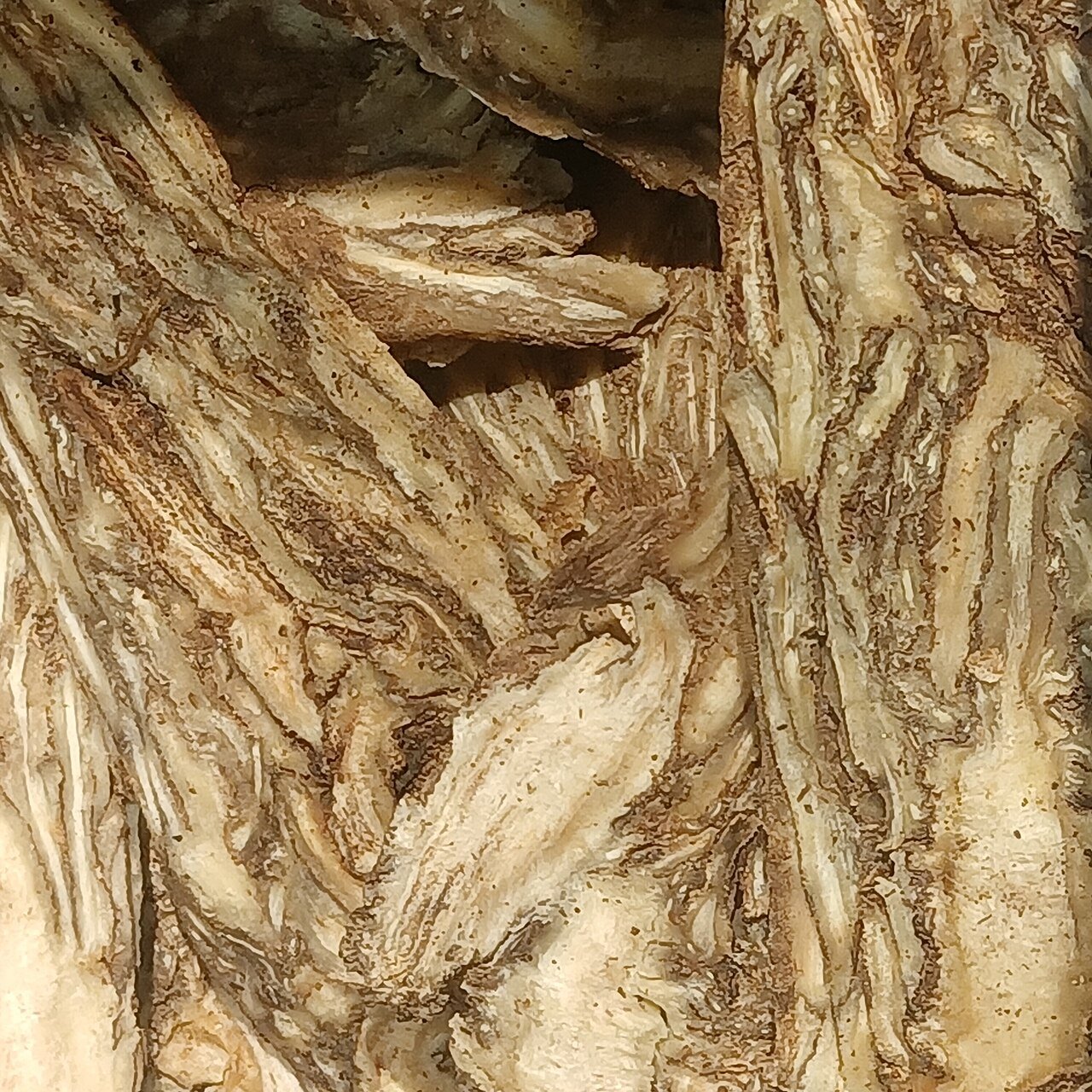
Dong quai refers here to Angelica sinensis, with the root used as the botanical starting material. Health Canada’s dong quai monograph identifies the species and root and describes uses within Traditional Chinese Medicine. Other Angelica species, including A. dahurica and A. archangelica, are different ingredients.
Dried slices, ground root powder and extracts offer different ways to work with the plant. An extract is produced by separating selected constituents from the starting material; its solvent, processing and carrier influence the resulting composition. A water extract used in a study, a ligustilide-focused grade and whole-root powder should therefore be described as distinct materials.
Ligustilide, ferulic acid and the extract profile
Ligustilide is a phthalide constituent associated with dong quai root. It is a useful marker for discussing composition and has been investigated in experimental studies of smooth-muscle activity. A ligustilide assay describes that constituent; it does not measure the whole extract or all of its biological properties.
Ferulic acid is a different constituent, belonging to the phenolic-acid group. A request for ferulic acid content is therefore a separate analytical question from a ligustilide specification. Our catalogue identifies these as constituent references, while the offered material’s actual profile should be documented in its specification.
An original study of purified Z-ligustilide documented changes during handling and over time. For formulation work, this makes the assay definition, test date and the proposed material’s stability and storage information useful questions to ask.
For buyers, this turns “dong quai extract” into a more precise choice: which composition is relevant to the project, how is it measured, and how does the sample behave in the intended formula? An extraction ratio alone cannot answer all three questions.
Dong quai benefits: what traditional use and research tell us
Traditional menstrual-health use and the human evidence
Dong quai has been used in Traditional Chinese Medicine in connection with menstrual complaints. An EMA assessment report summarizes these traditional menstrual-use descriptions. This explains part of the ingredient’s history and why it attracts interest in women’s-health development; it is a description of traditional use, not proof that any commercial extract achieves those outcomes.
A randomized, double-blind trial involving 71 postmenopausal women over 24 weeks tested dong quai alone. It did not outperform placebo for menopausal symptoms and did not show estrogen-like effects on the measured endometrial or vaginal outcomes. This particular human result is important when choosing a product concept: the ingredient should not be presented as established hormone replacement or a proven stand-alone menopause treatment.
Ligustilide and smooth-muscle activity
An original experimental study found that isolated ligustilide inhibited contractions in rat uterine tissue studied outside the animal. This provides a specific mechanistic reason for scientific interest in the constituent and its relationship to smooth-muscle activity. The evidence is ex-vivo tissue research; it does not establish menstrual-pain relief in people or the performance of a commercial extract containing 1% ligustilide.
Water-extract research on inflammatory signalling
In an original cell study, an A. sinensis root water extract reduced nitric oxide production and several inflammatory mediators in mouse macrophages stimulated with lipopolysaccharide. Such experiments help researchers examine how a preparation interacts with inflammatory signalling. These are laboratory cell findings, not a demonstrated anti-inflammatory treatment effect in humans, and the tested water extract is not interchangeable with every marker-standardized grade.
The useful lesson is that the plant, isolated ligustilide and a particular water extract represent different research materials. Product development benefits from matching the preparation and evidence to the intended concept, rather than combining all reported findings into a single claim.
Applications and formulation questions to evaluate
Once the intended finished-product category and destination are clear, sample evaluation can make the ingredient choice more practical:
- Capsules and tablets: compare marker content alongside carrier level, bulk density, flow and compatibility with the proposed formulation. Set the sample acceptance criteria before moving to a pilot order.
- Powder blends: evaluate flavour, odour, colour and mixing uniformity in the actual recipe. The sensory contribution of a botanical extract can matter as much as its headline assay.
- Liquid or beverage concepts: test dispersion, sedimentation and stability at the intended pH, processing temperature and storage conditions. Request a grade appropriate for evaluation rather than assuming all extracts dissolve identically.
- Multi-botanical formulations: assess the complete formula, ingredient interactions and evidence supporting the intended use. Research on a combination cannot automatically establish the contribution of dong quai by itself.
These are development suggestions, not a statement that a particular grade is approved for each use. For both US buyers and buyers in individual African countries, share the actual destination and product category so the relevant requirements can be considered.
Safety considerations for product planning
Health Canada’s monograph advises against use during pregnancy or with bleeding disorders or heavy periods, and calls for professional advice for breastfeeding, blood-thinning medicines and specified health conditions. Review the proposed preparation and target users with an appropriately qualified professional, particularly for hormone-sensitive conditions or concurrent medication. These considerations belong in the development brief, not only on the final label.
The monograph is a reference within a particular regulatory framework; it does not establish authorization for PHYTONIVA’s offered material or another destination market. Ingredient eligibility, final claims and the supporting safety information must be assessed for the actual product.
Choosing a specification and planning the order
The Angelica sinensis extract catalogue entry can be used to begin an enquiry. Identify the required plant part, extraction process and marker profile, then evaluate the proposed sample against the formulation brief. The concise checklist below covers the specification reference and the information needed for a quotation.
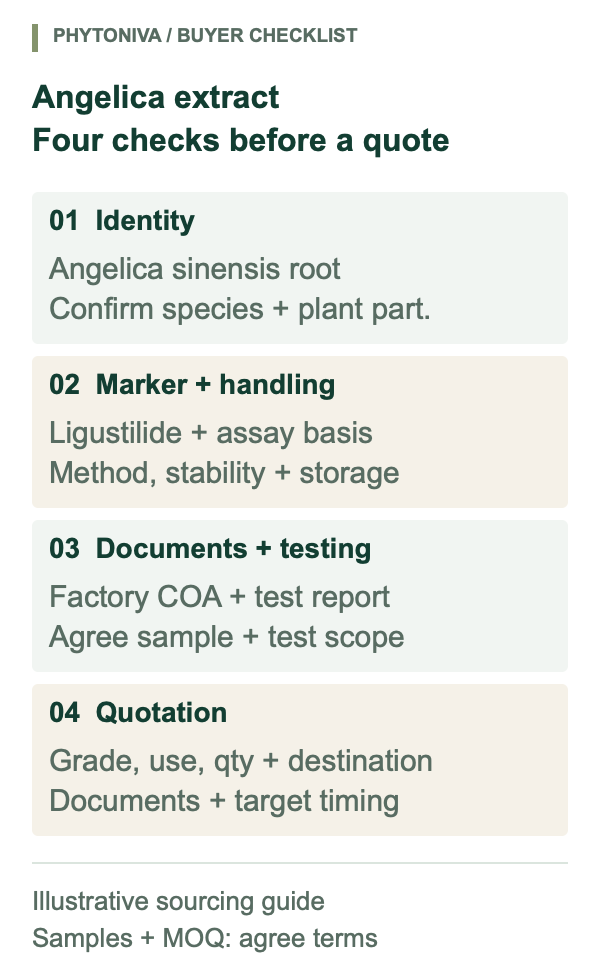
Angelica extract: four checks before a quote
Identity
Confirm Angelica sinensis and root as the source material in the supplier’s technical documents. Keep other Angelica species distinct when comparing extracts.
Marker + handling
The catalogue lists ligustilide 1% as a sourcing reference; confirm the actual offered grade and availability. Agree the assay method and reporting basis, and request stability, packaging and storage information for the proposed material.
Documents + testing
The manufacturer provides its batch certificate of analysis (COA) and technical data sheet (TDS). Before procurement and dispatch, PHYTONIVA commissions independent third-party testing and obtains the report for the agreed sample or batch, test scope and methods.
Quotation
Send the specification, intended use, quantity, destination, required documents and timing. Sample orders are welcome; MOQ, sample charges, freight, availability and timing are agreed for each order.
PHYTONIVA handles trade, procurement coordination and supply-resource matching. The manufacturing partner provides its own production and quality documents; we arrange the independent testing described above. Agree sampling, acceptance criteria, testing costs and timing for the project. The manufacturer’s COA, third-party test report and any certification certificate are distinct records, each applying to its stated material, sample or scope. See our quality and documentation process.
Product and purchasing FAQ
Is dong quai powder the same as a ligustilide-standardized extract?
No. Powder and extract are different processing forms. Compare the actual composition, carrier and analytical specifications against the development brief rather than treating their quantities as equivalent.
Does a ligustilide assay confirm the botanical species?
A marker result is one part of the specification. Confirm the botanical identity and root material separately through the supplier’s relevant technical and quality documents.
Can a small buyer start with a sample order?
Yes, sample-order enquiries are welcome. Explain whether the sample is for identity and assay checks, sensory assessment or a formulation trial, together with the quantity and required timing. Sample charges, freight and MOQ are agreed for the proposed order.
Discuss your dong quai extract project
Send the specification, application, quantity, destination, required documents and timing through the B2B enquiry form, email sales@phytoniva.com, or WhatsApp +86 19991898850. A clear brief helps us compare suitable products, manufacturers and purchasing arrangements for your project.
Sourcing coordination and quality checks
PHYTONIVA manages trade, sourcing and supplier coordination, matching ingredients and supply options to your specification, application and destination. The manufacturing partner provides its COA and relevant quality documents. Before procurement and dispatch, we arrange independent third-party quality testing and obtain the report for the agreed testing scope.
Specifications, sampling, test scope, methods and acceptance criteria are agreed before ordering. The manufacturer COA and agreed third-party test report accompany the shipment. Certification is checked separately for the named holder, product and valid scope.
See our quality and documentation process