Menu
Eleuthero Extract: Benefits Research, B+E Specifications and Bulk Buying
Eleuthero extract is an ingredient sourced from Eleutherococcus senticosus, commonly discussed in fatigue and stress-related botanical research. For B2B buyers, the useful starting point is a verified botanical identity and a defined eleutherosides B+E specification. An assay number alone does not establish clinical benefits or make different extracts interchangeable.
PHYTONIVA helps ingredient buyers compare supply options against their formulation and documentation needs. Our sourcing reference lists eleutherosides B+E at 0.8–1.5%. This is a catalogue reference range, not a confirmed stock list or a guarantee that every value is available. MOQ can be discussed according to specification, packaging and supply conditions; sample-order enquiries are welcome.
Eleuthero, Siberian ginseng and Panax: establish the identity first
“Siberian ginseng” is a common name used for eleuthero, but Eleutherococcus senticosus is different from Panax ginseng. Do not substitute ginsenoside requirements for eleutheroside requirements or transfer evidence between the plants. Specify the Latin name and actual plant part in the purchase brief.
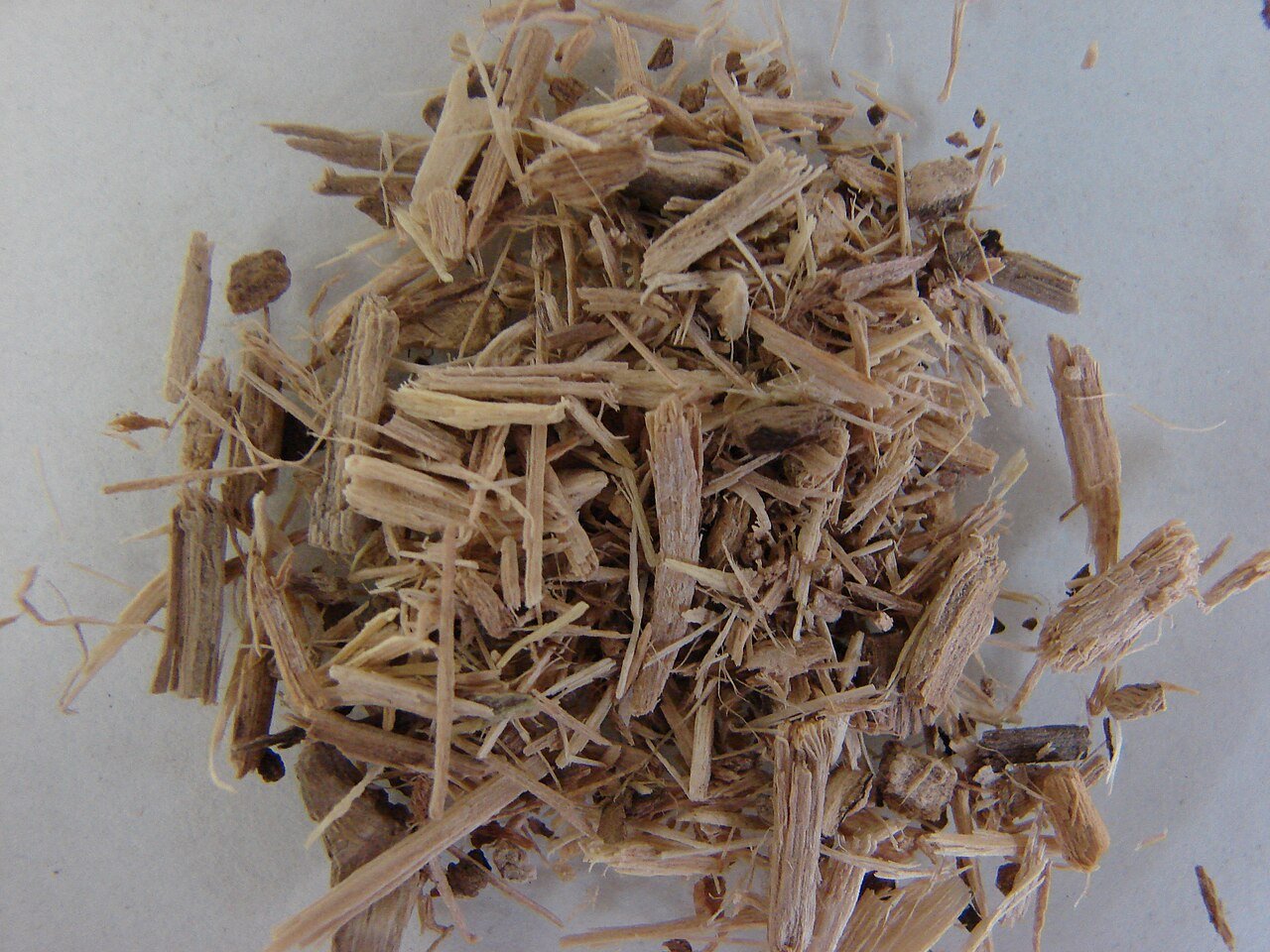
The European Medicines Agency’s eleutherococcus assessment concerns root preparations. Our supplier catalogue does not identify the part used for the listed grades. The photograph is a root identification reference, not an offered batch or confirmation of the extraction material. Request the actual part, origin, extraction solvent, extract ratio where relevant, and carrier composition in the technical data sheet (TDS).
For US food ingredient labeling, FDA’s explanation of 21 U.S.C. §343(u) restricts the term “ginseng” to material derived from the genus Panax. Use the verified eleuthero identity and have the final market-specific label reviewed. A familiar search term is not automatically an appropriate ingredient label.
View the eleuthero extract catalogue entry for the initial sourcing discussion. Confirm the offered grade and documents before ordering.
Eleuthero extract benefits: what the research supports
Traditional fatigue and weakness use
EMA recognizes a traditional-use basis for certain eleutherococcus root medicines addressing fatigue and weakness. Its assessment also notes that clinical studies do not provide firm evidence of efficacy. This distinction matters: long-standing medicinal use is not proof that an unspecified bulk extract reliably improves energy, stress resilience or sports performance.
A randomized trial did not establish overall fatigue efficacy
In a 2004 randomized controlled trial, 96 participants with persistent unexplained fatigue were assigned to treatment, and 76 provided two-month follow-up information. Both groups improved, but the full-sample difference between eleuthero and placebo was not statistically significant. Subgroup signals were exploratory and did not establish overall efficacy. These results concern that study preparation and population, not the commercial grades in our catalogue.
Buyer takeaway: “adaptogen” is a common positioning term, not a substitute for product-specific evidence. Match any research to the species, part, preparation and intended claim. Do not turn laboratory findings or traditional-use descriptions into a claim to treat chronic fatigue or another medical condition. These notes support ingredient evaluation; they are not treatment or dosing instructions.
Comparing eleutherosides B+E specifications
A B+E specification should say what was measured and how the reported total was obtained. Ask for the individual B and E results where available, the reference standards, the method and the reporting basis. “Total eleutherosides,” a B+E sum and a single-marker specification should not be assumed to describe the same assay.
- Identity and part: confirm Eleutherococcus senticosus and the actual extraction material; root research does not establish equivalence for another part.
- Assay definition: confirm whether 0.8–1.5% refers to the sum of B and E, the selected grade’s acceptance limit, and how the method distinguishes the markers.
- Basis and composition: specify dry basis or as-supplied basis, moisture treatment, any carrier and the complete extract composition.
- Process and application: discuss solvent, extract ratio and physical properties. Assess flavour, colour and dispersion in the intended formulation rather than predicting them from assay percentage.
The reference range does not mean all strengths share the same plant part, extraction process or test method. Nor does a higher marker percentage demonstrate a stronger health effect. Compare quotations against one agreed specification before comparing unit prices.
Eleuthero extract (Eleutherococcus senticosus): four checks before a quote
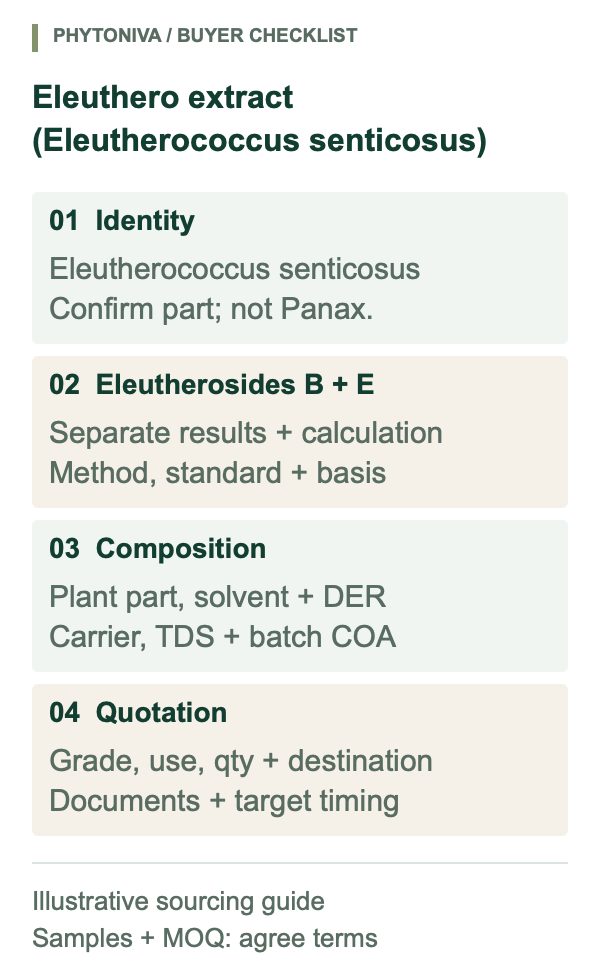
Identity
Confirm that the offered extract is Eleutherococcus senticosus using relevant identity documentation and a COA, and verify the actual plant part. Do not treat eleuthero as a Panax ingredient or assume different species or plant parts are interchangeable.
Eleutherosides B + E
Request the separate results for eleutherosides B and E, how the combined value is calculated, the analytical method, reference standards, and whether the result is on a dry basis or as supplied. The catalogue range of 0.8–1.5% B+E is a sourcing reference, not a guarantee of available grades or stock.
Composition
Confirm the plant part, extraction solvent, drug-to-extract ratio (DER), any carrier and full composition. Request the technical data sheet (TDS) and relevant batch certificate of analysis (COA), then assess a representative sample in your intended formulation.
Quotation
Provide the target specification, intended use, quantity, destination country, required documents and timing. Sample orders are welcome. MOQ depends on the grade, packaging and supply conditions; sample charges, freight and availability are confirmed individually, without a promise of free samples.
Quality documents and destination requirements
Request a TDS and relevant batch certificate of analysis (COA), including identity, marker assay and agreed quality limits. Depending on the intended use, discuss microbiological testing, heavy metals, pesticides, residual solvents and traceability, with methods and acceptance criteria stated clearly.
Any certification must match the holder, manufacturing site, product scope and current validity. Review the quality and documentation information when preparing the enquiry. A certificate for a supplier or another ingredient does not automatically cover your order.
State the destination country and finished-product category. A US supplement brief and a food or botanical-product brief for a particular African country can require different assessments. Do not treat a catalogue entry, an EMA traditional-use assessment or another country’s sale as authorization for your target market.
Flexible MOQ and a practical sample order
Sample orders can help small brands, ingredient distributors and formulation teams evaluate an extract before committing to bulk supply. Tell us the tests or formulation work planned, the sample quantity and destination. MOQ, sample charges, freight, pack size and timing are discussed for the chosen specification and current supply conditions; free samples or immediate availability are not promised.
After evaluation, agree how the sample’s identity, composition and test requirements will be carried into the bulk purchase specification. Keep a record of the approved specification and the supporting batch documents.
Eleuthero extract purchasing FAQ
Is eleuthero the same as Asian or American ginseng?
No. Specify Eleutherococcus senticosus for eleuthero. Asian and American ginseng are Panax materials; their marker specifications and research cannot simply be transferred to eleuthero.
Does a B+E percentage prove a fatigue benefit?
No. It describes an agreed chemical assay, not a clinical outcome. Research must be assessed for the actual preparation and intended claim.
Are all grades within 0.8–1.5% available?
Availability and the exact grade require confirmation. The catalogue range is a sourcing reference; the quotation should state the offered specification, method, composition and supply terms.
What should an RFQ include?
Send the botanical name and part required, B+E target and method if known, intended application, quantity, packaging, destination country, documents needed and delivery timing. If you are still choosing a specification, explain the application and evaluation criteria.
Request an eleuthero extract quotation
Use the ingredient enquiry form, email sales@phytoniva.com, or contact WhatsApp +86 19991898850. We welcome clear sample and bulk-order briefs and can compare suitable supply options against your requirements.
Sourcing coordination and quality checks
PHYTONIVA manages trade, sourcing and supplier coordination, matching ingredients and supply options to your specification, application and destination. The manufacturing partner provides its COA and relevant quality documents. Before procurement and dispatch, we arrange independent third-party quality testing and obtain the report for the agreed testing scope.
Specifications, sampling, test scope, methods and acceptance criteria are agreed before ordering. The manufacturer COA and agreed third-party test report accompany the shipment. Certification is checked separately for the named holder, product and valid scope.
See our quality and documentation process