Menu
Tribulus Terrestris Extract: Saponins, Research and Bulk Buying
Tribulus terrestris extract is a botanical ingredient that buyers often compare by total-saponin percentage. A useful buying decision also needs the plant part, test method, composition and intended application. A higher percentage alone does not establish a better fit, a particular protodioscin content or a proven health effect.
PHYTONIVA helps ingredient buyers compare suitable supply options. Our sourcing reference lists 40%, 60% and 90% total saponins; these are catalogue references, subject to confirmation for the offered material. MOQ can be discussed according to specification, packaging and supply conditions, and sample orders are welcome. Tell us what you need to evaluate before requesting a quote.
What is Tribulus terrestris extract?
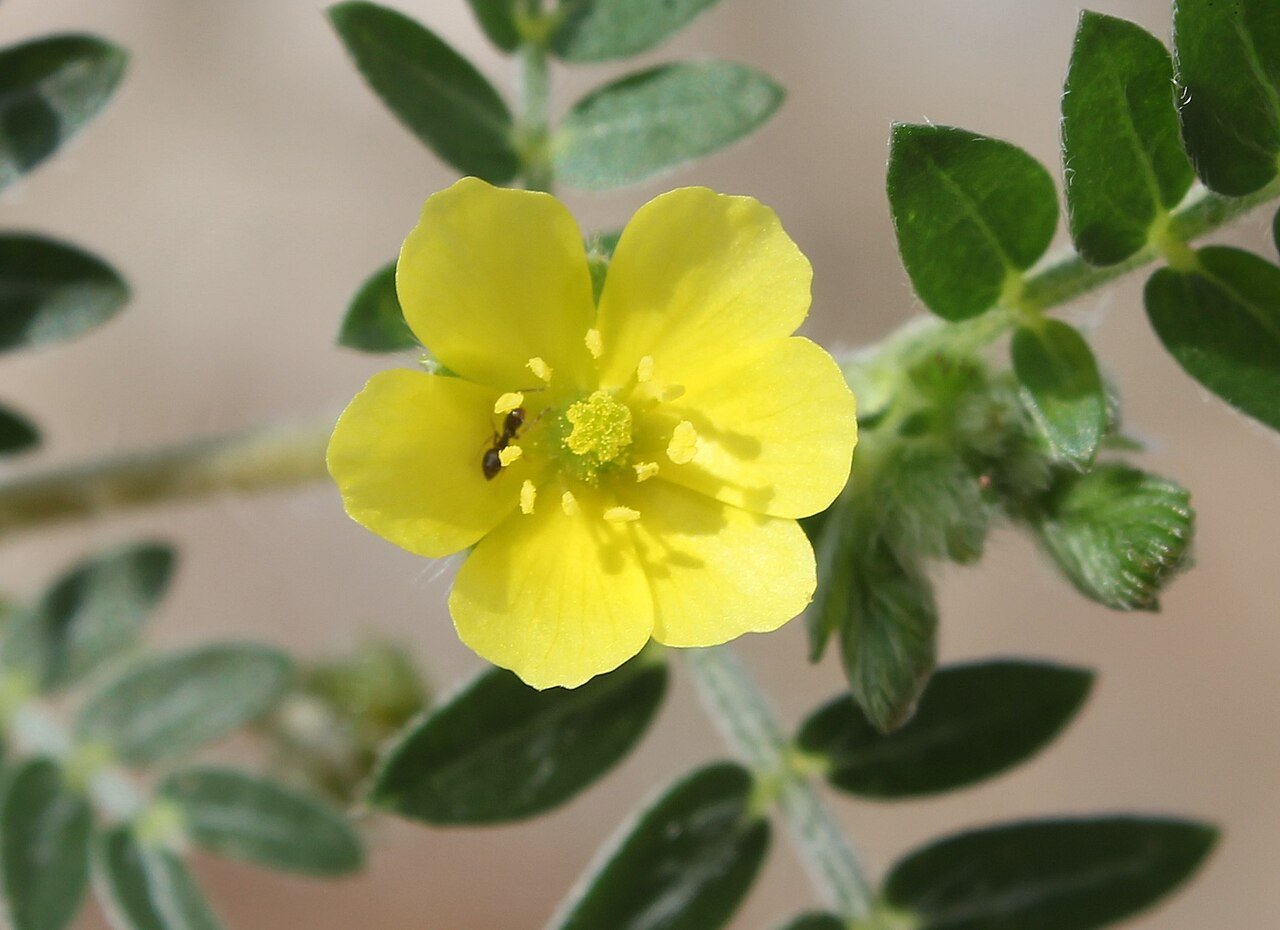
Tribulus terrestris is the botanical identity to specify when sourcing this ingredient. Extracts, raw botanical powders and extracts from different plant parts should be distinguished in a purchase specification. The botanical photograph above is an identification reference; it is not a photograph of an offered batch or confirmation that flowers or leaves are the supplied extraction material.
The catalogue does not confirm the plant part for these grades. Ask for the Latin name, actual part used, origin information, extraction process and a technical data sheet (TDS). Compare these with the ingredient described in any research you intend to use. A shared plant name does not make two preparations equivalent.
See the Tribulus extract entry in our product catalogue. The catalogue supports initial sourcing discussions; an agreed specification and relevant batch documents are needed for a purchase.
Benefits research: what buyers can and cannot conclude
Tribulus is discussed in sexual-health and sports-nutrition research, but the evidence concerns particular preparations and populations. It does not justify promising that every commercial extract raises testosterone, builds muscle or treats a medical condition.
A preparation-specific sexual-function trial
A 2017 randomized, double-blind, placebo-controlled trial enrolled 180 men with mild or moderate erectile dysfunction, with or without low sexual desire. Over 12 weeks, a particular standardized dry extract of the aerial parts improved questionnaire-based sexual-function outcomes compared with placebo. This is a clinical signal for that studied preparation and population, not evidence of equivalence for our catalogue’s 40%, 60% or 90% total-saponin references. The author affiliations include the product manufacturer.
Sports and testosterone claims need caution
The NIH Office of Dietary Supplements provides a cautious assessment of Tribulus as a performance ingredient. Buyers should also examine individual newer trials rather than relying on a general “testosterone booster” description.
For example, a 2021 randomized, single-blind trial studied 30 trained men for six weeks. Results were mixed: most performance and body-composition outcomes did not show a significant treatment-by-time effect. Testosterone was broadly maintained in the intervention group while it fell in the comparison group; that is different from demonstrating a clear increase from baseline. The intervention capsules also contained zinc sulfate, limiting attribution to Tribulus alone. This small, short study cannot establish that an unspecified bulk extract will improve performance or testosterone.
Procurement implication: choose measurable identity, composition and quality requirements. Do not substitute a catalogue assay percentage for substantiation of a finished-product claim. These research notes are for ingredient evaluation, not treatment or dosing advice.
How to compare 40%, 60% and 90% total-saponin references
An original chemical analysis of Tribulus aerial parts identified multiple saponins. Total saponins describe an aggregate assay result, whereas protodioscin is an individual compound. A total-saponin result does not establish the protodioscin content. If your formulation brief requires this marker, ask whether it can be specified and measured separately.
- Method and reference standard: request the test procedure and the material against which the result is calculated. Percentages obtained by different methods may not be directly comparable.
- Reporting basis: establish whether the percentage refers to a dry basis or the material as supplied, and how moisture and any carrier are handled.
- Composition and process: confirm the extraction solvent, extract ratio where relevant, excipients or carriers and the complete offered composition.
- Application fit: assess appearance, odour, dispersibility and behaviour in the actual formulation. These properties cannot be inferred from total saponins alone.
The 40%, 60% and 90% references are starting points for an RFQ. They do not mean that every grade is in stock, uses the same assay, has the same composition or has been tested in the clinical trials above.
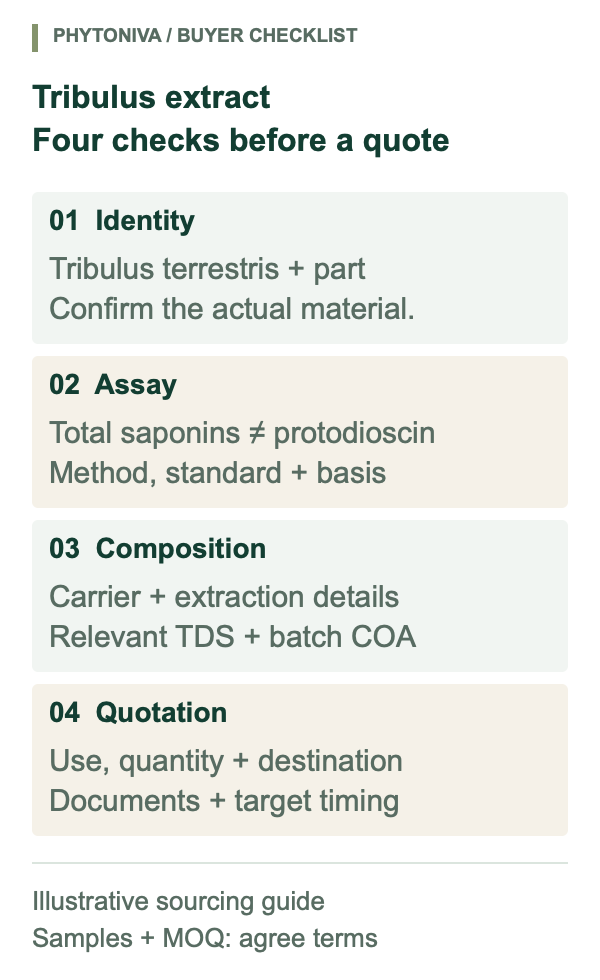
Tribulus extract: four checks before a quote
Identity
Confirm the identity as Tribulus terrestris and the actual plant part for the offered extract. A product name alone does not establish the material or make different plant parts interchangeable.
Assay
Request the total-saponin assay method, reference standard and reporting basis. The catalogue grades of 40%, 60% and 90% are sourcing references, not guaranteed available specifications. Total saponins do not establish the protodioscin content; specify and test that marker separately if required.
Composition
Confirm extraction details, any carrier and the full composition. Request the technical data sheet (TDS) and relevant batch certificate of analysis (COA), then assess a representative sample in your intended formulation.
Quotation
Provide the intended use, target specification, quantity, destination country, required documents and timing. Sample orders are welcome. MOQ, sample charges, freight and availability are discussed for the selected grade and supply conditions; free samples are not guaranteed.
Documents, destination and sample evaluation
Request the TDS and relevant batch certificate of analysis (COA), with agreed identity and assay tests, microbiological requirements, heavy-metal limits and other tests appropriate to the application. Where relevant, discuss residual solvents, pesticide testing and traceability. Define the methods and acceptance criteria before treating two quotations as comparable.
Any certification must be checked for its holder, site, scope, product coverage and validity. A supplier certificate does not automatically cover every ingredient or finished-product use. Our quality and documentation page explains the sourcing discussion.
For a US destination or a specific African country, state the country and intended product category. Ingredient acceptance, permitted claims and importer requirements need to be checked for that actual market and use; “Africa” alone is not a sufficient destination brief. We do not infer market authorization from a catalogue listing.
Use a representative sample to assess the agreed specification and application. If a sample is approved, agree how its specification, composition and test requirements will carry through to the bulk order.
Tribulus extract purchasing FAQ
Is a 90% grade always preferable to 40% or 60%?
No. The appropriate choice depends on the assay, composition, formulation and target specification. Compare material on a consistent testing basis before comparing prices or selecting a grade.
Does total saponins mean protodioscin?
No. Request a separate protodioscin specification and supporting test result if your brief requires it. Do not infer an individual marker percentage from a total-saponin claim.
Can I place a small trial or sample order?
Yes, sample-order enquiries are welcome. MOQ, pack size, sample charges, freight and timing are discussed for the selected specification and current supply conditions. Free samples and immediate availability are not promised.
What should I send for an accurate quotation?
Send the species and plant part required, target assay and method if known, intended application, quantity, packaging, destination country, document requirements and delivery timing. If a requirement is still open, tell us what you are trying to achieve so that suitable options can be compared.
Request a Tribulus terrestris extract quote
Discuss your specification through our ingredient enquiry form, email sales@phytoniva.com, or contact us on WhatsApp +86 19991898850. We welcome clear briefs from ingredient distributors, formulation teams and brands evaluating a sample before a bulk purchase.
Sourcing coordination and quality checks
PHYTONIVA manages trade, sourcing and supplier coordination, matching ingredients and supply options to your specification, application and destination. The manufacturing partner provides its COA and relevant quality documents. Before procurement and dispatch, we arrange independent third-party quality testing and obtain the report for the agreed testing scope.
Specifications, sampling, test scope, methods and acceptance criteria are agreed before ordering. The manufacturer COA and agreed third-party test report accompany the shipment. Certification is checked separately for the named holder, product and valid scope.
See our quality and documentation process