Menu
Cassia Nomame Extract: Research, Flavones and Bulk Buying
Buying Cassia nomame extract starts with botanical identity and a defined assay—not a weight-loss promise.
For supplement brands, ingredient distributors and formulation teams, this guide explains the research behind interest in the ingredient, the limits of that evidence and the information needed for a useful quotation. PHYTONIVA helps buyers compare sourcing options, including sample orders and MOQ negotiated against the specification and supply conditions.
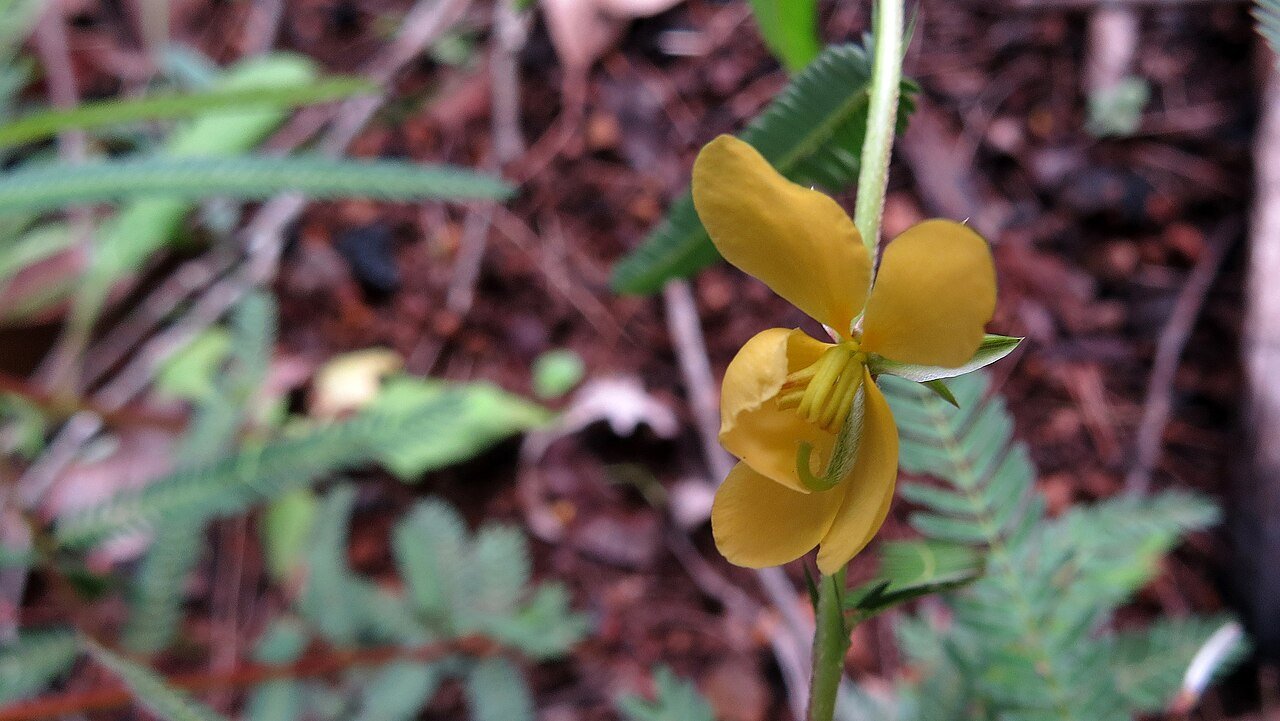
Cassia nomame extract: confirm the species and plant part
Cassia nomame is a botanical synonym of Chamaecrista nomame, the accepted name listed by the Royal Botanic Gardens, Kew. Include both names in a purchasing brief if needed, then require the supplier to confirm the actual botanical identity, plant part and traceability of the offered material. The catalogue common name “水皂角” does not replace that identity check.
Do not substitute a product labelled only “Cassia extract” or “Cassia seed.” Such a broad label is not sufficient to identify this species. Leaves, fruits and whole-plant materials are also different inputs; findings about one preparation cannot automatically be applied to another.
Our sourcing reference lists Cassia nomame extract with a flavones specification of 8–30%. This is a catalogue reference for enquiry, not confirmation of current stock, every intermediate grade, or a particular plant part. The offered grade, source material, manufacturing process and analytical definition must be agreed before a quotation is finalized.
Benefits research: what the studies actually tested
Interest in Cassia nomame includes research into lipase inhibition and lipid metabolism. These research directions can guide questions for a supplier; they do not establish that a commercial extract causes weight loss in people.
Leaf-derived luteolin: an in-vitro study
A 1994 primary study isolated luteolin from dried leaves and tested lipase inhibition in a laboratory system. That result concerns the isolated compound and the experimental conditions. It does not demonstrate the same activity for a catalogue flavones grade, or a clinical benefit from taking the ingredient.
Fruit-derived flavan dimers: a different analytical target
A 1997 study of fruit constituents reported flavan dimers with lipase-inhibitory activity in vitro. Flavan dimers, luteolin and an assay labelled “flavones” are not interchangeable specifications. Ask which constituents the offered method measures and how its result is calculated.
Extract research in rats
A 2000 study investigated a Cassia nomame extract in laboratory tests and high-fat-diet rat models. Its results are preclinical. They do not establish an effective human dose, predictable weight loss or suitability for every finished formulation.
Research on a multi-ingredient finished product would also need to be assessed separately: its results cannot isolate the contribution of Cassia nomame or prove that a different bulk extract is equivalent. Before using an ingredient claim, review the exact research material, population, formulation and proposed use. The studies cited here do not provide a general human safety or efficacy guarantee for the offered product.
How to compare flavones specifications
A higher percentage is useful only when the measurement has a clear meaning. Two offers can use the same percentage but different test procedures, reference standards or reporting bases. Do not treat 8–30% flavones as a guarantee of a specified luteolin concentration, flavan-dimer composition or lipase-inhibitory activity.
- Identity: Latin name, authenticated plant part, origin and traceability; do not infer the part from an illustrative photograph.
- Assay: named target, method, reference standard, sample preparation and calculation. Confirm whether the result is on an as-supplied or dry basis.
- Composition: extraction solvent and process information, carrier or excipient declaration, and the meaning of any extract ratio.
- Application: intended formulation, colour and taste expectations, particle size, dispersibility and stability checks using the actual sample.
- Documents: technical data sheet, representative COA, agreed contaminant and microbiological limits, and relevant residual-solvent or pesticide information.
Any certification must match the actual manufacturing site, product and valid scope. Our quality and documentation page explains the information to discuss. A catalogue range or certificate logo alone does not establish the suitability of a particular batch or destination.
Flexible MOQ and sample orders
Sample-order enquiries are welcome, including when a small brand is still comparing candidate specifications. Tell us what the sample needs to resolve: identity or assay verification, blend compatibility, taste, dispersibility or another defined purchasing question.
MOQ is discussed according to the grade, packaging, production arrangements and supply conditions. Sample quantity, charges, freight and timing are confirmed individually; samples are not automatically free. Separate the evaluation quantity from the expected commercial order quantity.
For a US project, state the intended finished-product use and the documents required by your quality or regulatory team. For an African destination, specify the country and intended use. A sourcing quotation does not by itself confirm market authorization, permitted claims or suitability for all countries.
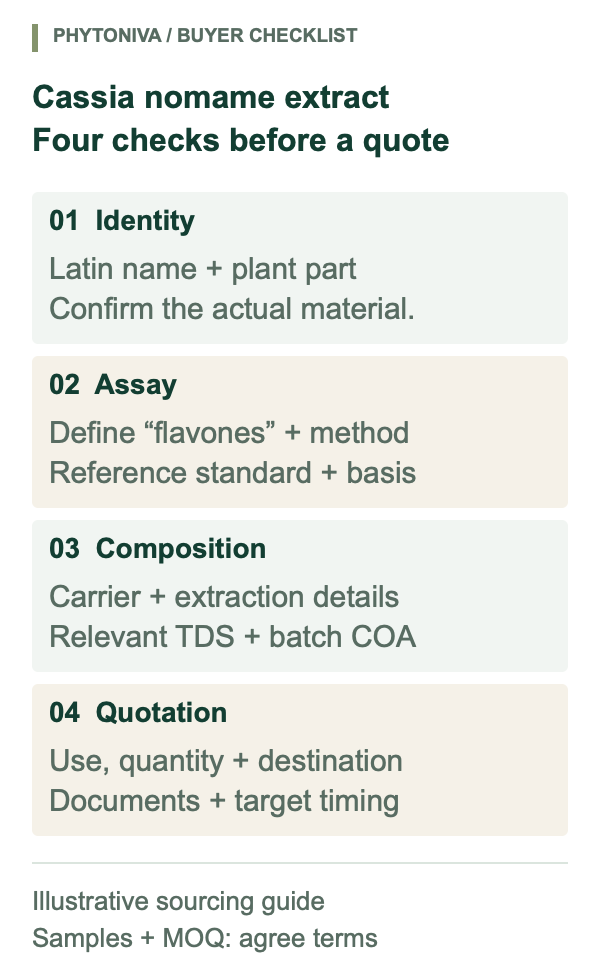
Cassia nomame extract: four checks before a quotation
Identity
Confirm whether the offered material is Chamaecrista nomame (synonym Cassia nomame), and confirm the plant part. The catalogue name alone does not establish identity or permit substitution with another botanical.
Assay
Clarify what the quoted flavones result measures, the analytical method, reference standard and reporting basis. A catalogue percentage is a reference for discussion, not a guaranteed available grade.
Composition
Confirm the extraction details, any carrier and complete composition. Request the technical data sheet (TDS) and relevant certificate of analysis (COA), then assess the sample for the intended formulation.
Quotation
Provide the intended use, target specification, quantity, destination, required documents and timing. Sample orders are welcome; MOQ, sample charges, freight and availability are confirmed according to the selected grade and supply conditions.
Frequently asked questions
Is Cassia nomame extract a proven weight-loss ingredient?
The cited studies include laboratory and rat research; they do not establish human weight-loss efficacy for an unspecified commercial extract. Evaluate evidence for the exact preparation and proposed finished-product claim.
Does “30% flavones” mean 30% luteolin?
No. The assay label does not establish that identity or concentration. Request the target definition, reference standard, method and report before comparing offers.
Are the leaves and fruits interchangeable?
Do not assume so. The cited studies used different materials. Agree the botanical part and process for the offered grade, then assess comparability with the evidence you intend to use.
Can a small buyer start with a sample order?
Yes, sample enquiries are welcome. Provide the proposed specification, use, quantity, destination, required documents and deadline so that applicable sample and MOQ terms can be discussed.
Request a Cassia nomame extract quotation
See the Cassia nomame catalogue reference or submit a sourcing enquiry. Include specification, intended use, sample and order quantities, destination country, documents and timing. Email sales@phytoniva.com or contact PHYTONIVA on WhatsApp. We help buyers compare suitable manufacturing-partner options against their requirements.
Sourcing coordination and quality checks
PHYTONIVA manages trade, sourcing and supplier coordination, matching ingredients and supply options to your specification, application and destination. The manufacturing partner provides its COA and relevant quality documents. Before procurement and dispatch, we arrange independent third-party quality testing and obtain the report for the agreed testing scope.
Specifications, sampling, test scope, methods and acceptance criteria are agreed before ordering. The manufacturer COA and agreed third-party test report accompany the shipment. Certification is checked separately for the named holder, product and valid scope.
See our quality and documentation process