Menu
Echinacea Extract: Benefits, Specifications and Wholesale Sourcing
Echinacea extract attracts interest from buyers developing immune-support and seasonal-wellness product concepts. However, “echinacea extract” is not a complete purchasing specification. Species, plant part, extraction process and constituent markers all need to be defined before comparing suppliers.

PHYTONIVA helps buyers discuss these requirements and identify suitable sourcing options. We welcome sample orders and offer flexible MOQ discussions based on the requested specification and order conditions.
What does research say about echinacea benefits?
Echinacea has been studied mainly in relation to colds and other respiratory infections. The U.S. National Center for Complementary and Integrative Health reports that echinacea may slightly reduce the chance of catching a cold, while its effect on shortening a cold remains unclear. Evidence for other health uses is more limited. These findings do not establish that any particular bulk extract will produce the same effects. Read the NCCIH overview.
For a professional buyer, the practical question is whether the research preparation is relevant to the ingredient and finished product under development. A different species, plant part or extraction process may produce a different composition. “Immune support” should therefore be treated as a formulation and evidence-review topic, not a blanket promise attached to every echinacea powder.
NCCIH also notes possible allergic reactions and gastrointestinal side effects. Finished-product teams should review safety, target users and proposed claims as part of development. A constituent percentage is a quality specification, not proof of clinical efficacy.
Which echinacea extract specifications can buyers discuss?
Our partner catalog lists the following specification ranges for enquiry:
Swipe or scroll horizontally to view the full table.
| Marker | Catalog specification range | What to confirm |
|---|---|---|
| Polyphenols | 4–7% | Assay method and reference standard |
| Cichoric acid, also searched as chicoric acid | 2–4% | Exact grade, assay and botanical source |
| Echinacoside | 1–4% | Exact grade, species, plant part and assay |
These entries should not be read as a guarantee that one grade simultaneously meets all three ranges. The exact SKU, composition, current availability and agreed specification must be confirmed during quotation.
The catalog identifies the material as Echinacea Extract but does not establish the species and plant part for every listed grade. Buyers requiring a particular species or root versus aerial material should state that requirement explicitly.
How to compare wholesale quotations
A useful comparison starts with a shared purchasing specification. Send each potential supplier the same botanical identity, plant part, marker level, testing requirements and intended application.
Also clarify carrier ingredients, extraction solvent, relevant contaminant limits and packing. Request a specification sheet and an applicable COA to assess how the offered material is described and tested. For buyers in the United States or an African destination, specify the actual destination country and intended use so document requirements can be discussed for that market. If certification is essential, request documents covering the relevant supplier and product rather than relying on a general certification logo.
Compare the commercial conditions as well: sample cost, shipping, MOQ, lead time and the quantity being quoted. A lower unit price for a different grade or a much larger order may not represent the best option for an initial formulation trial.
Starting with samples and a flexible MOQ
Early-stage brands and development teams may need a small evaluation order before a production purchase. PHYTONIVA welcomes these enquiries. Share the quantity you actually need and the purpose of the trial so we can assess the available options.
MOQ can be discussed according to the grade, packing and supply conditions. Sample pricing, freight, availability and lead time are confirmed individually. We do not require buyers to present a large-volume forecast simply to begin a specification discussion.
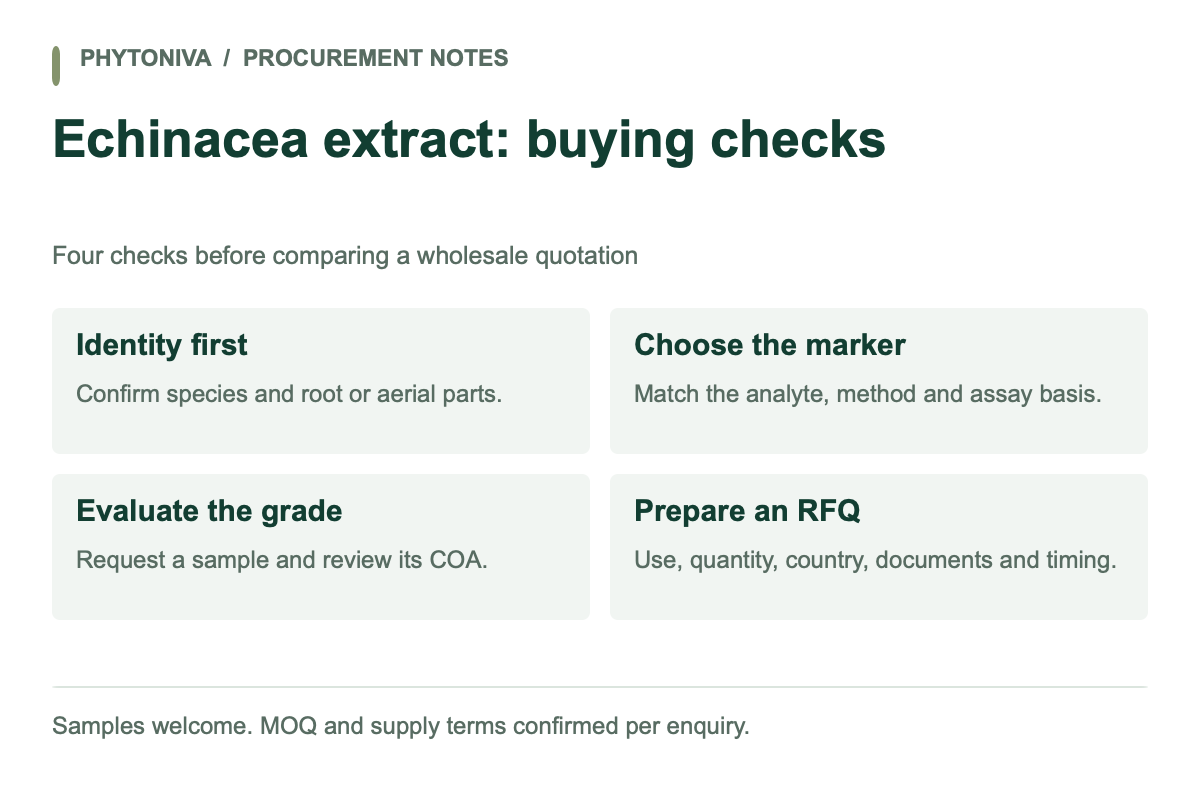
- Identity first: Confirm species and root or aerial parts.
- Choose the marker: Match the analyte, method and assay basis.
- Evaluate the grade: Request a sample and review its COA.
- Prepare an RFQ: Use, quantity, country, documents and timing.
Frequently asked questions
Which marker should I specify: polyphenols, cichoric acid or echinacoside?
Use the marker required by your formulation brief or purchasing standard, together with botanical identity and testing requirements. If it is not yet decided, explain the intended application and provide any reference specification for discussion.
Can I compare extracts by percentage alone?
No. Compare the same marker measured by a comparable method, and check species, plant part and overall composition. A higher number for a different marker is not a meaningful like-for-like comparison.
Are samples available for a small business?
Sample-order enquiries from small businesses are welcome. Provide your target grade, sample quantity, destination and evaluation requirements; the available terms will be confirmed in a quotation.
Send your echinacea purchasing requirements
For a sample or wholesale quotation, provide species and plant part if specified, target marker and percentage, application, quantity, destination, document requirements and timing.
Email sales@phytoniva.com or message PHYTONIVA on WhatsApp. For trial orders, see our MOQ and sample-order guide. You can also browse our ingredient catalog to discuss a broader sourcing list.
This article is for B2B sourcing and formulation discussions. It does not claim that the supplied ingredient prevents or treats illness. Product suitability and claims require review for the specific formulation and intended market.
Sourcing coordination and quality checks
PHYTONIVA manages trade, sourcing and supplier coordination, matching ingredients and supply options to your specification, application and destination. The manufacturing partner provides its COA and relevant quality documents. Before procurement and dispatch, we arrange independent third-party quality testing and obtain the report for the agreed testing scope.
Specifications, sampling, test scope, methods and acceptance criteria are agreed before ordering. The manufacturer COA and agreed third-party test report accompany the shipment. Certification is checked separately for the named holder, product and valid scope.
See our quality and documentation process