Menu
Maltodextrin in Botanical Extracts: A Buyer’s Carrier Checklist
When buying a botanical extract powder, ask for the full composition, including any maltodextrin or other carrier, before comparing prices. The weight of supplied powder is not automatically the weight of native extract. A useful quotation identifies the botanical material, carrier proportion and basis of any constituent assay.
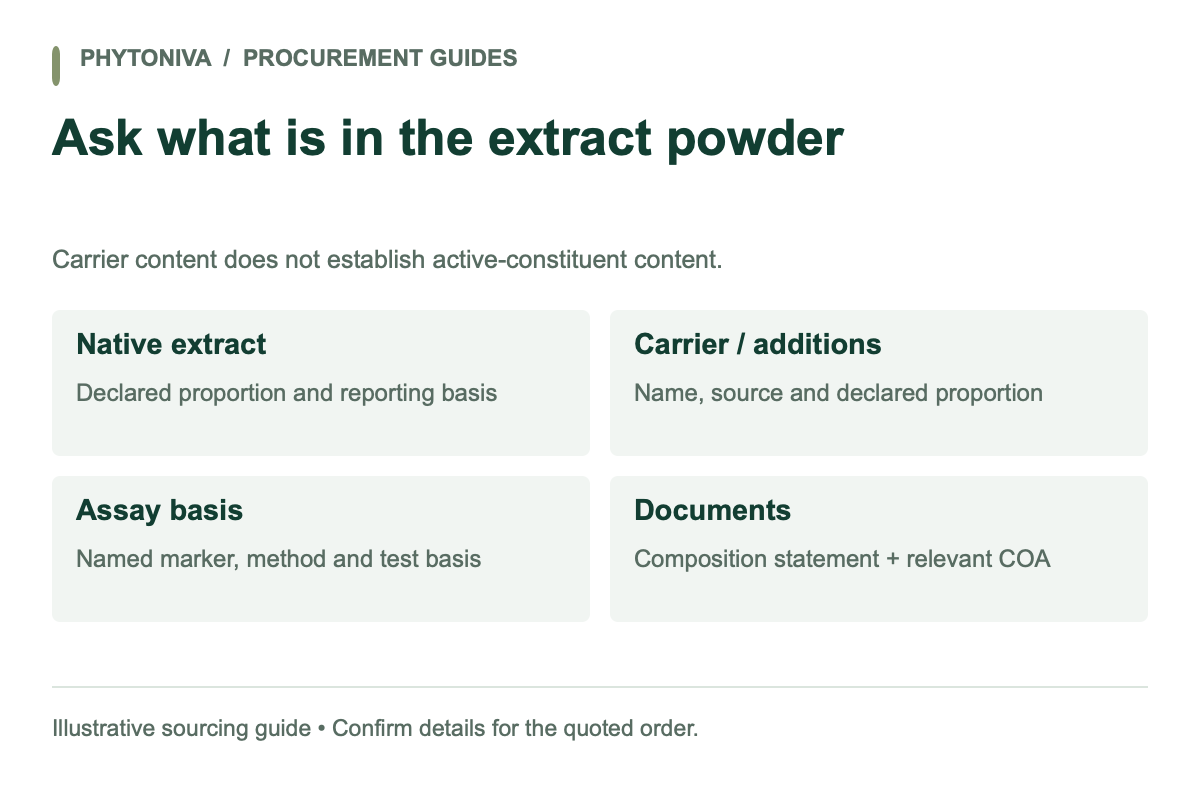
- Native extract: request the declared proportion and reporting basis.
- Carrier or additions: confirm names, sources and declared proportions.
- Assay: identify the marker, method and reporting basis.
- Documents: request the composition statement and relevant COA; the two answer different questions.
This checklist is for small brands, formulators and distributors preparing a sample or trial order. It is a procurement worksheet, not a claim that one carrier level is suitable for every formulation.
What is a carrier in a botanical extract?
A carrier is an added component of the supplied preparation. The EHPM Quality Guide, section 17.3, distinguishes native extract from preparations that include technological additives or ingredients such as maltodextrin to support incorporation into the final product. This industry guidance does not certify a particular supplier or product.
Ask the supplier why a carrier is used in the proposed grade and what alternatives, if any, are available. Do not assume that every extract contains maltodextrin, or that a carrier-free grade will behave the same way in your process.
Six fields to request before approving a sample
- Botanical identity: scientific name, plant part and the exact product code being quoted.
- Composition: the declared native-extract proportion, each carrier or other added component, and the basis of those percentages.
- Carrier details: name, source and supporting declarations relevant to your purchasing requirements.
- Assay: named constituent or marker, target range, analytical method, and whether the result refers to the supplied powder or another basis.
- Trial requirements: your intended format and the physical characteristics you need to evaluate, such as dispersibility, colour and flow during processing.
- Documents: confirm the current specification, composition statement and required tests before ordering. The manufacturer COA and agreed third-party test reports are provided with the shipment.
A COA and a composition statement answer different questions. If a component is absent from the COA, ask for its declaration rather than assuming that it is absent from the powder.
How carrier content changes a price comparison
Hypothetical arithmetic only: suppose two otherwise comparable powders have a declared native-extract content of 80% and 50% by mass, with the balance declared as carrier. A 1 kg pack would contain 0.8 kg and 0.5 kg of native extract respectively. If each pack cost USD 20, the arithmetic cost per kilogram of native extract would be USD 25 and USD 40.
The calculation is price per kilogram of supplied powder divided by its native-extract mass fraction. These are invented numbers, not PHYTONIVA prices or specifications. The calculation does not establish chemical equivalence, efficacy or the best ingredient for a formulation. Compare identity, extraction details, assay basis and trial performance separately. Do not infer an active-constituent percentage from the carrier percentage.
Questions buyers often ask
Does “100% botanical extract” mean no carrier?
Do not rely on that phrase alone. Request an explicit composition statement for the exact grade and written clarification of what “100%” describes.
Is a carrier-free extract always the better purchase?
Choose against your agreed formulation and documentation requirements. Request suitable samples and evaluate them in your own process before deciding. Availability of a carrier-free alternative needs confirmation.
Does a 10:1 ratio tell me the carrier content?
No. Ask how the ratio is defined and request the carrier declaration separately. Our 10:1 versus standardized extract guide explains the different questions these descriptions answer.
A copy-ready enquiry for a small trial order
“We are evaluating [botanical name and plant part] for [product format] in [destination market]. Please quote [sample quantity] and [trial-order quantity]. Confirm the product code, full composition, carrier name and proportion, constituent specification and assay basis. Please include the proposed specification, packaging, quotation basis and the agreed document requirements. The manufacturer COA and agreed third-party reports are to accompany the shipment. Our carrier restrictions are [requirements / none specified].”
Before reordering, retain the approved product code and specification revision. Ask whether the composition, source of the carrier or assay basis has changed, and agree how any proposed change will be reviewed.
Discuss a botanical extract requirement with PHYTONIVA
PHYTONIVA supports B2B ingredient sourcing and specification matching. Browse our botanical ingredient catalogue or send a procurement enquiry with the ingredient, carrier requirements, quantity, intended use and destination. Grade availability, documents, MOQ, pricing and delivery terms are confirmed for the specific enquiry.
Sourcing coordination and quality checks
PHYTONIVA manages trade, sourcing and supplier coordination, matching ingredients and supply options to your specification, application and destination. The manufacturing partner provides its COA and relevant quality documents. Before procurement and dispatch, we arrange independent third-party quality testing and obtain the report for the agreed testing scope.
Specifications, sampling, test scope, methods and acceptance criteria are agreed before ordering. The manufacturer COA and agreed third-party test report accompany the shipment. Certification is checked separately for the named holder, product and valid scope.
See our quality and documentation process