Menu
10:1 Botanical Extract vs Standardized Extract: A Buyer’s Checklist
A 10:1 extract ratio and a standardized constituent percentage describe different things. For a botanical ingredient quotation, ask for both the ratio basis and the measured constituent specification when available. Do not compare two powders on the ratio alone.
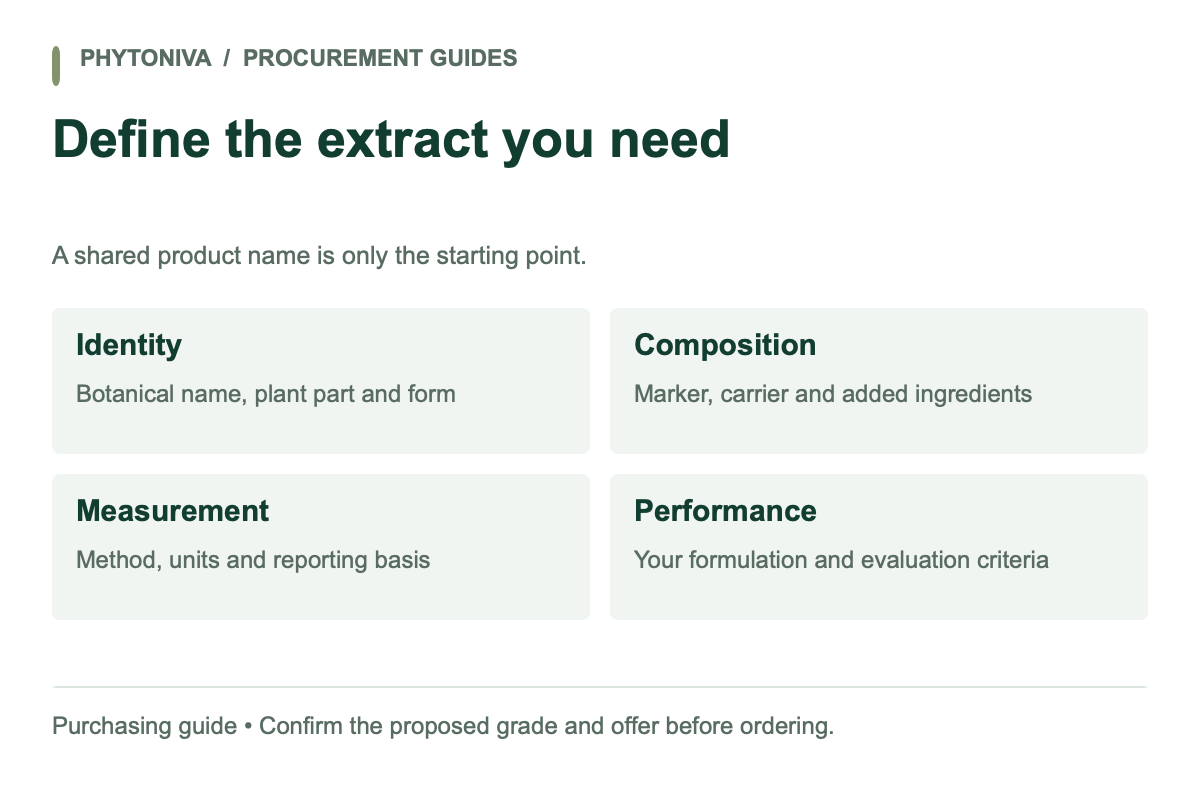
- Identity: Botanical name, plant part and form
- Composition: Marker, carrier and added ingredients
- Measurement: Method, units and reporting basis
- Performance: Your formulation and evaluation criteria
This purchasing checklist is for small supplement, beverage and personal-care teams comparing bulk ingredients. It helps you prepare a clear enquiry before requesting samples or agreeing to a first order.
What does a 10:1 botanical extract mean?
A plant-to-extract ratio describes the relationship between starting botanical material and the extract obtained. A clearly defined 10:1 native-extract ratio would relate ten units of starting material to one unit of native extract. It does not mean 10% active constituents. A larger ratio alone does not establish greater efficacy or an equivalent chemical composition. See the discussion of ratios and their limitations in Monagas and colleagues’ review of plant-to-extract ratios.
Native extract or finished powder: which is being quoted?
The European Medicines Agency distinguishes the ratio to native extract from the ratio to the whole extract containing excipients. Ask whether the quoted powder includes carriers and request their declared proportions. The EMA quality guideline provides useful terminology in the context of herbal medicinal products; it does not establish approval of a food, supplement or cosmetic ingredient in your destination market.
How is a standardized extract different?
For procurement, request a named constituent or constituent group, its acceptance range, the analytical method and the reporting basis. A ratio cannot replace those fields. Likewise, an assay percentage without a clearly identified substance and method is an incomplete comparison. For a practical example, read our guide to EGCG, catechins and tea polyphenols.
Seven questions to put in your supplier enquiry
- Identity: What botanical species and plant part does the quotation cover?
- Ratio: What does the stated ratio refer to, and is the starting material described on a fresh or dry basis?
- Composition: What is the native-extract proportion, and which carriers or other ingredients are present?
- Assay: Which constituent is measured, by which method, and against which acceptance limit?
- Documents: What specification, testing scope and shipment documents will be agreed? For PHYTONIVA orders, the manufacturer COA and agreed third-party test reports are provided with the shipment.
- Trial suitability: Which physical requirements should be agreed for your process, such as dispersibility, colour or particle size?
- Commercial terms: What sample quantity, trial quantity, packaging, delivery destination and quotation basis should be used?
Keep unanswered fields visible in your comparison sheet. “To be confirmed” is more useful than treating two incomplete quotations as equivalent.
A simple quotation comparison for a small buyer
Suppose one offer says only “10:1 extract” and another lists a named constituent percentage with a method. These descriptions do not give you enough information to select a substitute or compare like-for-like prices. Send both suppliers the same specification questions, then request revised quotations against your agreed requirements. This is an illustrative purchasing situation, not a description of PHYTONIVA inventory.
Before paying for a larger quantity, write down what your sample review must establish and who will approve it. Keep the sample identification, proposed specification and subsequent order reference together. Ask the supplier to confirm the specification applicable to the material being ordered rather than assuming a sample document covers every future shipment.
Copy this RFQ checklist
“We are evaluating [botanical name and plant part] for [application] in [destination country]. Please clarify your extract ratio and its basis, extraction solvent, native-extract and carrier composition, and any constituent assay with method and reporting basis. Please quote [sample quantity] and [trial quantity] separately, state packaging and delivery terms, and identify the specification and documents available for review.”
You can leave the constituent target open if your formulation team has not selected one. State that you need specification options instead of choosing an arbitrary percentage for the enquiry.
Questions buyers ask
Is 20:1 automatically better than 10:1?
No. A larger ratio alone cannot establish better performance. Compare the botanical identity, extraction conditions, composition and relevant analytical evidence before deciding whether two materials suit the same project.
Can an extract ratio replace a COA?
No. Ask for the specification and relevant test results for the offered material. A ratio describes a production relationship; it is not a complete batch-quality document.
Can PHYTONIVA help compare specification options?
Send your ingredient name, application, quantity and destination to PHYTONIVA for a sourcing discussion. Availability, documents, MOQ and delivery terms need confirmation for the particular product and supplier. Review the botanical ingredient catalogue or submit your purchasing requirements.
Sourcing coordination and quality checks
PHYTONIVA manages trade, sourcing and supplier coordination, matching ingredients and supply options to your specification, application and destination. The manufacturing partner provides its COA and relevant quality documents. Before procurement and dispatch, we arrange independent third-party quality testing and obtain the report for the agreed testing scope.
Specifications, sampling, test scope, methods and acceptance criteria are agreed before ordering. The manufacturer COA and agreed third-party test report accompany the shipment. Certification is checked separately for the named holder, product and valid scope.
See our quality and documentation process