Menu
Turmeric Extract Quotations: What Changes the Price?
A useful turmeric extract quotation needs more than a price per kilogram. Align the assay, composition, quantity and delivery scope first. Otherwise, a lower headline price may describe a different material or exclude costs you will still need to pay.
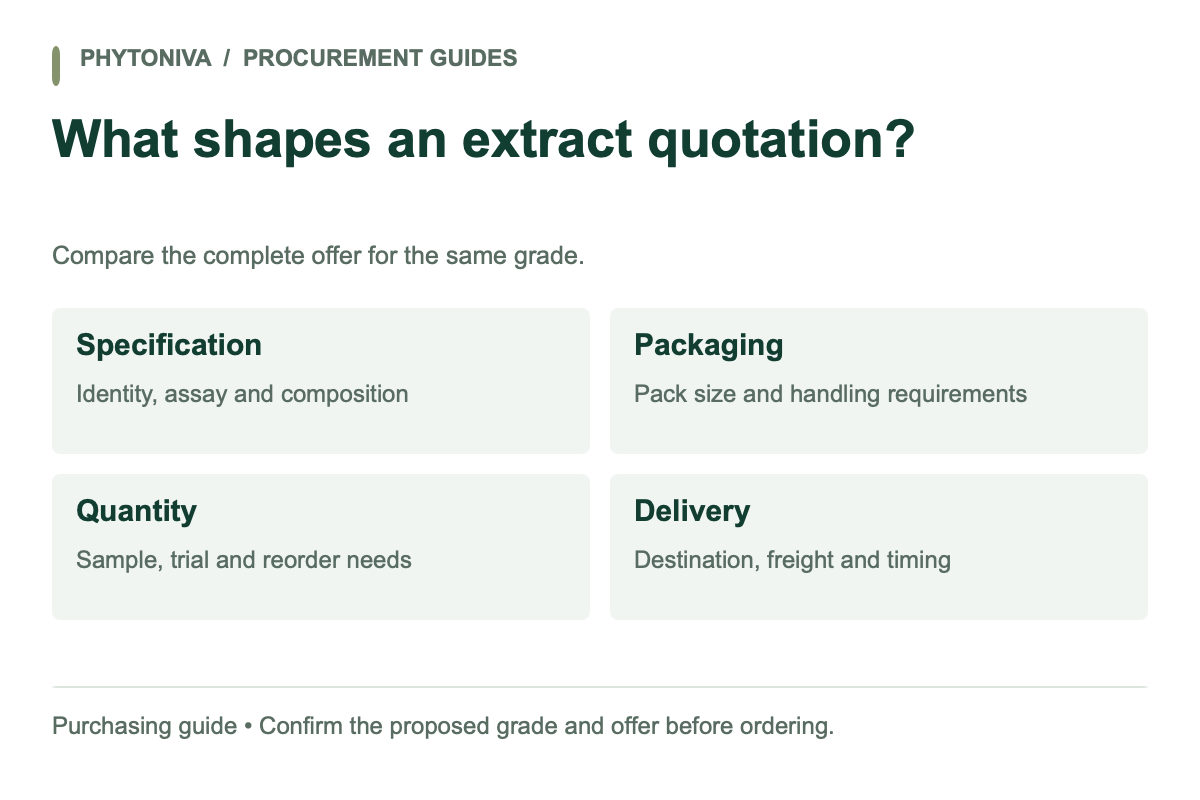
- Specification: Identity, assay and composition
- Packaging: Pack size and handling requirements
- Quantity: Sample, trial and reorder needs
- Delivery: Destination, freight and timing
1. Define what the quoted assay measures
Specify whether you need a ratio extract or an extract standardized to a particular curcuminoid content. If a quotation states total curcuminoids, ask which compounds are included, the analytical method and whether the percentage is reported on a dry basis or as supplied. Do not treat an extraction ratio as a measured curcuminoid percentage.
Curcumin is a constituent of turmeric, while commercial formulations can differ in composition. The NCCIH turmeric overview provides independent background and safety context. It is not a certificate for the material being quoted.
2. Compare composition and formulation performance
Request the declared carrier and other added components. A simple powder and a formulation containing a dispersion system should not be compared as if their compositions were identical. Ask what the offered material is designed to do, then evaluate that claim using a sample in your actual application.
For beverage or liquid projects, include your mixing process, pH and expected appearance in the enquiry. For capsules or other dry formats, include the relevant handling and manufacturing requirements. These are questions for selecting and testing a grade, not a promise that a particular grade is available.
3. Make testing and documents part of the quotation
State the tests and declarations required for your destination and application. Ask which results are already documented, which need additional testing, who performs the tests, and whether any additional cost or time is included in the offer. Review the specification and applicable COA together; a certificate from another product or site is not a substitute.
If your project requires organic, Halal, Kosher or another certification, request the relevant certificate and check its holder, scope and validity. PHYTONIVA is a sourcing and trade partner. Certification must be assessed for the named manufacturer or product; it is not a blanket attribute of every quotation.
4. Separate sample, pilot and repeat-order quantities
A small brand should tell the supplier its immediate trial quantity and its expected repeat-order quantity separately. Ask for a quotation for each practical order stage, including sample fees, packing and MOQ. Do not assume that a price for a larger order applies to a small trial shipment.
Also confirm how long the quotation remains valid and what starts the lead-time clock: payment, specification approval, sample approval or another agreed milestone. A stated number of days is difficult to use without its starting condition and delivery scope.
5. Compare the delivered cost
Ask every supplier to quote against the same destination and delivery term. Record material cost, packing or handling charges, transport, insurance where applicable, and costs excluded from the offer. Confirm responsibility for import clearance, duties, taxes and final delivery with the supplier and your destination-side broker.
For your internal comparison, divide the total comparable order cost by the net kilograms you expect to receive. Keep recoverable taxes separate from non-recoverable costs if your accountant advises that treatment. The result is a purchasing comparison, not a guarantee of the final customs assessment.
A ready-to-use turmeric extract enquiry
“We are developing [application] for [destination]. Please quote turmeric extract against [target assay and method], with [carrier/dispersion requirements]. Our trial quantity is [quantity] and expected repeat order is [quantity]. Please confirm sample terms, MOQ, packing, lead time and delivery scope, and identify the specification, COA and required certification documents available for the proposed material.”
PHYTONIVA’s turmeric extract page explains the details to confirm. We do not advertise a fixed assay grade, universal MOQ or current price here: those depend on the material and commercial terms confirmed for your enquiry.
Request a turmeric extract quotation. For a broader comparison worksheet, read how to compare botanical extract quotations.
Sourcing coordination and quality checks
PHYTONIVA manages trade, sourcing and supplier coordination, matching ingredients and supply options to your specification, application and destination. The manufacturing partner provides its COA and relevant quality documents. Before procurement and dispatch, we arrange independent third-party quality testing and obtain the report for the agreed testing scope.
Specifications, sampling, test scope, methods and acceptance criteria are agreed before ordering. The manufacturer COA and agreed third-party test report accompany the shipment. Certification is checked separately for the named holder, product and valid scope.
See our quality and documentation process