Menu
Epimedium Extract: Icariin, Benefits and Uses
Epimedium extract, often called horny goat weed extract, is a botanical ingredient known for icariin and related flavonoids. Research into bone metabolism and sexual-function pathways has made it interesting to botanical brands and formulation teams. Understanding the preparation behind those findings helps buyers choose a meaningful specification instead of simply chasing the highest percentage.
PHYTONIVA helps small brands, ingredient distributors and development teams match products and supply options to their specification, application, budget and destination. Sample orders are welcome; MOQ is discussed according to the grade, packaging and supply conditions.
Compare sourcing specificationsDiscuss a sample or bulk order
What is Epimedium extract?
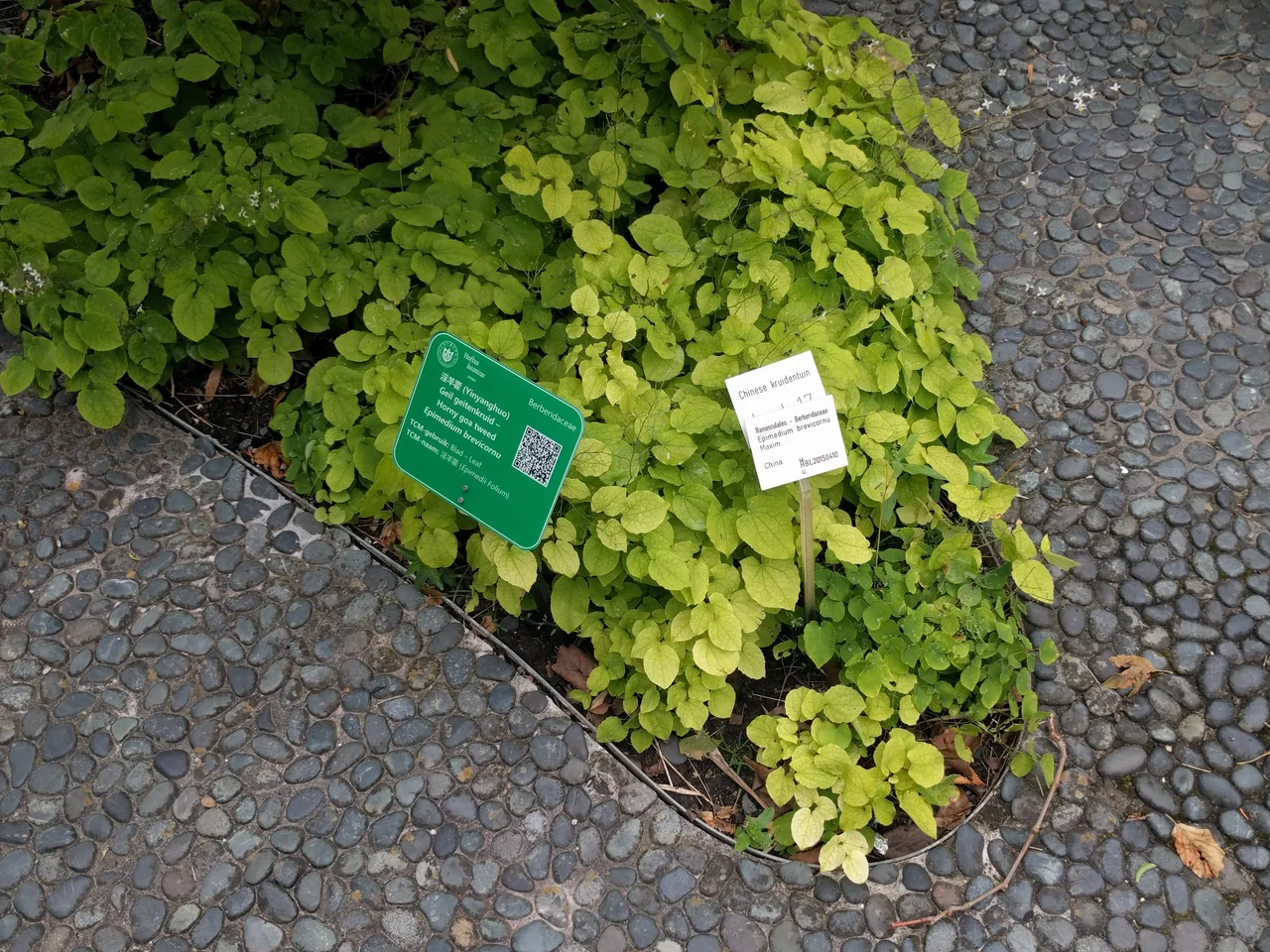
Epimedium is a plant genus, not a single standardized ingredient. This guide focuses on leaf-derived preparations. Health Canada’s icariin ingredient record lists leaves of Epimedium brevicornu and Epimedium koreanum as source materials. That record helps explain botanical sourcing; it does not identify the species in an individual supplier offer.
A useful specification names the species, plant part and extraction process. Leaf powder, a broader leaf extract and highly enriched icariin have different compositions. The name “horny goat weed” alone does not tell you which of these you are buying.
Icariin and flavonoids: what makes this ingredient distinctive?
Icariin is a prenylated flavonoid glycoside used as a constituent marker. Other related compounds and metabolites include icariside II, icaritin and desmethylicaritin. Their different names matter: an icariin result, a total-flavonoid result and a measurement of a metabolite describe different things.
In a randomized study of 30 healthy men, researchers followed metabolites after a single dose of a defined Epimedium extract. Icariside II and desmethylicaritin were prominent circulating metabolites, while icariin itself was below detection. This human pharmacokinetic finding shows why a label percentage is not a direct prediction of absorption or biological effect; it was not an efficacy trial. Read the original study.
What benefits are being investigated?
Bone health: a human research signal
A 24-month placebo-controlled trial randomized 100 late-postmenopausal women; 85 completed it. A preparation combining icariin, daidzein and genistein maintained bone mineral density while the placebo group lost bone density; both groups received calcium. This supports interest in bone-health formulation research. It does not isolate icariin’s contribution, establish fracture prevention or demonstrate that an arbitrary commercial extract has the same effect. Original 2007 trial.
A later placebo-controlled trial in 58 postmenopausal women used 740 mg of a defined prenylflavonoid extract daily for six weeks. At the eight-week assessment, higher bone-specific alkaline phosphatase, a bone-formation marker, was reported; the decrease in TRAF6, a protein associated with bone-resorbing cells, was only a statistical trend. These biomarker findings suggest a development direction, not proven stronger bones or fewer fractures. The short trial cannot establish long-term safety. Original 2021 trial.
Sexual-function pathways: laboratory evidence
In a primary laboratory study, isolated icariin inhibited PDE5 enzyme isoforms and helped sustain cGMP in isolated rat cavernous smooth-muscle cells under the experimental conditions. cGMP is involved in smooth-muscle relaxation, explaining interest in this pathway. These were enzyme and cell experiments, not a human trial showing improved erections, libido or testosterone. They do not establish equivalence to prescription medicines. Original mechanistic study.
How can a formulation team evaluate Epimedium extract?
Bone-health and adult botanical-wellness concepts are possible areas for assessment, subject to the evidence, intended users and destination requirements for the actual preparation. Select the ingredient profile around the development objective, then test the proposed grade in the finished formulation.
- Capsules and tablets: assess marker delivery, serving mass, powder flow, moisture behavior and compatibility with other ingredients. Research doses are not dosing instructions for a different extract.
- Powder blends or sachets: evaluate taste, color, particle size, mixing uniformity and carrier content with a representative sample.
- Liquid or beverage concepts: test dispersion, settling and marker stability at the intended pH, temperature and storage conditions. A higher icariin assay does not guarantee water solubility or better performance.
Safety assessment should address hormonal activity and medicines. Memorial Sloan Kettering’s clinical guidance advises avoidance with heart disease and hormone-sensitive cancers, and flags possible CYP3A4 and aromatase-inhibitor interactions whose clinical relevance is uncertain. Qualified review should consider the actual preparation and user group; the studies above do not establish suitability for pregnancy, breastfeeding or children.
How should buyers compare icariin specifications?
Our supplier reference catalogue lists icariin 10–98% and flavonoids 10–50%. These describe specification references across different grades, not stock availability or a promise of every concentration. At high icariin levels, clarify whether the material is a highly enriched constituent preparation rather than a broader botanical extract.
Agree the named analyte, assay method, reference standard, reporting basis and carrier content. An icariin percentage cannot substitute for a total-flavonoid specification. If a supplier reports total flavonoids, establish what that method measures before comparing quotations or translating the result into a formulation requirement.
View the Epimedium extract catalogue entry.
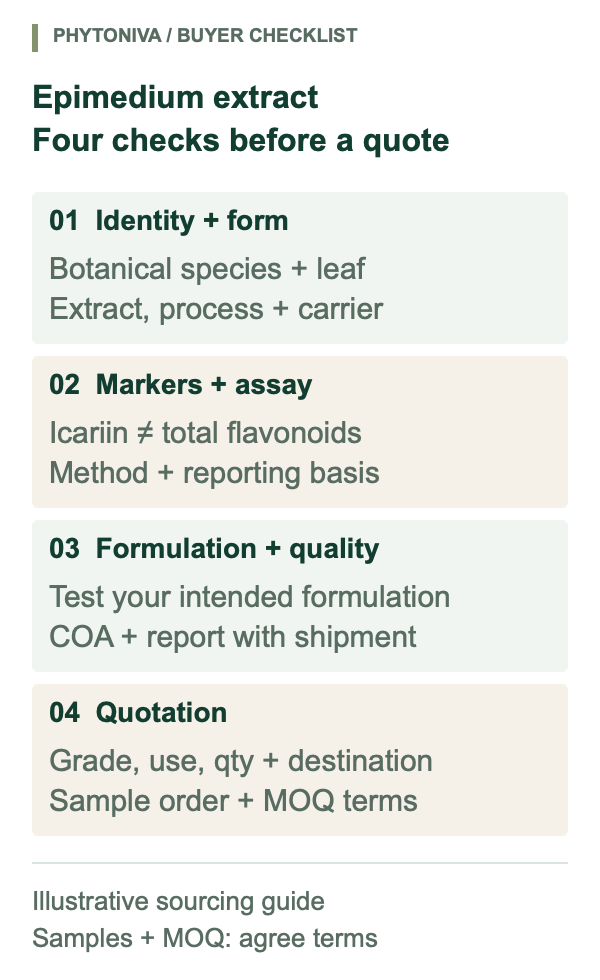
Epimedium extract: four checks before a quote
Identity + form
Confirm the offered Epimedium species, leaf as the specified plant part and the extract form. Define the extraction process and carrier; leaf powder, a broader leaf extract and highly enriched icariin are different purchasing specifications.
Markers + assay
Specify icariin and, if needed, total flavonoids separately. These measurements are not interchangeable. Agree the named analytes, assay method, reference standard and reporting basis; compare results only on a consistent basis.
Formulation + quality
Evaluate the proposed grade in your intended formulation, including taste, dispersibility and processing stability where relevant. Before ordering, agree sampling, test scope, methods and acceptance criteria. PHYTONIVA arranges independent third-party testing before procurement and dispatch; the manufacturer COA and agreed third-party report accompany the shipment.
Quotation
Send the specification, intended use, quantity, destination, required shipment documents and timing. Sample orders are welcome; MOQ, sample costs and packing are agreed for your requirements and supply conditions.
Frequently asked questions
Is a higher icariin percentage always better?
No. A concentrated constituent and a broader extract can serve different development goals. Compare composition, the relevant research preparation and actual formulation behavior before choosing a grade.
Does “horny goat weed extract” identify the species?
No. Ask for the botanical species, leaf or other specified plant part, extraction process and marker specification. A common name alone is not enough to match two offers.
Can I start with a sample or small order?
Yes, sample-order enquiries are welcome. Provide your target grade and evaluation needs; sample quantity, charges, packaging, availability and subsequent MOQ are agreed for the proposed supply option.
Who provides the quality documents?
The manufacturer provides its COA. PHYTONIVA coordinates sourcing and independent third-party quality testing before procurement and dispatch. The manufacturer COA and agreed third-party report accompany the shipment; we do not currently provide presale COA samples or public COA downloads. A report covers its stated sample and test scope; certification is checked separately for the named holder, product and valid scope. See our quality coordination workflow.
Discuss your Epimedium extract project
Send the botanical identity and plant part, icariin or other marker requirement, application, quantity, destination, document needs and target timing. We can help compare suitable products and supply options against those requirements.
Request a quotation · sales@phytoniva.com · WhatsApp +86 19991898850
Sourcing coordination and quality checks
PHYTONIVA manages trade, sourcing and supplier coordination, matching ingredients and supply options to your specification, application and destination. The manufacturing partner provides its COA and relevant quality documents. Before procurement and dispatch, we arrange independent third-party quality testing and obtain the report for the agreed testing scope.
Specifications, sampling, test scope, methods and acceptance criteria are agreed before ordering. The manufacturer COA and agreed third-party test report accompany the shipment. Certification is checked separately for the named holder, product and valid scope.
See our quality and documentation process