Menu
Kudzu Root Extract: Puerarin, Benefits and Uses
Kudzu root extract is a botanical ingredient valued for its isoflavones, especially puerarin. Its distinctive chemistry has attracted research into menopausal symptoms, bone turnover and energy metabolism. For a brand or formulation team, the useful starting point is understanding which root extract, constituent profile and application a study actually examined.
PHYTONIVA helps small brands, ingredient distributors and development teams match a proposed grade to their specification, budget and destination requirements. Sample orders are welcome, with MOQ discussed according to specification, packaging and supply conditions.
What is kudzu root extract?
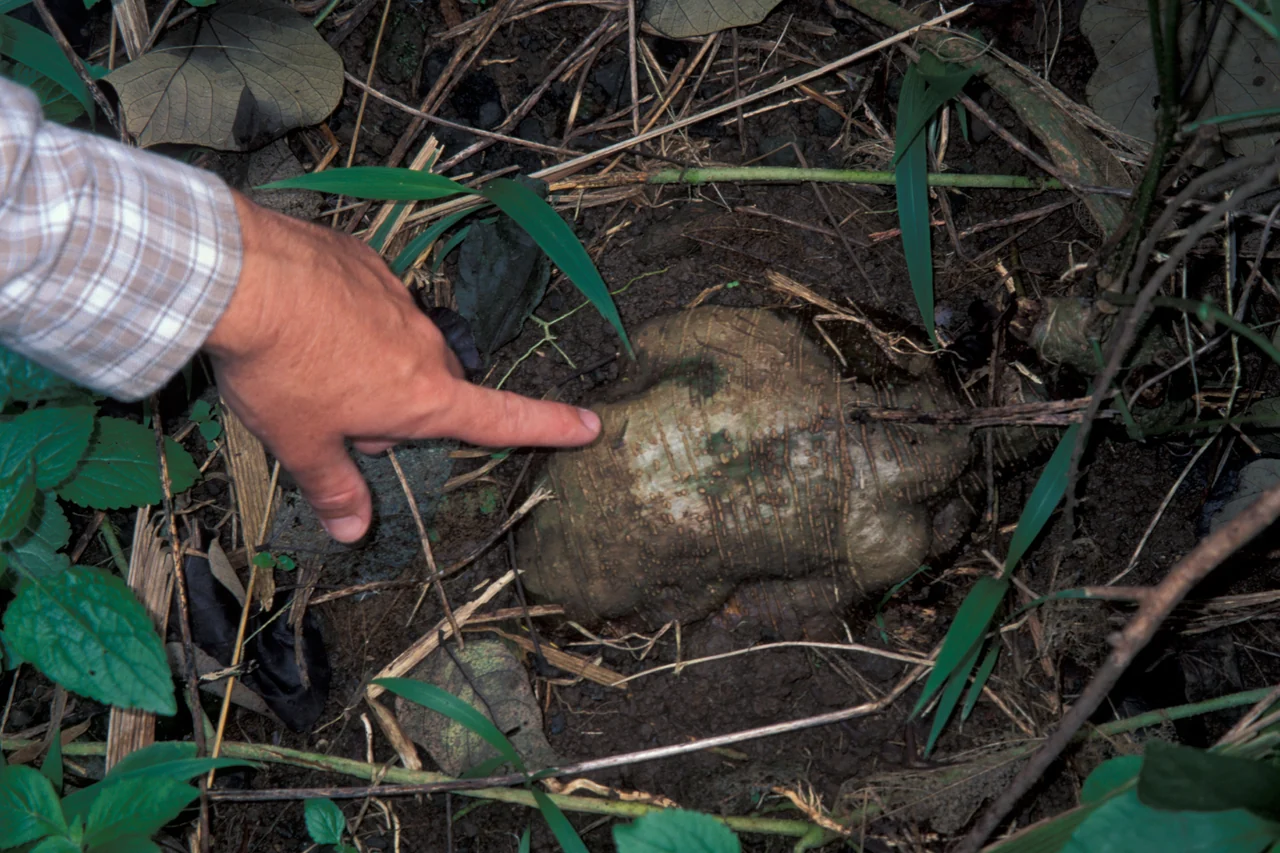
This guide concerns the root of Pueraria montana var. lobata, widely reported in research as Pueraria lobata. Kew records the latter as a synonym. A useful purchase specification states both the botanical identity and the plant part, rather than just “kudzu”.
Root extract, whole-root powder and purified root starch serve different formulation purposes. Extraction changes the constituent profile; an extract percentage is not a measurement of the amount of whole root in a product. Root evidence also should not be transferred to kudzu flowers or to the distinct botanical Pueraria mirifica.
Puerarin, daidzin and daidzein: what makes the ingredient distinctive?
Health Canada’s root-source record lists puerarin, daidzin and daidzein among the constituents. Puerarin is an isoflavone C-glycoside; daidzin is an O-glycoside, while daidzein is an aglycone. These names describe different molecules, not alternative labels for one percentage.
That distinction matters when comparing extracts. A primary absorption study using isolated pig intestinal tissue found different transport and transformation patterns for C- and O-glycoside isoflavones. It illustrates why composition matters; it does not prove superior human absorption for a commercial grade. Read the experimental study.
What benefits have researchers investigated?
Menopausal symptoms and bone-turnover markers
A 2021 exploratory study assigned 50 women to five regimens of an ethanol-root-extract capsule that also contained calcium. After four weeks, one group showed reductions from baseline in serum CTX-I (18.4%) and urinary CTX-II (17.4%), markers of bone and cartilage breakdown; symptom scores improved in four groups. However, there was no placebo, the study was industry funded, and marker changes do not prove stronger bones or fewer fractures. Adverse events were reported by 45 of 50 participants, mostly mild; four discontinued because of events. This is an early research signal, not established efficacy. Original trial.
An earlier three-month trial involving 127 postmenopausal women compared a P. lobata preparation, hormone replacement therapy and no treatment. It found no significant lipid, FSH or LH differences versus the no-treatment control with the botanical preparation, and the authors did not establish an overall general-health benefit for menopause. Together, these findings support further investigation rather than a blanket “hormone balancing” claim. Original 2003 study.
Energy metabolism and glucose handling
In a 2017 experiment, a water extract of kudzu root reduced weight gain and liver fat and improved glucose tolerance in high-fat-diet mice over 16 weeks. Associated muscle findings involved AMPK and PGC-1α, pathways involved in energy use; parallel cell work examined mitochondrial activity. These results give researchers a reason to investigate metabolic applications. They remain animal and cell findings, not evidence that a supplied extract causes human weight loss or treats diabetes. Original preclinical study.
How can a formulation team evaluate kudzu root extract?
Women’s nutrition and broader botanical wellness concepts are possible areas for formulation assessment, provided the evidence and suitability of the exact preparation are reviewed. Product-development work should connect a constituent profile to a clear purpose, rather than select the highest percentage by default.
- Capsules and tablets: assess the proposed serving mass, marker delivery, flow, moisture behavior and compatibility with other ingredients. Study doses are not automatic dosing recommendations for a different extract.
- Powder blends and sachets: evaluate taste, color, particle size, mixing uniformity and the contribution of any carrier in the actual formula.
- Beverage concepts: test dispersibility, sedimentation and marker stability at the intended pH, processing temperature and shelf life. A powder description alone does not guarantee water solubility.
Isoflavone activity also makes the intended user group important. Memorial Sloan Kettering’s clinical guidance advises avoidance in hormone-sensitive cancers and with tamoxifen, and flags possible interactions with methotrexate and diabetes medicines; some interaction evidence is preclinical. A qualified safety review should address the actual preparation, users and medicines before a consumer formula is finalized. The studies discussed here do not establish suitability for pregnancy, breastfeeding or children.
How should buyers compare puerarin specifications?
Our supplier reference catalogue lists puerarin 1–98% and flavonoids 10–40% as specification references. These are different grade descriptions, not a promise that every concentration is stocked or that both ranges describe the same SKU. At high puerarin concentrations, clarify whether the offer is a purified constituent preparation rather than a broad root extract.
Puerarin content and a total-flavonoid result cannot be substituted for one another. Agree the named analytes, assay method, reference standard, reporting basis and carrier content. A “total flavonoids” label also does not by itself define which isoflavones were measured. Match the specification to your application and evaluate a representative proposed-grade sample under agreed conditions.
View the kudzu root extract catalogue entry.
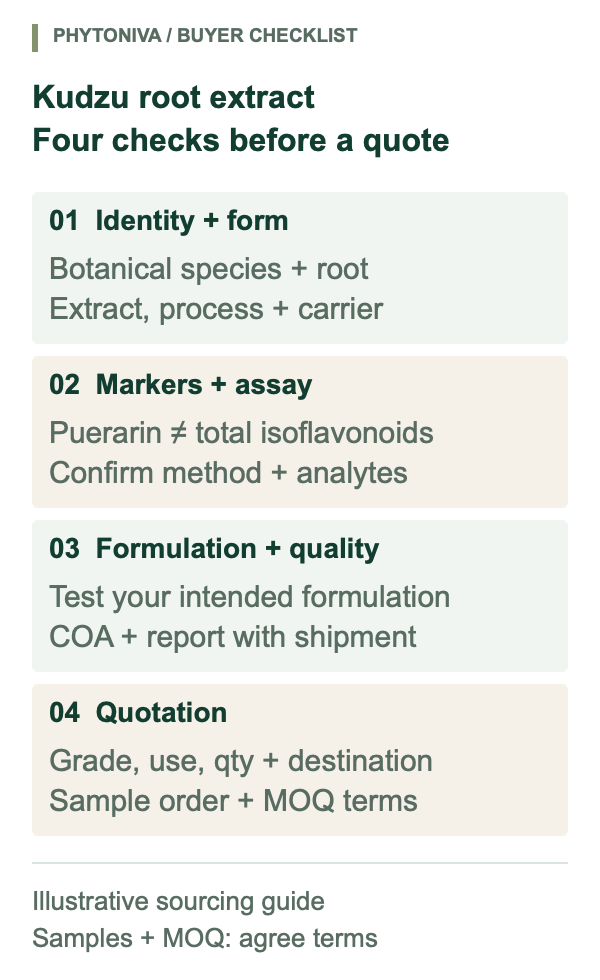
Kudzu root extract: four checks before a quote
Identity + form
Confirm the botanical species, root as the plant part and extract as the offered form. Define the extraction process and carrier; root powder, root extract and isolated puerarin are different purchasing specifications.
Markers + assay
Confirm puerarin and, if required, a defined total-isoflavonoid specification separately. These results are not interchangeable. Agree the analytes, assay method and reporting basis; a catalogue total-flavonoid label alone does not define a total-isoflavonoid assay.
Formulation + quality
Evaluate the proposed grade in your intended formulation, including taste, dispersibility and processing stability where relevant. Before ordering, agree sampling, test scope, methods and acceptance criteria. PHYTONIVA arranges independent third-party testing before procurement and dispatch; the manufacturer COA and agreed third-party report accompany the shipment.
Quotation
Send the specification, intended use, quantity, destination, required shipment documents and timing. Sample orders are welcome; MOQ, sample costs and packing are agreed for your requirements and supply conditions.
Frequently asked questions
Is 98% puerarin always preferable to a lower-content extract?
No. A concentrated marker preparation and a broader extract can have different compositions and formulation requirements. Choose against the intended ingredient profile and evidence, then compare assay results on the same basis.
Can root powder replace the extract in a formula?
Not by using the same weight automatically. Extraction, constituent concentration, carriers and physical behavior can differ. Recalculate and test the actual formula if you change the ingredient form.
Can I start with a sample or small order?
Yes, sample enquiries are welcome. Tell us the target specification and your evaluation needs; sample quantity, cost, packaging and subsequent MOQ are agreed against the proposed supply option.
Who supplies the quality documents?
The manufacturer provides its COA; PHYTONIVA coordinates sourcing and independent third-party testing. The manufacturer COA and agreed third-party report accompany the shipment. We do not currently provide presale COA samples or public COA downloads. A test report covers its stated sample and test scope; certification is checked separately for its holder, product and valid scope. See our quality coordination workflow.
Discuss your kudzu root extract project
Send the botanical identity, puerarin or other marker requirement, intended use, quantity, destination, document needs and target timing. We can help compare suitable products and supply options for your requirements.
Request a quotation · sales@phytoniva.com · WhatsApp +86 19991898850
Sourcing coordination and quality checks
PHYTONIVA manages trade, sourcing and supplier coordination, matching ingredients and supply options to your specification, application and destination. The manufacturing partner provides its COA and relevant quality documents. Before procurement and dispatch, we arrange independent third-party quality testing and obtain the report for the agreed testing scope.
Specifications, sampling, test scope, methods and acceptance criteria are agreed before ordering. The manufacturer COA and agreed third-party test report accompany the shipment. Certification is checked separately for the named holder, product and valid scope.
See our quality and documentation process