Menu
White Kidney Bean Extract: Benefits, Activity and Uses
White kidney bean extract is a seed-derived botanical ingredient studied for its interaction with starch digestion. Its best-known functional component is an alpha-amylase inhibitor: a protein that can reduce the activity of an enzyme used to break down starch. This makes the ingredient interesting for meal-related nutrition and weight-management product development.
The useful starting point is to understand the preparation, its measured inhibitory activity and the evidence behind the intended application. PHYTONIVA coordinates sourcing for small brands, distributors and development teams. Sample orders are welcome, with MOQ discussed according to specification, packaging and supply conditions.
Compare sourcing specificationsDiscuss a sample or bulk order
What is white kidney bean extract?
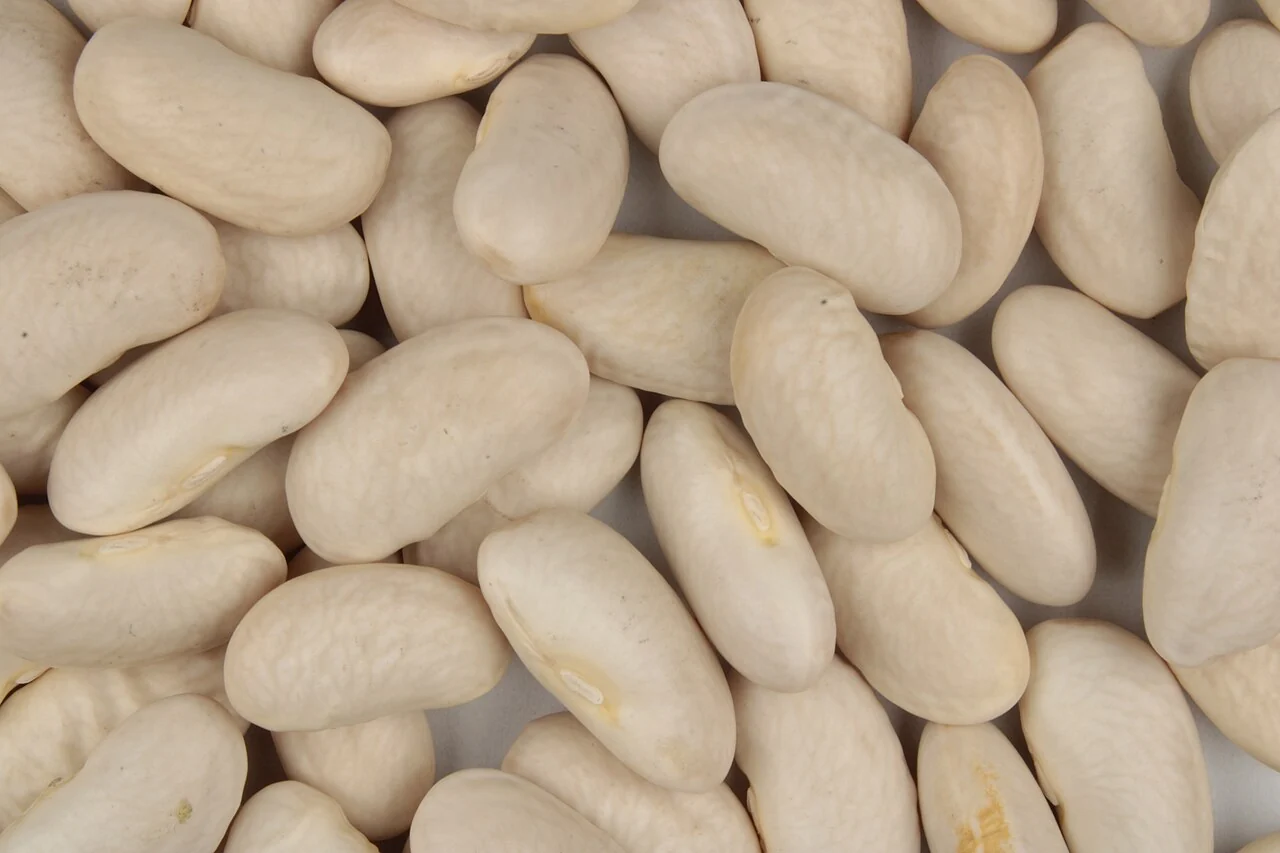
White kidney beans are varieties of the common bean, Phaseolus vulgaris. The ingredient discussed here comes from the seed, not the pod. Health Canada’s ingredient monograph identifies dried seed as the source for standardized aqueous extracts.
A processed extract is different from whole cooked beans or ordinary bean flour. Extraction, protein separation and subsequent processing influence which constituents remain and how the material performs. Confirm the botanical identity, seed starting material, process and any carrier in the proposed specification.
How does alpha-amylase inhibition work?
Alpha-amylase helps break starch into smaller carbohydrate fragments during digestion; other enzymes then complete the steps that make sugars available for absorption. A white-bean inhibitor can interfere with the alpha-amylase step. The mechanism therefore concerns starch digestion, rather than directly removing sugar already present in a food or blocking dietary fat.
An original biochemical study isolated a protein inhibitor from kidney beans and called it phaseolamin. Its activity depended on test conditions, including pH and temperature. For a finished product, the relevant question is how a defined preparation performs in the intended formula and meal context—not simply how many milligrams of “bean extract” it contains.
Phaseolin, phaseolamin and activity units
These similar-looking names need careful interpretation. Phaseolin is a major seed storage protein, described separately from lectins and other proteins in original bean-protein research. Phaseolamin was the name used for the purified alpha-amylase inhibitor in the biochemical study above. They should not be treated as interchangeable merely because their names resemble each other.
A named-compound percentage and an inhibitory-activity result also answer different questions. The former concerns how much of the specified material is measured; the latter describes performance in a defined assay. For an activity result, request the unit definition, enzyme and substrate used, pH, temperature, reaction time and reporting basis. Without a comparable method, a larger U/g number is not enough to establish a better ingredient.
White kidney bean benefits research: what people studies found
Meal response: a small white-bread experiment
A 2009 open-label crossover study tested a specific aqueous extract, Phase 2, in 13 healthy adults. With 3 g of the extract powder mixed into butter and served with white bread, the measured glycemic index was about 34% lower than with the control meal. Lower powder amounts and the capsule conditions did not produce statistically significant reductions.
This is a useful illustration of how amount and delivery format can matter. It was a small, unblinded, industry-supported study with unadjusted multiple comparisons. A lower test-meal GI does not establish diabetes treatment or the same effect from another extract, food or formulation.
Weight management: a specific extract with a reduced-calorie diet
A trial published in 2024 compared the same proprietary ingredient family with placebo in adults with overweight or moderate obesity. Ninety people received treatment, and 81 were included in the final valid-case analysis. All groups followed a diet designed to reduce estimated energy intake by about 20%.
After 12 weeks, mean weight loss was 4.48 kg in the 3 g/day group, 3.18 kg in the 2.1 g/day group and 0.54 kg with placebo. This gives a concrete research direction for weight-management development, under the study’s preparation and dietary conditions. The trial had industry funding and does not establish long-term maintenance or equivalent outcomes for the catalogue grades discussed below.
The NIH Office of Dietary Supplements also notes that clinical findings across white-bean trials have been inconsistent. Research doses and results help explain the evidence; they are not a dosing recommendation or a promise of weight loss for a finished product.
Turning the ingredient into a formulation brief
For a brand or distributor, the most useful sample work connects the ingredient’s function with the actual product format:
- Capsules and tablets: compare inhibitory activity, carrier content, flow, serving size and release characteristics. The white-bread study is a reminder that powder and capsule results cannot automatically be exchanged.
- Sachets and powder blends: evaluate mixing uniformity, taste, dispersibility and activity in the complete formula. Clearly distinguish a functional extract from ordinary bean flour.
- Heat-processed or liquid concepts: check whether activity survives the proposed temperature, pH and storage conditions. Specify finished-matrix testing rather than assuming the incoming ingredient result remains unchanged.
- Meal-related nutrition concepts: define the intended starch-containing meal, target users and supporting evidence. Alpha-amylase inhibition should not become a claim that all carbohydrate calories disappear.
Tell us the destination country and finished-product category. Ingredient suitability, labelling and permitted claims need review for that particular market and preparation.
Processing and safety are separate from potency
Raw or undercooked kidney beans can contain harmful levels of the lectin phytohaemagglutinin, or PHA. The FDA describes nausea, severe vomiting and diarrhoea from high exposure. Raw bean powder should not be treated as a ready-to-use substitute for an appropriately processed extract. For procurement, confirm the manufacturing controls and residual lectin or haemagglutinating-activity assessment as well as the desired alpha-amylase inhibition.
These are different quality questions. Health Canada’s monograph treats inhibitory potency and haemagglutinating activity separately; it advises against use during pregnancy and calls for professional advice during breastfeeding or with diabetes. The NIH fact sheet lists reported effects such as gas, soft stools, constipation and headache. Consider the actual preparation, target users and medicines when developing the product.
Comparing sourcing specifications and samples
The white kidney bean extract catalogue entry includes references expressed in two different ways:
- “Phaseolin 1% or 2%”: confirm what the supplier means by this label, the analytical target and the method. Do not silently reinterpret it as a guaranteed alpha-amylase inhibitor content.
- Alpha-amylase inhibitory activity of 20,000 U/g: confirm the definition and assay conditions behind that activity value, and its basis per gram of the offered material.
These references cannot be converted into one another or assumed to describe the same SKU. They are starting points for clarification, not a stock promise or proof of equivalence to a clinical-study ingredient. Agree the required activity, processing, carrier, safety checks and acceptance criteria before selecting the proposed grade.
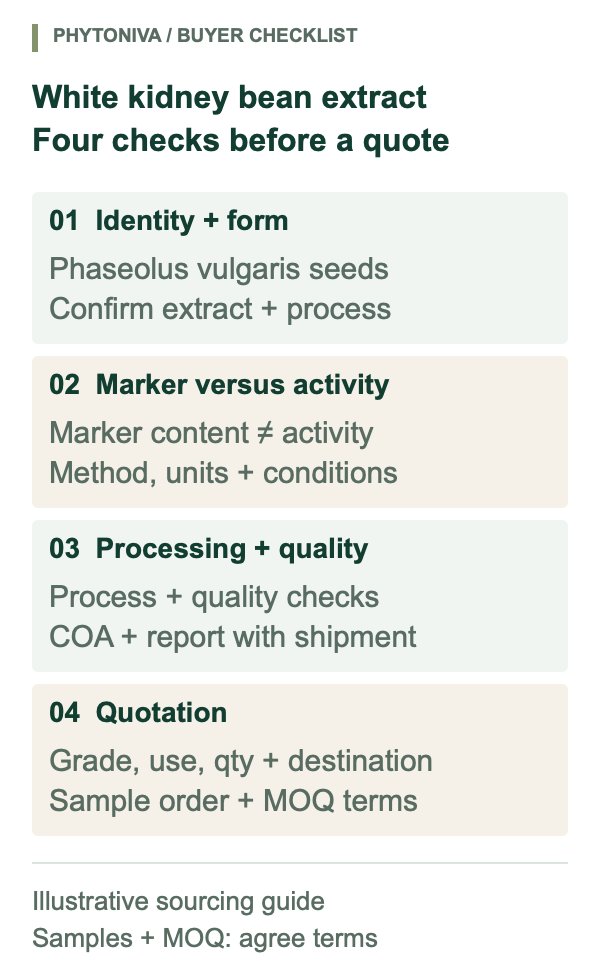
White kidney bean extract: four checks before a quote
Identity + form
Confirm Phaseolus vulgaris seeds and the offered form, such as extract or bean powder. Define the processing method, carrier and compatibility with your finished formulation.
Marker versus activity
Confirm the exact marker named in the specification. Catalogue references “Phaseolin” 1% or 2% and inhibitory activity 20000 U/g describe different measurements and cannot be converted into one another. Phaseolin and phaseolamin name different proteins; ask the supplier to identify what the catalogue marker measures. For an activity specification, agree the method, unit definition and test conditions.
Processing + quality
Assess activity after the proposed processing and in the finished formulation; agree residual lectin or haemagglutinating-activity controls and other quality checks separately. Before ordering, agree sampling, test scope, methods and acceptance criteria. PHYTONIVA arranges independent third-party testing before procurement and dispatch; the factory COA and agreed third-party test report accompany the shipment.
Quotation
Send the specification, intended use, quantity, destination, required shipment documents and timing. Sample orders are welcome; MOQ, sample costs and packing are agreed for your requirements and supply conditions.
Our quality and documentation process explains how testing and shipment documents are coordinated for the order.
White kidney bean extract FAQ
Is this ingredient intended to block every type of carbohydrate?
No. Its characteristic mechanism concerns an enzyme involved in starch breakdown. It should not be presented as cancelling sugar, fat or all the calories in a meal.
Can a percentage be converted directly into U/g?
No. A concentration and a functional activity measurement describe different properties. A meaningful comparison requires the exact marker, unit definition, method and reporting basis.
Can I evaluate a sample before a larger purchase?
Yes. Sample-order enquiries are welcome for formulation, functional testing and sensory evaluation. Share the intended tests and quantity; charges, freight, timing and subsequent MOQ are agreed for the proposed order.
Discuss your white kidney bean extract project
Send the required specification or activity, intended use, quantity, destination, shipment-document requirements and timing through our B2B enquiry form, email sales@phytoniva.com, or WhatsApp +86 19991898850. We can use that brief to compare appropriate products, manufacturers and supply arrangements.
Sourcing coordination and quality checks
PHYTONIVA manages trade, sourcing and supplier coordination, matching ingredients and supply options to your specification, application and destination. The manufacturing partner provides its COA and relevant quality documents. Before procurement and dispatch, we arrange independent third-party quality testing and obtain the report for the agreed testing scope.
Specifications, sampling, test scope, methods and acceptance criteria are agreed before ordering. The manufacturer COA and agreed third-party test report accompany the shipment. Certification is checked separately for the named holder, product and valid scope.
See our quality and documentation process